Iranian authorities tortured British couple in prison, source says
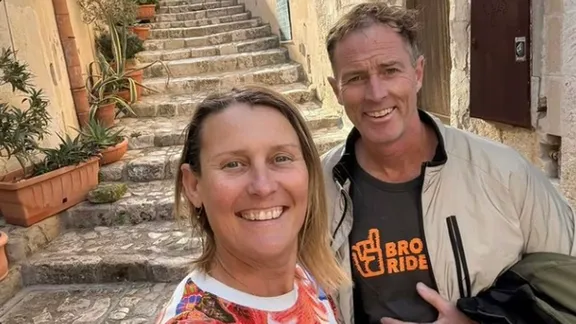
Craig and Lindsay Foreman
A British couple held in solitary confinement in Iran since January on espionage charges was beaten, deprived of sleep and threatened with execution, a source familiar with the matter told Iran International.
Lindsay and Craig Foreman were recently moved to the Gharchak Women’s Prison and the Greater Tehran Central Penitentiary, added the source familiar with the situation who spoke on condition of anonymity citing security concerns.
The couple had been held by Iran’s Ministry of Intelligence for the past seven months.
According to the source, the couple were subjected to torture including sleep depravation, beating and threats of execution by security agents seeking to extract confessions but have maintained their innocence.
The couple, both in their 50s, entered Iran from Armenia during a motorcycle world tour. After visiting Tabriz, Tehran and Isfahan, they planned to travel to Kerman.
On January 4, 2025, they were arrested on their way to city of Kerman and charged with spying. Britain has rejected the charges and demanded their release.
The UK foreign office said the couple was receiving consular assistance in response to a request for comment by Iran International.
“We are deeply concerned by reports that two British nationals have been charged with espionage in Iran. We continue to raise this case directly with the Iranian authorities," it said in a statement.
“We are providing them with consular assistance and remain in close contact with their family members.”
Iran has long detained and convicted foreign nationals in a bid for to gain financial or political concessions from foreign powers.
Tehran has consistently denied that the detentions are politically motivated.
Political prisoners at Iran's Ghezel Hesar prison have launched a hunger strike in response to a violent raid by guards and their transfer to solitary confinement, a source told Iran International on Wednesday.
On July 26, security forces raided Unit 4 of Ghezel Hesar prison in the town of Karaj, which houses political prisoners, to suppress detainees involved in a campaign against the death penalty.
Since the raid, families of about 20 prisoners have raised concerns about their whereabouts and filed petitions and requests for information.
A source familiar with the situation who declined to be named for security reasons told Iran International that the prisoners were beaten before being placed in solitary confinement. In protest, they launched a collective hunger strike.
The raid targeted approximately 25 prisoners who had participated in a campaign known as “No to Execution Tuesdays.”
The campaign began on January last year, when political prisoners in the women’s ward of Tehran’s Evin Prison started holding weekly hunger strikes every Tuesday to protest the rising number of executions.
Two men accused of belonging to the outlawed Mojahedin-e-Khalq (MEK) opposition group were executed on July 26.
The executions of Behrouz Ehsani-Eslamlou and Mehdi Hassani were carried out in Evin Prison, where they had been held since their arrest. Both were convicted in September 2024 by a Tehran revolutionary court on a range of national security charges.
Iran is one of the most aggressive state actors targeting individuals in the United Kingdom through transnational repression, according to a new parliamentary report.
The inquiry alleged Tehran’s intelligence services have orchestrated dozens of operations to surveil, intimidate, or physically harm UK-based dissidents, journalists, and other perceived critics.
Security agencies have investigated more than 20 credible threats to life linked to Iran since 2022.
“Iran represents one of the highest kidnap and assassination state threats to the UK, with the Homeland Security Group describing the threat of physical attack on individuals in the UK as the greatest level of threat we currently face from Iran,” according to the report released this week.
The tactics include assassination plots, stalking, digital hacking, threats to family members, online abuse, and coordinated smear campaigns.
One key target has been Iran International, a London-based Persian-language broadcaster.
British interior minister Yvette Cooper said in May that Iran posed an "unacceptable threat" to domestic security after authorities charged three Iranian nationals under a national security law following a major counter-terrorism investigation.
Three of the Iranian nationals were later charged with offences under the National Security Act, accused of acting on behalf of Iran’s intelligence service and carried out surveillance targeting Iran International journalists.
Broader strategy of coercion
The report warns of a broader strategy of coercion extending beyond direct threats. Iranian-linked cultural and religious centers in the UK are allegedly being used to gather intelligence on the Iranian diaspora and promote the interests of Tehran.
Kasra Aarabi, director of research on Iran's Islamic Revolutionary Guard Corps (IRGC) at US-based advocacy group United Against Nuclear Iran (UANI), points to what he calls a state-run infiltration network.
"Charities, mosques, academic institutions and cultural centers consistently carried out IRGC-linked activities on its premises,” including direct contact with some of “the most radical and extremist commanders of the IRGC.”
“The failure to address this issue is putting the UK’s national security and British lives at risk,” he told Iran International.
Journalists and women most targeted
Journalists covering Iran remain especially vulnerable, with Iran International and BBC Persian staff facing asset freezes, defamation campaigns, and threats to their families still living in Iran.
The Islamic Republic’s targeting of journalists reflects its fear of independent reporting, UK Director of Reporters Without Borders Fiona O’Brien told Iran International.
“If you're going to go to that length to try and shut something down, to try and silence people ... you must feel very threatened by that kind of information,” she said.
Female journalists reporting on protests and human rights violations have been targeted with gendered abuse, including threats of sexual violence.
The inquiry also highlights the regime’s evolving tactics, including AI-generated deepfake pornography, doctored images, and fabricated narratives used to discredit and silence.
"Impacts extend far beyond those directly targeted, creating a broader ‘chilling effect’ on entire communities and undermining fundamental rights such as freedom of expression, assembly, and association,” the committee said.
Intelligence resources stretched
The fear can be used as a method to overwhelm a country’s security apparatus.
Dr. Omid Shams, a UK-based human rights lawyer of Iranian origin, said the Islamic Republic has shifted from high-level, sophisticated operations to more chaotic, diffuse strategies that are harder for security agencies to detect.
Rather than relying solely on trained agents, Tehran increasingly uses local criminal gangs and petty criminals to carry out lower-level attacks.
“The goal,” Shams said, “is to stretch intelligence resources so thin that authorities are forced to either limit dissidents’ activities or negotiate indirectly with Iran to reduce pressure.”
UK policy still catching up
Despite the scope of the threat, the UK government has yet to formally define transnational repression in law or develop a strategy for addressing it, according to the committee, which urged the government to create a legal definition, train police, support victims, and systematically track these incidents.
Iran — alongside Russia — has been placed under the “enhanced tier” of the UK’s Foreign Influence Registration Scheme, requiring those acting on Tehran’s behalf to declare their activities. The report also calls for coordinated international pressure through the United Nations and INTERPOL.
A former interior ministry official who criticized Hamas leader Yahya Sinwar after the October 7 attacks on Israel has been sentenced to six months in prison by a Tehran court, online outlet Jahan News reported on Tuesday.
Abdolreza Davari, a former adviser to Iran's minister of interior and a former deputy chief of the government's official news agency, is known for his rightwing, provocative commentary on social media.
In September 2024, he questioned Sinwar's motives to mastermind October 7 in a post on X.
“Yahya Sinwar is fluent in Hebrew and served as the liaison between prisoners and Israeli authorities during his imprisonment in Israel," Davari wrote.
"Sinwar is the commander of Operation Al-Aqsa Flood, which he launched without informing or coordinating with Ismail Haniyeh and Hezbollah in Lebanon, and his costly actions raise a big question mark about him.”
He later deleted the post but other users joined the discussion and suggested the slain Hamas commander was an Israeli agent.
Davari was sentenced to six months in jail, a fine, confiscation of his smart phone and a ban on social media activity, Jahan News reported.
The case is currently under appeal, while Davari is also being prosecuted for other controversial remarks made against Fereydoun Abbasi, former head of the Atomic Energy Organization of Iran (AEOI), who was killed during an Israeli airstrike on June 13.
On June 14, Davari alleged Abbasi might have staged a terror attack on himself in 2009 to raise his profile and eventually become head of the AEOI.
Iran’s parliament has ordered the foreign ministry to build a comprehensive database of Iranians living overseas, a binding move seen as part of a broader state strategy to reengage with its global diaspora.
Lawmakers approved Article 5 of the “Support for Iranians Abroad” bill in a public session on Wednesday, mandating that the ministry gather data on expatriates and establish communication mechanisms within six months of the law taking effect.
The ministry must also report annually to the parliament’s National Security and Foreign Policy Committee on progress.
The legislation does not specify what categories of personal data will be collected, how it will be gathered, or whether the consent of individuals will be required.
The measure follows President Masoud Pezeshkian’s public call earlier this month for Iranians abroad to return “without fear,” urging the judiciary and intelligence agencies to coordinate efforts to ensure their safety.
“These individuals are also assets of this land,” Pezeshkian said during a July 26 meeting at the foreign ministry.
He emphasized the need to “create a framework” that encourages comfortable returns, echoing comments by Culture Minister Reza Salehi Amiri, who said the country was “rolling out the red carpet.”
Yet the renewed outreach has been met with skepticism. In recent years, several dual and foreign-based nationals have been detained upon arrival or departure from Iran, often without transparent legal proceedings.
Earlier this week, Siamak Namazi, a former Iranian-American prisoner who was held in Iran for eight years, criticized Pezeshkian’s call, accusing the Islamic Republic of continuing a “heinous diplomacy of hostage-taking.”
Among the most recent cases was Nasrin Roshan, a British-Iranian dual citizen detained in November 2023 at Tehran’s airport and held for 550 days before her release in May. Similarly, Iranian-American journalist Reza Valizadeh was arrested shortly after returning in early 2024 and later sentenced to 10 years in prison by a Revolutionary Court.
The broader legislation, initially passed in outline form last week with support from 209 lawmakers, proposes easing bureaucratic barriers, offering consular services, and revisiting policies on dual citizenship, investment, and education for Iranians abroad.
Still, some lawmakers voiced doubt about its potential impact.
“Until domestic issues such as administrative corruption, a weak banking system, and lack of meritocracy are resolved, this bill will not encourage Iranians to return,” said MP Ahmad Fatemi of Babol earlier this month.
A December 2024 nationwide survey on migration found that while 19% of 12,000 respondents were living abroad, only one in five expressed interest in returning. The same study revealed that just 16% of Iranians were not considering emigration.
Iran’s government withdrew a controversial internet bill amid mounting public pressure and accusations that it sought to criminalize dissent under the guise of combating false information.
“In line with national cohesion and on the president’s directive, the cabinet today approved the withdrawal of the digital content bill,” government spokeswoman Fatemeh Mohajerani announced on X on Wednesday.
The bill, titled “Combating the Dissemination of False Content in Cyberspace,” had sparked fierce backlash since it was submitted to parliament on July 20 by President Masoud Pezeshkian’s cabinet.
It proposed prison terms, bans, and fines for online users. Penalties would be harsher for repeat violations, fake accounts, or posts during “crisis or wartime”.
“This bill is not an obstacle to free speech,” Mohajerani said earlier this month. “Its aim is to address fake and harmful news that damages public trust.”
Critics warned that its vague terms—such as “distorted, misleading, and harmful to public perception"—opened the door for arbitrary prosecutions.
“The bill is not designed to fight lies, but rather to eliminate independent narratives,” journalist Alireza Rajaei wrote last week.
Legal scholar Kambiz Norouzi and Reform Front chair Azar Mansouri both urged Pezeshkian to honor his constitutional commitments to civil liberties.
The proposal came just days after a fragile ceasefire was brokered with Israel. During the 12-day war, widespread internet blackouts across Iran had been attributed to issues of national security.
Though Pezeshkian had campaigned on promises of dialogue and press freedom, reformist figures accused him of enabling the very crackdowns he vowed to resist.
In October, rights watchdog Freedom House ranked Iran as having the world’s third most repressive internet environment and lambasted the Islamic Republic for criminalizing online criticism to boost voter turnout and legitimize its presidential elections.