Iran demands US compensation for war damage before any talks
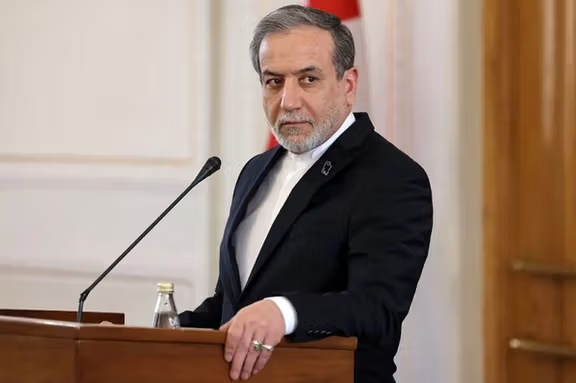
Iranian Foreign Minister Abbas Araghchi
Iran will not return to nuclear negotiations unless the United States agrees to provide compensation for damages sustained during last month’s war, Foreign Minister Abbas Araghchi told the Financial Times.
"They should explain why they attacked us in the middle of... negotiations, and they have to ensure that they are not going to repeat that," Araghchi said in an interview published on Thursday.
The official added that the US must take responsibility for striking Iran during ongoing diplomatic exchanges and that talks cannot resume without financial redress.
Iran confirms new enrichment plant near Isfahan was hit
A third enrichment facility near Isfahan was struck during last month’s conflict, Araghchi told FT, marking the first time Tehran has publicly acknowledged the site was targeted.
Araghchi said the plant had been prepared for activation in response to a formal censure by the International Atomic Energy Agency’s board of governors, which criticized Iran’s lack of cooperation.
“As far as I know, the preparations were made, but it was not active when it was attacked,” he said.
The site was hit as part of a broader US operation that, two days before a ceasefire, targeted Iran’s main enrichment centers at Fordow and Natanz and struck multiple facilities in Isfahan.
‘Road to negotiation is narrow’
Araghchi said he has been in contact with US envoy Steve Witkoff and that the two sides have exchanged messages before, during and after the war. He described the path to talks as narrow but not closed.
“I need to convince my hierarchy that if we go for negotiation, the other side is coming with real determination for a win-win deal,” he said. But he added that Tehran requires confidence-building measures before proceeding, including financial compensation and security assurances.
Araghchi repeated Iran’s rejection of US demands for “zero enrichment” and said Tehran would not abandon its rights under the Nuclear Non-Proliferation Treaty. He said Iran still retains the knowledge and technical capability to resume high-level enrichment if needed.
Talks with IAEA expected next month
Though Iran suspended cooperation with the International Atomic Energy Agency after the war, Araghchi said Tehran expects to hold technical talks with the agency in the coming weeks to discuss a “new modality of cooperation.” He said the talks would not involve inspections.
Western officials say Iran’s nuclear infrastructure was heavily damaged but not eliminated, and that a significant stockpile of highly enriched uranium may remain.
Warning to Europe over snapback
Araghchi also warned the UK, France and Germany that any move to trigger the UN snapback mechanism, which would restore sanctions lifted under the 2015 nuclear deal, would end Iran’s talks with them.
“If they do snapback, that means that this is the end of the road for them,” he said. “With the Europeans, there is no reason right now to negotiate because they cannot lift sanctions, they cannot do anything.”
The US said it remains open to direct talks with Iran but reaffirmed its maximum pressure strategy this week by announcing new sanctions on an Iranian oil shipping network.
Iran's Islamic Revolutionary Guards Corps (IRGC) on Wednesday issued a cryptic warning to Israel that the geography of Tehran's response to any future attack would shift and its arch-foe would face a punishing response.
"The geography of the response and the battlefield may change, and Iran's reactions will be more crushing than previously observed," state media outlet Mehr news cited the spokesman of the sprawling military organization as saying.
“If the Zionist regime launches a new attack on the powerful and resilient Iran, the initiative to end the conflict will be in our hands,’ Ali Mohammad Naeini said.
Israel's surprise 12-day military campaign against Iran last month killed hundreds of military personnel and civilians in air strikes and drone attacks. Missile salvos by Iran killed 28 Israeli civilians.
Iranian military leaders had made similar threats against Israel before the conflict, and official declarations of victory following the war have yet to substantively grapple with the lopsided toll and Tehran's intelligence lapses.
“We will not allow the sirens in the occupied territories to fall silent, and the enemy must not have the opportunity to leave its shelters,” Naeini said. “They will experience more fleeing and displacement than they did during the 12-day war.”
Iran's armed allies in the region have been degraded by nearly two years of Israeli attacks, but an Emirati news outlet reported on Wednesday that a top IRGC general traveled to Iraq to shore up support for Tehran-backed militias there.
Citing Iraqi political sources close to the Shi'ite-run political establishment, al-Ain al-Ekhbariya reported that the commander of the IRGC's elite Quds Force Esmail Qaani made an unannounced visit to Iran's neighbor.
The visit, the outlet said, involved meetings with senior Shi'ite political and militia leaders and aimed at shoring up unity and coordination as parliamentary elections loom.
Mysterious attacks hit Western-run oil facilities in Iraq's Kurdish region this month, in strikes blamed by local officials on Iran-backed militias. The sources cited by al-Ain al-Ekhbariya alleged Qaani described the events as not authorized by Tehran.
Following a US-brokered ceasefire on June 25, Israel and Iran have repeatedly exchanged threats.
Israel 'wiped off the face of the earth'
Iran’s interim chief of staff, Habibollah Sayyari, praised the Islamic Republic’s wartime performance on Wednesday, saying the conflict extended beyond just Israel.
“People must understand that we did not fight just one regime, we fought the world. That means we fought NATO, Europe and the United States. This is very important, yet we emerged from it with our heads held high,” Sayyari said.
Former IRGC chief Mohsen Rezaei added to the uptick of official military rhetoric on Wednesday, threatening to eradicate Israel.
“A day will come when great revenge and severe punishment will be carried out, and Israel will be wiped off the face of the earth forever,” Rezaei said on Wednesday.
The United States on Wednesday sanctioned an alleged global shipping and smuggling network controlled by the son of Ali Shamkhani, Iran's former national security chief and an adviser to supreme leader Ali Khamenei.
More than 50 individuals and entities were designated, and over 50 vessels identified, in what the US Treasury called its largest Iran-related action since 2018.
“The Shamkhani family’s shipping empire highlights how the Iranian regime elites leverage their positions to accrue massive wealth and fund the regime’s dangerous behavior,” Treasury Secretary Scott Bessent said in a statement.
According to the Treasury, Hossein Shamkhani—who uses false identities including “H,” “Hector,” and “Hugo Hayek,” the name on his Dominican passport—built the network by exploiting his father’s political reach.
US Treasury map alleging geographic scope of Shamkhani-linked shipping activities
“This network transports oil and petroleum products from Iran and Russia, as well as other cargo, to buyers around the world, generating tens of billions of dollars in profit,” the Treasury press release said.
'Targeting elite not people'
The agency added that the network’s containership fleet also carries cargo in and out of Iran, employing tactics similar to those used by sanctioned oil tankers—frequent changes in operators and management firms to obscure ties to the Shamkhani family and avoid blacklisting.
The sweeping sanctions freeze any US-based assets and prohibit Americans from doing business with the named entities.
US Treasury graphic alleging processes underlying Shamkhani-linked shipping activities
The Shamkhani family has also been accused of using its illicit wealth to obtain foreign passports and luxury properties abroad—privileges far removed from the daily struggles of ordinary Iranians.
“These sanctions target the regime’s elite inner circle,” Bessent said, “not the people of Iran.”
Ali Shamkhani, a former defense minister and former secretary of Iran’s Supreme National Security Council, was sanctioned by the US in 2020. Thursday’s action suggests Washington sees his family as central to Tehran’s efforts to evade international economic pressure.
Though enforcement depends on cooperation from third parties, the move signals Washington’s intent to escalate pressure on Iran’s ruling elite amid stalled nuclear diplomacy and deepening ties between Tehran and Moscow.
Iran is one of the most aggressive state actors targeting individuals in the United Kingdom through transnational repression, according to a new parliamentary report.
The inquiry alleged Tehran’s intelligence services have orchestrated dozens of operations to surveil, intimidate, or physically harm UK-based dissidents, journalists, and other perceived critics.
Security agencies have investigated more than 20 credible threats to life linked to Iran since 2022.
“Iran represents one of the highest kidnap and assassination state threats to the UK, with the Homeland Security Group describing the threat of physical attack on individuals in the UK as the greatest level of threat we currently face from Iran,” according to the report released this week.
The tactics include assassination plots, stalking, digital hacking, threats to family members, online abuse, and coordinated smear campaigns.
One key target has been Iran International, a London-based Persian-language broadcaster.
British interior minister Yvette Cooper said in May that Iran posed an "unacceptable threat" to domestic security after authorities charged three Iranian nationals under a national security law following a major counter-terrorism investigation.
Three of the Iranian nationals were later charged with offences under the National Security Act, accused of acting on behalf of Iran’s intelligence service and carried out surveillance targeting Iran International journalists.
Broader strategy of coercion
The report warns of a broader strategy of coercion extending beyond direct threats. Iranian-linked cultural and religious centers in the UK are allegedly being used to gather intelligence on the Iranian diaspora and promote the interests of Tehran.
Kasra Aarabi, director of research on Iran's Islamic Revolutionary Guard Corps (IRGC) at US-based advocacy group United Against Nuclear Iran (UANI), points to what he calls a state-run infiltration network.
"Charities, mosques, academic institutions and cultural centers consistently carried out IRGC-linked activities on its premises,” including direct contact with some of “the most radical and extremist commanders of the IRGC.”
“The failure to address this issue is putting the UK’s national security and British lives at risk,” he told Iran International.
Journalists and women most targeted
Journalists covering Iran remain especially vulnerable, with Iran International and BBC Persian staff facing asset freezes, defamation campaigns, and threats to their families still living in Iran.
The Islamic Republic’s targeting of journalists reflects its fear of independent reporting, UK Director of Reporters Without Borders Fiona O’Brien told Iran International.
“If you're going to go to that length to try and shut something down, to try and silence people ... you must feel very threatened by that kind of information,” she said.
Female journalists reporting on protests and human rights violations have been targeted with gendered abuse, including threats of sexual violence.
The inquiry also highlights the regime’s evolving tactics, including AI-generated deepfake pornography, doctored images, and fabricated narratives used to discredit and silence.
"Impacts extend far beyond those directly targeted, creating a broader ‘chilling effect’ on entire communities and undermining fundamental rights such as freedom of expression, assembly, and association,” the committee said.
Intelligence resources stretched
The fear can be used as a method to overwhelm a country’s security apparatus.
Dr. Omid Shams, a UK-based human rights lawyer of Iranian origin, said the Islamic Republic has shifted from high-level, sophisticated operations to more chaotic, diffuse strategies that are harder for security agencies to detect.
Rather than relying solely on trained agents, Tehran increasingly uses local criminal gangs and petty criminals to carry out lower-level attacks.
“The goal,” Shams said, “is to stretch intelligence resources so thin that authorities are forced to either limit dissidents’ activities or negotiate indirectly with Iran to reduce pressure.”
UK policy still catching up
Despite the scope of the threat, the UK government has yet to formally define transnational repression in law or develop a strategy for addressing it, according to the committee, which urged the government to create a legal definition, train police, support victims, and systematically track these incidents.
Iran — alongside Russia — has been placed under the “enhanced tier” of the UK’s Foreign Influence Registration Scheme, requiring those acting on Tehran’s behalf to declare their activities. The report also calls for coordinated international pressure through the United Nations and INTERPOL.
Russia said on Wednesday that attacks on Iran’s nuclear facilities must not become routine and warned of the catastrophic risks such strikes could pose.
Russian Foreign Ministry spokeswoman Maria Zakharova said that a pledge to avoid further strikes was a necessary condition for restarting cooperation between Iran and the International Atomic Energy Agency (IAEA), which has been limited in its access to Iranian sites.
Dialogue with China and Iran
Zakharova pointed to recent trilateral talks between Iran, Russia, and China as a sign that a nuclear agreement remains possible through diplomacy. She said ongoing dialogue could create space for progress, if conducted in good faith.
She referred to joint meetings in New York and Tehran where the three sides discussed ways to protect the 2015 nuclear deal and coordinate against efforts to revive UN sanctions. Russia said it supports a diplomatic framework that includes security assurances and avoids military pressure.
Beijing and Moscow have expressed support for Iran’s call for a new model of cooperation with the IAEA, after Iran’s parliament voted in late June to suspend collaboration with the agency following a ceasefire with Israel and demanded security guarantees before restoring access.
Pressure builds over snapback threat
The statements come as Iran, China and Russia have held joint meetings in New York and Tehran to coordinate their stance on the risk of snapback UN sanctions, penalties lifted under the 2015 nuclear deal that could return if no new agreement is reached.
Iranian officials have warned they may leave the Nuclear Non-Proliferation Treaty (NPT) if European powers, France, Germany and the UK, trigger the mechanism, which they have threatened to do by the end of August.
Bread prices have surged nationwide in Iran, with Tehran registering hikes of up to 50 percent, state media reported Wednesday, as inflation continues to squeeze household budgets and frustrate bakers.
In the capital, the price of Barbari—a widely consumed semi-flat bread—rose 31 percent to 46,000 rials (about $0.05), while the popular flat bread Taftoon jumped 52 percent to 20,000 rials ($0.02), and Lavash climbed 39 percent to 15,500 rials ($0.017).
Sangak, another staple, was set at 76,000 rials ($0.085), with a 20,000 rial ($0.022) surcharge for sesame toppings.
A Barbari bakery in Iran
“The price of Barbari should have increased by at least 52 percent,” said Amir Karamlou, spokesman for Tehran’s traditional bakers’ union, adding that the current hike in the capital falls short of what was approved for other provincial capitals.
Reports from IRGC-linked Fars News highlighted a growing gap between official rates and prices charged by bakeries, which, while struggling to make ends meet, are keeping prices higher than those stipulated by the government.
The hike follows protests in recent months by bakers over cuts to subsidized flour. Some told Iran International they had already been forced to sell Sangak at 100,000 to 200,000 rials ($0.11- $0.22), citing flour shortages and black-market pricing.
Meanwhile, some provinces have yet to formally implement the government's increases, Mehr News reported, citing disputes over pricing authority and scope.
A Taftoon Bakery in Iran
However, with the minimum monthly wage now worth just $120, well below the estimated $400 needed for basic living, the pressure on consumers continues to mount.
At least one third of the country now lives below the poverty line as the country's floundering economy continues to make life in the country ever more difficult.
Iran’s year-on-year inflation rate rose to 41.2% in July, marking the highest level in two years, according to the country’s Statistical Center. The 41.2% figure means households paid over 40% more for the same basket of goods and services compared to July last year.
The figure reflects an increase from 39.4% in June and comes amid a broader surge in prices for essential goods and food items.
The latest consumer price index report, released this week, showed that annual, monthly, and point-to-point inflation all climbed in the fourth month of the Iranian calendar year,which ended on July 22.