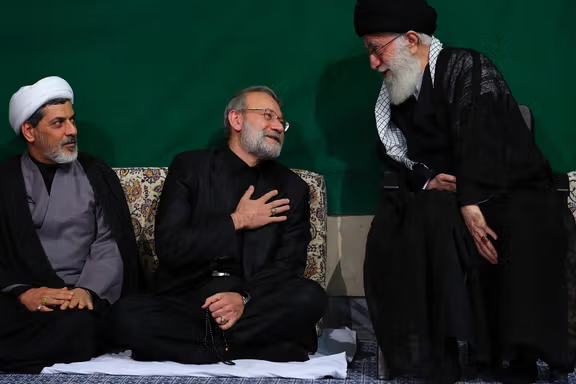
Larijani set for top security role as Iran revives wartime Defense Council
Iran will reorganize its Supreme National Security Council under a conservative stalwart, state media reported on Friday, as Tehran grapples with fallout from a June war with Israel.
"With structural reforms in the Supreme National Security Council finalized, informed sources report the establishment of a new body called the 'Defense Council' — a strategic council tasked with overseeing national defense policies, whose structure is expected to be finalized soon," the Revolutionary Guard-affiliated Fars News reported on Friday.
Ali Larijani, a top advisor to Supreme Leader Ali Khamenei, is likely to be appointed as the new secretary of the Supreme National Security Council in the coming days, the report said.
Larijani would replace Ali Akbar Ahmadian who is expected to "take charge of several special and strategic national dossiers," the report said, calling them "high-level, forward-driving and strategic missions that require overarching coordination and management."
The Defense Council is considered part of the new governance framework in the defense and security sphere, Fars News said without providing further details.
The move elevates a stalwart conservative and personal confidant of Supreme Leader Ali Khamenei, in what may signal a redoubled conservative stance as Iran’s security and diplomatic challenges mount.
Ali Akbar Velayati, another senior adviser to Iran’s Supreme Leader, earlier suggested Iran may reconsider its restrictive social policies in the aftermath of the war with Israel in a remark seen by Tehran media as a rare official acknowledgement of public discontent.
“Maintaining national cohesion, as emphasized by the Supreme Leader, can include changing certain social approaches of the establishment and prioritizing public satisfaction in a way that is tangible for the people,” former foreign minister Velayati posted on X on July 21.
Two days later, prominent imprisoned political activist and ex-official Mostafa Tajzadeh issued a statement demanding Khamenei admit profound failures following a war with Israel and usher in fundamental change or else quit.
The leader of Iran's Green Movement Mir-Hossein Mousavi who has been under house arrest since 2011 has also called for a referendum on a constitutional assembly, arguing that the current political system ruling Iran does not represent all Iranian people.
“The bitter situation the country has faced is the result of a series of major mistakes,” Mousavi said in a statement published on July 11.
Allegations of a “shadow government” meddling in Iran’s foreign policy have reignited concerns about the country’s diplomatic direction, just as high-stakes nuclear talks with the West hang in the balance.
The term—now increasingly invoked in political discourse—refers to an unofficial power network believed to influence key decisions behind the scenes, beyond the authority of the Foreign Ministry.
In an unsigned commentary on Tuesday, the conservative Jomhouri Eslami newspaper accused the ministry of failing to assert control over foreign policy, blaming Tehran’s limited success on interference from shadow actors.
“Those whose heavy shadow over the 2015 nuclear deal and many negotiations caused irreparable damage continue to dictate terms in foreign policy, especially in the realm of negotiations,” it wrote.
The piece warned that such interference, “under the very sensitive current circumstances, is more dangerous than deadly poison.”
Jalili in the Crosshairs
Although no names were mentioned, Iranian media widely interpreted the remarks as targeting ultra-hardliner Saeed Jalili and his circle of allies in the Paydari Party.
Jalili, who lost the 2024 presidential election to Masoud Pezeshkian, previously served as Iran’s chief nuclear negotiator during the years leading up to 2010, when multiple rounds of UN sanctions were imposed on Tehran.
He remains a trusted figure for Supreme Leader Ali Khamenei, serving as his representative to the Supreme National Security Council and sitting on both the Strategic Council on Foreign Relations and the Expediency Discernment Council.
Saeed Jalili speaking to media
A day after the Jomhouri Eslami piece, the IRGC-affiliated Javan newspaper hit back.
“If this alleged shadow government truly exists, why doesn’t Jomhouri Eslami reveal its leaders and operators?” it asked. “And if the claim is entirely false, why doesn’t the public prosecutor step in? Is the reputation of the Islamic Republic to be handed out freely to whoever wishes to exploit it?”
Moderates are calling for serious diplomacy and a renewed effort to reach agreements with the US and Europe. Hardliners, meanwhile, accuse them of appeasement and advocate for a more confrontational approach.
With the return of UN sanctions looming under the nuclear deal’s snapback provision, Tehran has warned European governments it may pull out of the Non-Proliferation Treaty in retaliation—threatening a complete breakdown in diplomatic engagement.
Tehran is once again urging Iranians abroad to return as part of its patriotic messaging after the war with Israel, but many remain deeply skeptical, citing years of repression, arrests and broken promises.
Last week, President Masoud Pezeshkian said Iranians living in other countries should be able to return without fear.
His culture minister, Reza Salehi Amiri, then appeared on state TV to hammer the message home: “This land belongs to you, and we are rolling out the red carpet."
Yet skepticism runs deep.
Returnees—especially dual nationals—have often been detained, interrogated, or sentenced on vague charges such as propaganda against the system or acting against national security.
‘Almost none stayed long’
“From (President Mohammad) Khatami in the late 1990s to Pezeshkian now, everyone has tried to woo expat professionals and people with financial resources to invest back in Iran,” Kamran, a 56-year-old who runs a family business in Tehran’s Grand Bazaar, told Iran International.
“I know a few who came back over the years, but almost none stayed long enough to invest.”
Kamran’s children live in Canada. He says he prefers they not return, even for short visits.
“They participated in every protest rally in Canada in recent years and have posted anti-government content online,” he explains. “That can get them into serious trouble. I won’t let them take any risks.”
Mitra, a housewife in Tehran, says her relatives avoid returning for the same reason.
“They meet their parents in countries like Turkey once or twice a year. It’s hard for their elderly parents, but they feel it’s better to be safe than sorry.”
New bill, old problems
There are an estimated 4 to 5 million Iranians living abroad—from Turkey and the United Arab Emirates to Australia, North America and nearly every country in Western Europe. Collectively, their wealth is believed to exceed one trillion dollars.
To tap into that potential, parliament is reviewing a bill titled Support for Iranians Abroad, proposing easier travel, expanded consular services, looser dual citizenship restrictions, and new academic and investment incentives.
“I don’t know what the government is thinking, asking diaspora Iranians to come back and invest. They must be fools to do so when neither their lives nor their money is safe,” said Mehdi, a 45-year-old artist in Tehran.
Other critics say the real obstacles are structural: deep corruption, cronyism and the dominance of security institutions over the economy.
“Diaspora Iranians don’t just listen to officials’ words—they watch their actions,” wrote former telecom minister Mohammad-Javad Azari-Jahromi on X. “Concrete reform of policies and procedures matters more than slogans.”
Social media activist Arash Ghaffari mocked the initiative given the country's ongoing water and electricity outages.
“The honorable President has invited Iranians abroad to return to their beloved homeland, overflowing with water and electricity in the summer, an abundance of gas in the winter, a land of stable prices, an economic paradise!” he posted on X.
A reformist call for renewed talks with the United States as a way out of Iran’s post-war troubles has laid bare deep divisions within the Islamic Republic, with hardliners accusing the letter’s authors of treason and appeasement.
In their public letter to President Masoud Pezeshkian, published July 28 in multiple outlets, the Reform Front warned that the ceasefire with Israel is fragile and a return of UN sanctions is imminent, urging a fundamental rethink of foreign policy.
“A comprehensive development strategy instead of a strategy of survival and confrontation requires negotiations with the United States and European governments to resolve mutual issues, lift sanctions, and obtain necessary security guarantees,” the letter read.
It warned that unless such a path is taken, Iran faces either a renewed war that would devastate the country’s vital infrastructure, or a prolonged state of neither war nor peace, marked by total isolation that would erode the Iran's capacity to function.
“Minor and piecemeal reforms will not solve the country’s problems,” the authors said. “Today, the nation needs bold and difficult choices.”
Mounting hardship, muted leadership
The call comes amid growing economic hardship, with chronic water and electricity outages fueling public anger and hampering an already strained economy.
The Reform Front accused Pezeshkian of failing to stand up to hardliner overreach, including the recent act of parliament requiring the administration to suspend cooperation with the International Atomic Energy Agency (IAEA).
“The president has remained silent in the face of a war-mongering foreign policy and the state broadcaster’s continuous attacks against his own government,” they wrote.
Hardline backlash was swift and scathing.
‘Discredited losers’
Javan, affiliated with the Revolutionary Guards, called the letter an echo of demands by the Islamic Republic’s opposition. Conservative commentator and former Javan chief Abdollah Ganji rejected the moderates’ advice as “a call for surrender” in daily Hamshahri.
But the harshest attack—as usual—came from Kayhan, whose editor-in-chief is appointed by Supreme Leader Ali Khamenei.
“What’s striking is that they don’t dare say … what exactly should be done now for these discredited political losers to consider it a ‘revision of policies’ or a ‘correct decision,’” read a Monday editorial.
“Should we hand over our defensive deterrent? Completely shut down the nuclear program? Release the arrested spies and traitors so they can commit more acts of treason?"
"If the CIA and Mossad had commissioned people to translate their unmet demands into Persian, would it have looked any different from this letter?” the editorial asked.
Iran's intelligence ministry issued a lengthy statement asserting alleged successes amid a punishing 12-day war with Israel last month which it said scotched elaborate regime change plans by an array of foreign and domestic enemies.
The ministry said it had thwarted assassinations plots against 35 officials, conducted raids and made arrests targeting the Baha'i religious minority, evangelical Christians, foreign-baed dissidents, Sunni Muslim jihadists, separatists, monarchists and media organizations acting in league with Israel.
Hundreds of military personnel, nuclear scientists and civilians were killed in Israel's surprise campaign last month including top commanders, in major intelligence lapses the statement appeared aimed at addressing.
"What happened during the 12-day imposed was a war plan with planning and full-scale utilization of combined military, security, intelligence, cognitive warfare, disruptive actions, assassination, sabotage, destabilization and incitement of internal unrest," the statement issued on Monday said.
The multifarious plots, it added, were "aiming for the delusion of subjugating and forcing Iran to surrender and overthrowing the sacred Islamic Republic,” it added.
Israel was able to launch deadly attack drones at senior military Islamic Revolutionary Guards Corps (IRGC) leaders from inside the country, killing the armed forces chief of staff, IRGC leader and the elite unit's commanders of aerospace and military operations.
An Iranian analyst alleged in a newspaper interview last week that Israel caused over 100 Iranian missile launchers to explode upon activation during the war last month and that it had hacked the country’s entire air defense system.
The daughter of a top Iranian military commander assassinated by Israel last month said her father was chased down and killed by Israeli agents in a hot pursuit in Tehran and not an airstrike as originally reported.
Not offering explanations for any lapses, the ministry said it "detected and neutralized" Israeli plots to assassinate 23 senior civilian and military officials during the conflict and 13 similar attempts in the months leading up to it.
'Thugs, rebels'
The ministry alleged that it had carried out successful intelligence operations inside Israel, saying its activities were ongoing.
"Numerous and varied offensive and intelligence measures (aggressive espionage) were carried out in various cities of the occupied territories against the interests of the Zionist regime and the criminal gang that rules it."
Israeli authorities say they have uncovered more than 25 cases of Iranian recruitment over the past year, with more than 35 people indicted on serious security charges.
"One of the approaches implemented was to recruit intelligence and operational agents from the regime’s innermost military and security layers," the ministry added. "The larger and more sensitive part of the missions is still ongoing."
The ministry said it had faced down threats from street thugs to the NATO alliance.
"The enemy sought to activate criminals, diverse terrorists in various guises, deploy awaiting spies, conduct assassinations and sabotage, and to mobilize mercenaries, monarchist remnants, thugs, rebel groups, and dormant hypocrite cells to inflame tensions, provoke dissatisfaction and professional protests, and turn conditions into uncontrolled street riots and chaos”, the statement said.
"We faced not only the petty Zionist regime but also the Western intelligence-security NATO,” it added.
A June 23 Israeli air attack on Evin Prison - known for housing dissidents and foreign detainees - was aimed at catalyzing a nationwide revolt, the ministry alleged. Iranian authorities said 80 people were killed in the attack and Amnesty International called for it to be investigated as a war crime.
“We detected and fully neutralized a Mossad-directed monarchist plot to launch and dispatch armed operational teams from across the country to Tehran on June 22 for terrorist actions the next day (during the Evin prison bombing) targeting nearby military and law enforcement centers," the ministry said.
“This monarchist-Zionist scenario was thwarted by identifying involved agents, striking enemy operational teams, and arresting 122 mercenaries across 23 provinces before any terrorist action in Tehran."
Iran’s state broadcaster (IRIB) is facing backlash after refusing to air an interview with Foreign Minister Abbas Araghchi that included politically sensitive disclosures about the 12-day war with Israel.
The hour-long interview, part of the “Story of the War” documentary series produced by the Islamic Propaganda Organization, was scheduled to air on Saturday. But to the public's surprise, it was rejected by the state broadcaster IRIB without explanation.
Instead, the segment was uploaded on Sunday to the organization’s YouTube channel, ON TV. Clips quickly spread across social media.
On X, Araghchi’s media adviser, Mehran Ranjbaran, confirmed IRIB had blocked the broadcast, validating widespread suspicions online.
What did Araghchi say about the war?
Araghchi made several notable disclosures—some politically sensitive. Perhaps most strikingly, he admitted to direct and ongoing contact with US negotiator Steve Witkoff throughout the conflict via messaging apps.
“I posted the tweet announcing the end of the war after coordinating with higher authorities. The system had already decided in advance that if the other side stopped the attacks, without any preconditions, we would stop as well,” he said.
In Iranian political jargon, the system (nezam) usually refers to the Supreme Leader Ali Khamenei.
He added that when confusion arose over ceasefire terms, “Right then and there, I messaged Witkoff and told him that Israel was making excuses and accusing Iran of violations—which hadn’t happened—and that if they took any action, we would respond immediately and more forcefully than before.”
Araghchi claimed that the US President Donald Trump then ordered Israeli pilots to stand down—proof, he said, that Israel had been acting in coordination with the US all along.
Khamenei has on several occasions confirmed that the foreign ministry only carries out the decision made by the Supreme National Security Council (SNSC). The council’s decisions can only be implemented after his endorsement. Araghchi's remarks, therefore, highlighted his responsibility for all decisions taken related to the war.
The retaliation debate
Araghchi also pushed back against hardliners’ claims that President Masoud Pezeshkian had opposed retaliatory action for the killing of Hamas leader Ismail Haniyeh in Tehran last year.
According to him, Iran’s Armed Forces Chief of Staff Mohammad Bagheri, who was killed in the war, firmly dismissed such allegations.
Bagheri, according to Araghchi, said he was responsible for defending the country and would carry out his duty the moment he was sure he could protect the country from the consequences of retaliation. “He said he hadn’t even asked the President yet,” he added.
Many believe the official who criticized Pezeshkian was IRIB’s head Peyman Jebelli who is sometimes invited to the SNSC’s sessions.
Araghchi’s disclosures have triggered strong responses from journalists, analysts, and online users. Many condemned IRIB’s refusal to broadcast the interview.
“Either Araghchi is not the foreign minister of the Islamic Republic of Iran, or the national broadcaster is not truly national. Logically, it can't be anything other than one of these two,” political analyst Erfan Pazhuhandeh wrote on X.
IT expert Mohammad Keshvari similarly criticized the IRIB in a post on X. “The untold stories of the war—told by the Foreign Minister—something any sensible TV network would jump at the chance to broadcast, ended up being aired by the online platform ON. These same people will then complain that they can't compete with online platforms.”
“It’s understandable why the national broadcaster didn’t air the interview—because it brings everything that they have said against the diplomatic apparatus into question,” journalist Ehsan Taghadosi remarked on X.
IRIB and the ultra-hardliners
IRIB is led by figures close to Iran’s ultra-hardline Paydari Party and former nuclear negotiator Saeed Jalili. The latter’s brother, Vahid Jalili, serves as the organization’s deputy head in cultural affairs.
Vahid Jalili,an official member of the Paydari Party, has considerable influence over IRIB’s editorial direction and programming decisions.
Under Jebelli and Vahid Jalili’s leadership, IRIB has become a mouthpiece for Paydari-aligned narratives, often downplaying diplomacy in favor of confrontation with the West and Israel.