Iran's security chief says Israel was ‘helpless’ under missile barrage
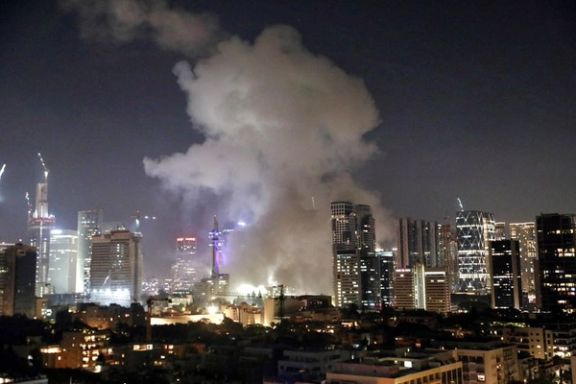
Smoke billows following missile attack from Iran on Israel, at Tel Aviv, Israel, June 13.
Israel was left “desperate” under Iranian missile fire during the 12-day conflict earlier this summer, Tehran’s security chief Ali Larijani said in a state television interview after returning from visits to Iraq and Lebanon.
The program—titled Tehran–Tel Aviv—marked Larijani’s reemergence as Supreme Leader Ali Khamenei’s representative to the Supreme National Security Council (SNSC).
“The enemy thought they had the most defensive capability, but Iran’s rain of missiles completely left them helpless,” he said.
Larijani quoted “a regional official” as saying that Israel's prime minister Benjamin Netanyahu had told him Iran was “finished” a day into the war, but by the fourth or fifth day admitted Israel had “big problems.”
Still, Larijani cautioned against triumphalism.
“We must not become arrogant, because the enemy studies these things and finds new methods. We are doing the same and must not act with only one military method.”
Yet military leaders on both sides have continued the war of words, with Israel’s army chief vowing readiness for further strikes and Iran’s General Staff warning of “a far stronger response” to any future attacks by Israel or the United States.
'Infiltration is serious'
Larijani also said the June clash was distinct because of Washington’s direct involvement. “It was face to face,” he told the broadcaster.
“The Americans, who always hid behind regional issues, came onto the scene themselves. Their defense secretary explicitly ordered the bombings.”
The broadcast sought to cement his role as both strategist and spokesman for Iran’s postwar stance—portraying the conflict as proof of Iran’s reach and resilience while acknowledging deep vulnerabilities.
“The strategy and manner of Iran’s military moves against Israel were an achievement. Of course we had weaknesses too,” Larijani said.
“The issue of the enemy’s infiltration inside Iran is serious. We had weaknesses that are painful.”
Israel’s economy shrank 3.5 percent in the second quarter of the year as the 12-day war with Iran disrupted businesses and investment, the country’s Central Bureau of Statistics said on Sunday.
From April to June, Israel’s business sector contracted 6.2%. Private consumption dropped 4.1%, public spending fell 1%, and investment in fixed assets plunged 12.3%, signaling weakening confidence.
Exports of goods and services, excluding startups and diamonds, declined 3.5%, while imports, excluding defense purchases, rose 3.1%.
The downturn followed the June conflict with Iran, which began after Israel attacked military and nuclear sites on June 13.
Iran responded with missile strikes that forced many Israelis into shelters.
The United States joined on June 22 with airstrikes on Iran’s nuclear facilities at Fordow, Natanz, and Isfahan. A US-brokered ceasefire took effect on June 24, ending the 12-day war.
Bank of Israel Governor Amir Yaron told Bloomberg in late June that the fighting was likely to cost nearly $6 billion or 1% of GDP.
Analyst Andreas Krieg told TRT World that overall losses could reach between $11.5 billion and $17.8 billion, around 2% to 3% of Israel’s economy.
Costly for Tehran
The conflict also took a heavy toll on Iran’s economy.
Krieg estimated Iran’s direct and indirect losses at $24 billion to $35 billion, equal to 6% to 9% of its $380 billion GDP.
The conflict also dealt a heavy blow to Iran’s trade: non-oil exports in June totaled $3.4 billion, according to Iranian customs statistics—a 34% drop from a year earlier.
Iran’s digital economy was also hit.
The communications minister reported a 30% contraction and losses of 150 trillion rials (about $170 million) in one month, attributing the damage to widespread internet restrictions imposed during the fighting.
Records compiled by Iran International show that since the ceasefire with Israel in late June, at least 50 explosions and fires have struck 19 provinces, raising questions over their cause.
Since June 24, officials and state media in Iran have repeatedly described the incidents as ordinary accidents, often blaming gas leaks, electrical faults or waste fires.
While pledging that investigations would reveal the causes, they have consistently denied any link to Israel.
The blasts came in the middle of summer, a season when gas use is at its lowest. Some fires broke out near military facilities.
The sudden death of Ali Taeb — a former representative of Supreme Leader Ali Khamenei at the Sarallah Headquarters, a key Revolutionary Guard security command — deepened doubts.
Of the sites affected, about 30 percent were commercial, 24 percent residential, 16 percent industrial, 14 percent military, 10 percent public facilities, and 6 percent of unknown use.
The peak came on July 14 with four incidents. Tehran province had the most overall with 15, followed by Hormozgan with five, Khorasan Razavi with four, East Azarbaijan and Alborz with three each, five provinces with two, and nine provinces with at least one.
Explosions and fires from June 24 to June 30
The first case after the ceasefire was on June 24, when a residential unit in Kermanshah’s Karnachi district exploded. Officials blamed a gas leak.
On June 25, another residential unit in Tehran’s Jannatabad district was destroyed, also officially described as a gas explosion in an unfinished building.
The same day, another explosion occurred on Hedayat Boulevard in Mashhad, likewise blamed on gas. That evening in Dezful, residents reported powerful blasts. Military officials said they were caused by the destruction of old munitions.
On June 26, flames poured from a unit in the Aseman Tower in Tehran’s Farmanieh district. Given the recent targeting of military and security officials during the 12-day war, doubts grew. No clear cause was ever announced.
The same day, an explosion and fire were reported at Tabriz refinery, northwest of Iran. In an unusual move, the IRGC’s Ashura unit issued a statement blaming a nitrogen tank replacement.
In Urmia, another explosion was reported near the airport and again it was attributed to the disposal of munitions.
Around the same time, residents in Tehran’s northeast, near Shahrak-e Mahallati, and in Hamedan, reported powerful blasts. Both were officially described as air defense tests.
On July 4, a huge fire engulfed the Noor shopping center in Qeshm Island, destroying at least 200 stores. Its scale required 130 firefighters from several towns.
On July 5, an explosion was reported near the Istak factory in Sanandaj, attributed to a battery warehouse.
On July 7, repeated blasts were heard in western Tehran, with no official explanation. On July 9, a fire struck workshops in Khalazir, west of Tehran.
That night, Bandar Abbas’s main bazaar, the Hormozgan Mega Mall, burned.
On July 10, an explosion destroyed a unit in Pamchal-9 Tower in western Tehran. Witnesses reported seeing a projectile, and security forces quickly sealed the site.
Officials called it a gas blast, but the tower had no gas piping.
On July 15, a fire broke out at Mashhad’s Qaem shopping center, which officials linked to the building’s age, while Tabriz’s Zomorrod Tower also caught fire with no cause given.
In Tehran’s Esfahanak district, a five-story apartment block with 60 units burned, blamed on a car fire in the garage.
On July 16, a blaze hit Baghlarbaghi park in Tabriz, said to be caused by an amusement ride engine.
On July 17, smoke rose near Barekat Hospital in Tehran’s Chitgar area, blamed on a garbage depot fire.
On July 19, an explosion at Abadan refinery was blamed on a pump leak. That night, a 30-story residential tower in Tehran’s Kharrazi district caught fire, blamed on a faulty air conditioner.
The same day, smoke was seen on Neauphle-le-Château Street in Tehran, near the Italian Embassy, which officials said was caused by burning waste.
On July 20, Yazd’s Mehriz industrial park was engulfed by flames, while a residential-commercial building in Rasht burned, leaving 18 injured.
Explosions and fires from July 21 to July 26
On July 21, a major fire struck Kharazmi industrial park in Alborz province. The same day, a petrochemical plant near Ziar in Isfahan exploded, burning 1,500 square meters.
On July 22, Anzali Free Zone’s Venus shopping mall caught fire, injuring 16. The same day, Qeshm’s Dolphin Mall also burned. In Qom’s Fatemieh district, an explosion destroyed a home, which officials said was caused by a water heater.
On July 23, fire swept through workshops at Isfahan’s science park.
On July 25, Bandar Abbas’s old bazaar burned.
On July 26, a large fire hit Mahdis Hypermarket in Mazandaran’s Qaemshahr.
Explosions and fires from July 28 to August 11
On July 28, another blaze swept Qeshm’s Persian Gulf-2 mall.
On July 31, a fire broke out at a furniture workshop in Nasirabad industrial park near Robat Karim, which officials attributed to an electrical fault. The same day, flames were reported in Kermanshah, officially blamed on a water company depot, while in Mashhad a fire near Qaem hospital was said to have been caused by burning trees.
On August 4, a dormitory on Tehran’s Enghelab Street caught fire, which officials attributed to a neighboring carpentry shop. The same day, flames spread across Shiraz’s Derak mountains, blamed on careless hikers.
On August 6, a blaze swept through the Aliabad industrial zone in Tehran. Two days later, on August 8, an explosion struck a scrapyard in Gachsaran.
On August 9, a fire broke out at Anzali’s Caspian shopping mall and at warehouses in Saveh’s industrial zone, destroying motorcycles and storage for paper and wood. In Mehran, near Iran’s western border with Iraq, an explosion destroyed a tent for Arbaeen pilgrims, which officials blamed on a gas cylinder.
On August 11, residents of Savojbolagh district in Alborz province reported blasts and a fire in the Hiv mountains, which officials blamed on careless hikers.
Although officials have attributed the incidents to causes such as gas leaks and accidents, their number, timing after the 12-day war, and proximity to sensitive sites have prompted continued public questioning.
Iran’s missiles are capable of striking into the heart of Europe and could eventually target US cities from the sea, an Iranian lawmaker said on Sunday.
“Perhaps our next missile will hit Washington directly. We can target America from the sea. The Aerospace Force of the IRGC has been working for 20 years on making it possible to strike America from Iranian ships. Even if we have not yet reached this technology, it remains within our grasp,” Amir Hayat-Moqaddam, a member of parliament’s National Security and Foreign Policy Committee, told Didban Iran.
While the United States is 10,000 kilometers away, Iranian ships could approach within 2,000 kilometers and launch missiles at Washington, New York and other cities, he added.
In early 2023, two Iranian naval vessels, the IRIS Makran and the IRIS Dena, were reported to be heading toward the Panama Canal after crossing the Atlantic, but they ultimately did not transit the waterway. In 2021, Iranian naval vessels Makran and Sahand completed a mission to the Atlantic Ocean, reaching Venezuela.
“Even now, all European countries are in our range. With our existing missiles we can strike France, Germany, the UK, and all of Western and Eastern Europe.”
However, Hayat-Moqaddam downplayed the impact, saying that Iran has already endured seven years of sanctions since US President Donald Trump withdrew from the JCPOA nuclear deal in 2018.
“All possible sanctions have already been imposed on our country. The unilateral and multilateral sanctions by the US and Europe are already at their peak. So activating the snapback mechanism will bring no new negative consequences for Iran’s economy and is merely a political move,” he said.
European officials have warned Tehran that unless it fully cooperates with the International Atomic Energy Agency (IAEA), the mechanism could be activated, restoring UN sanctions this fall.
Negotiations under the Trump administration began with a 60-day ultimatum to Iran. On the 61st day, June 13, Israel launched a surprise military campaign against Iran, striking key nuclear and military sites and personnel, including Iran's chief of staff and senior nuclear scientists.
The Israeli strikes began on the eve of the sixth round of negotiations with the United States.
A Hezbollah member sentenced to death in absentia for the 2022 killing of Irish UN peacekeeper Private Seán Rooney in Lebanon is believed to be hiding in Iran, Ireland’s Sunday World newspaper reported, citing diplomatic sources.
Mohammad Ayyad was convicted by a Lebanese military tribunal latein July for his role in the fatal attack on a UN convoy near the village of Al-Aqbiya, south of Beirut. He was not present at the trial, and Lebanese authorities have not disclosed his whereabouts.
“We suspect he is in Iran and it is unlikely anyone will hand him over to face a death penalty,” one diplomatic source told the newspaper. “It is not a satisfactory situation but all we can do is keep the pressure on and see if we can get justice for Seán and his family.”
Rooney, 23, from Dundalk, was killed on December 14, 2022, when a group of armed men opened fire on the peacekeepers’ vehicle as they travelled towards Beirut airport. Three other Irish soldiers were injured in the attack.
According to Sunday World, several other Lebanese men received lighter sentences over the shooting, including short jail terms, fines, or acquittals. The Beirut government has appealed the verdicts following pressure from Ireland and Rooney’s family, the paper said.
Irish Defense Minister Simon Harris said last week that Dublin continues to press for accountability. “The Government has repeatedly stressed the need for justice to be served in this case. We have raised the issue with the UN and the Lebanese authorities,” he said after meeting Rooney’s mother, Natasha.
Lebanon has not carried out an execution in more than 20 years, and Irish officials have indicated they would prefer Ayyad serve a life sentence rather than face capital punishment.
An Irish coroner’s inquest into Rooney’s death has been postponed, while an independent review of the circumstances surrounding the attack, led by barrister Michael Delaney, is underway and expected to conclude in the autumn.
Iran’s Revolutionary Guards said on Sunday their forces had killed six militants and dismantled two hideouts in the southeastern province of Sistan-Baluchestan, seizing explosives and weapons in a series of operations against armed groups.
The public relations office of the Quds Base of the Guards’ ground forces said in a statement carried by Tasnim news agency that “two terrorist teams were destroyed in coordinated operations in the north and south of the province.”
The IRGC’s Quds Base in southeast Iran — one of its 10 regional commands — oversees forces in Sistan-Baluchestan and Kerman provinces, and is separate from the Quds Force, the Guards’ overseas unit.
The statement said that “six trained terrorists who intended to carry out sabotage and terrorist operations were killed and others detained.”
The Guards said they found “25 kilograms of explosives, ready-to-detonate bombs, detonators, remotes, blasting cord, radios and other equipment” in a raid on a safe house in Chabahar, in the province’s southeast.
The statement added that another militant hideout in the north of the province was also struck.
The Guards praised local residents for their cooperation and urged them to report suspicious activities via designated hotlines.
The operations come amid a surge of violence in the province, where the Sunni militant group Jaish al-Adl has carried out a series of deadly attacks in recent weeks.
On Friday, a police officer was killed and another wounded in the city of Iranshahr after gunmen opened fire on a military vehicle, according to police. Jaish al-Adl claimed responsibility.
Sistan-Baluchestan, which borders Pakistan and Afghanistan, has long been the scene of unrest involving Sunni militants, drug traffickers, and security forces.
Jaish al-Adl, designated a terrorist organization by both Iran and the United States, says it is fighting for the rights of Iran’s Baluch minority but Tehran accuses it of links to cross-border militant networks.