Iran says sanctions move by Europe would halt UN nuclear inspector access
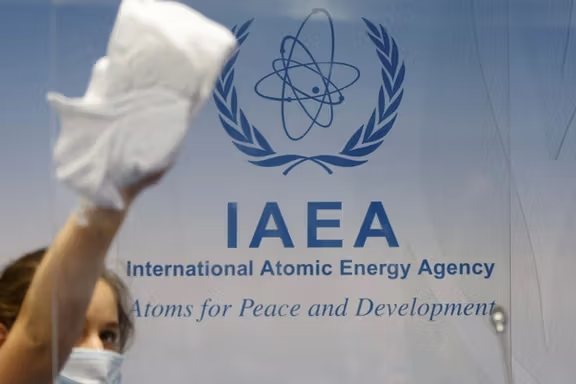
Cleaning staff works before a news conference attended by IAEA Director General Rafael Grossi during an IAEA Board of Governors meeting in Vienna, Austria, September 13, 2021.
Iran’s deputy foreign minister warned on Wednesday that if three European countries move to trigger international sanctions at the United Nations, progress toward resuming the work of nuclear inspectors would be thwarted.
Kazem Gharibabadi added that France, Germany and the United Kingdom are not authorized to invoke provisions of the Joint Comprehensive Plan of Action (JCPOA), a 2015 nuclear deal, since they are no longer active participants in the agreement.
“"If the snapback mechanism is activated, the current path with the IAEA will be affected and halted,” Gharibabadi told official Iranian media on Wednesday.
Iran said this week that inspectors from the International Atomic Energy Agency had re-entered the country after being barred amid a 12-day war with Israel in June. No agreement has yet been reached on the resumption of their work, however.
The European troika dubbed the E3 are likely to begin a process to trigger the so-called snapback of international sanctions on Iran over its nuclear program after talks on Tuesday with Tehran yielded little progress, Reuters reported citing sources.
The move could come as early as Thursday, four diplomats cited by Reuters said, but the countries hope Iran will make diplomatic concessions within the next 30 days.
“We told them, if you’re truly implementing the JCPOA, provide a report showing how. The indicators and information we have contradict their claim," Gharibabadi added. "Not only has Europe failed to implement the JCPOA, but new sanctions have been imposed over the years, the latest being only a few months ago against Iran’s shipping and aviation industries.”
The snapback mechanism, part of United Nations Security Council Resolution 2231 which endorsed the deal, allows any party to the accord to file a complaint accusing Iran of non-compliance.
If no resolution is reached within 30 days, all previous UN sanctions would automatically be reimposed, including arms embargoes, cargo inspections and missile restrictions.
The three European countries have warned Iran they will restore UN measures unless talks resume and produce results by the end of August.
Agency inspectors at Bushehr
Gharibabadi also responded to domestic criticism over the presence of International Atomic Energy Agency (IAEA) inspectors in Iran, saying their access was necessary in the case of a nuclear power plant.
“Without IAEA inspectors in Iran, the Bushehr power plant’s operations would be disrupted. Do some really want our Bushehr plant shut down? The return of IAEA inspectors to facilities is a specific case, conducted with necessary coordination and approvals,” Gharibabadi said.
The Bushehr facility, which uses nuclear fuel supplied by Russia’s Rosatom, requires IAEA monitoring for re-fueling with low-enriched uranium.
“In about a month, it’s time to replace the fuel at the Bushehr power plant, and this must be done in the presence of Agency inspectors,” Araghchi said last week.
Since then, Iran and the three European countries have held two rounds of negotiations, one in Istanbul in July and another in Geneva on August 26, but no concrete progress was announced.
An investigative report by the Sydney Morning Herald citing court documents reveals that gangsters allegedly hired by Iran to carry out anti-Semitic attacks badly bungled their mission, hitting incorrect targets and fleeing when spotted by bystanders.
Australia expelled Iran’s ambassador to the country after it accused Tehran of backing attacks on Jewish targets in the country, including arson on a synagogue, in a separate case involving other suspects..
Australia said Iran guided arson attacks on the Adass Israel Synagogue in Melbourne December 2024 and Lewis’ Continental Kitchen in Sydney last year.
The Australian Security Intelligence Organisation (ASIO) said it had traced funding to Iran’s Islamic Revolutionary Guard Corps (IRGC). Iran has denied the allegations.
Detailed communications among the alleged perpetrators show the ringleader of the attack on the restaurant was a man named Sayed Moosawi, according to the documents cited by the newspaper.
Moosawi, it added, recruited another individual, Wayne Ogden, to plan an attack on the Curly Lewis Brewery — a site with no apparent connection to the Jewish community or faith.
Ogden, together with another suspect Joun Amoui, drove to the brewery wearing masks and rubber gloves one of them armed with a sledgehammer. However, Signal messages indicate that Amoui panicked and fled the scene when spotted by a member of the public.
Moosawi, who referred to himself as “James Bond” in the messages, reacted furiously, cursing at the two and berating them for their ineptitude.
The pair later regrouped with two new accomplices, Guy Finnegan and Craig Banfoft, in a renewed attempt to torch the brewery. That arson attempt failed as well, with sprinklers extinguishing the fire and limiting damage.
In subsequent messages, one of the accomplices even joked that the group might be targeting the wrong site. Eventually, in October 2024, the team succeeded in setting fire to the Curly Lewis Brewery’s kitchen, causing extensive damage.
According to court evidence, Moosawi allegedly paid $12,000 in total and offered $4,000 to the two accomplices to complete the attack. He has a prior criminal record and arrived in Australia in 2005 with his family on refugee status.
The prime minister said the government’s actions sent a clear message that foreign-directed aggression on Australian soil would not be tolerated.
Britain, France and Germany are likely to begin a process to trigger the so-called snapback of international sanctions on Iran over its nuclear program after talks with Tehran yielded little progress, Reuters reported citing sources.
The trio dubbed the E3 is due to initiate the sanctions as early as Thursday, four diplomats cited by Reuters said, but hopes Iran will make diplomatic concessions within the next 30 days.
The snapback mechanism, part of UN Security Council Resolution 2231 — which endorsed the 2015 nuclear deal called the Joint Comprehensive Plan of Action (JCPOA) — allows any party to the accord to file a complaint accusing Iran of non-compliance.
If no resolution is reached within 30 days, all previous UN sanctions would automatically resume and would include arms embargoes, cargo inspections and missile restrictions.
A round of nuclear talks involving Iran and France, Germany and the United Kingdom concluded in Geneva on Tuesday, with tangible progress announced.
Deputy foreign ministers from the four countries took part in the meetings which followed a previous round held in Istanbul in July.
The European powers have pressed Iran to resume talks with the United States and cooperation with International Atomic Energy Agency inspectors.
Both were put on hold amid a 12-day war launched by Israel on Iran which was capped off with US strikes on three key Iranian nuclear sites.
Iran denies seeking nuclear weapons but Israel and Western powers doubt its intentions.
Triggering the UN sanctions is likely to lead to complex, fast-paced diplomacy.
“There will be intense negotiation, diplomats say, over the form of that resolution. Among the questions are: will 2231 be extended and for how long, and will snapback clearly be allowed at a later date,” Wall Street Journal reporter Laurence Norman said on X Wednesday.
“The fundamental point is if there’s snapback tomorrow (Thursday), it’s not the end of diplomacy. It’s just going to proceed for a short period under new rules of the game,” he added.
Tehran on Wednesday warned of unspecified consequences if the countries triggered the sanctions mechanism and asserted they had no right to do so.
"In Geneva, we explained to the Europeans that, for legal reasons, they have no right to use the snapback mechanism, and that if such a thing happens, it will have consequences for them," Iran's foreign ministry spokesman Esmail Baghaei said.
"It was agreed that contacts between Iran and the European side would continue in the coming days," he added.
One member of Iran’s Revolutionary Guards (IRGC) was killed and another wounded during armed clashes in Sistan-Baluchestan province on Wednesday, the IRGC’s Quds base said in a statement.
According to the statement, 13 militants were killed and others arrested in three separate operations across the cities of Iranshahr, Khash, and Saravan — areas that have seen a surge in violence in recent weeks.
According to the rights group Haalvsh, the Iranshahr operation began around 5 a.m. in the Chah-Jamal area and continued for several hours, with residents reporting the sound of sustained gunfire and visible plumes of smoke. Images sent to Haalvsh showed two destroyed vehicles being towed away by a crane.
In Saravan, local sources reported that IRGC forces surrounded a house in the village of Houshak and struck it with heavy weapons and drones, resulting in a large explosion and fire.
The Sunni militant group Jaish al-Adl, designated a terrorist organization by both Iran and the United States, issued a statement acknowledging it had suffered casualties in the confrontations but said details were still being verified.
The operations come less than a week after gunmen killed five Iranian police officers in an ambush near Iranshahr, which authorities blamed on militant groups. Jaish al-Adl previously claimed responsibility for that attack, as well as earlier assaults in Saravan and Zahedan.
In response to that violence, the IRGC said it had destroyed two militant cells in the province, seizing explosives and communications equipment. The Guards said the militants were planning sabotage and bombings with the help of safe houses identified by local informants.
Sistan-Baluchestan, which borders Pakistan and Afghanistan, has long been a center of insurgency by Sunni militant groups and is considered one of Iran’s most restive regions.
Australia’s intelligence agency says it traced money behind last year’s arson attack on a Melbourne synagogue to Iran’s Revolutionary Guards, though the young men accused of carrying it out may not have known who was directing them.
"They're just using cut-outs, including people who are criminals and members of organized crime gangs to do their bidding or direct their bidding," Australian Security Intelligence Organization (ASIO) Mike Burgess told reporters on Tuesday.
Younes Ali Younes, 20, appeared in Melbourne’s Magistrates Court on Wednesday charged with stealing a car and setting fire to the Adass Israel synagogue on December 6.
He did not seek bail or enter a plea. Another man, Giovanni Laulu, 21, was charged last month on the same counts.
Prime Minister Anthony Albanese said on Tuesday that investigators uncovered a “supply chain” of payments leading from local criminals to Tehran.
“Security forces have done extraordinary work to trace the source of the funding of these criminal elements who’ve been used as tools of the Iranian regime,” he told the Australian Broadcasting Corporation.
A tip-off from Israeli intelligence assisted ASIO during the inquiry, Sky News reported on Wednesday, with confidential sources confirming Israel provided a lead in relation to one of the firebombings.
Most of the work, however — including mapping networks of suspects and breaking through encrypted messaging — was conducted by ASIO investigators.
The attack was captured on CCTV showing three hooded figures unloading jerry cans of fuel from a stolen car before igniting the synagogue’s entrance and fleeing. Police said lives were endangered as people were inside at the time, though no injuries occurred.
Albanese on Tuesday expelled Iran’s ambassador after receiving a briefing from the Australian Security Intelligence Organization, joining other Western governments accusing Tehran of covert operations abroad.
Security agencies in Britain and Sweden have previously warned of Iran’s use of criminal proxies, while London has reported foiling 20 Iran-linked plots since 2022.
Victoria state’s Joint Counter Terrorism Team described the arson as politically motivated and involving offshore direction, while Home Affairs Minister Tony Burke said local perpetrators likely had no knowledge of who ultimately ordered the attack.
The return of IAEA inspectors was approved by Iran’s Supreme National Security Council and was for supervising a fuel swap at the Bushehr nuclear plant, Foreign Minister Abbas Araghchi said on Wednesday.
Araghchi stressed that no agreement had yet been finalized with the UN nuclear watchdog regarding a broader framework for cooperation.
He also said the law passed by parliament after the June Israeli and US strikes — requiring all IAEA inspections to be approved by the Supreme National Security Council — had been observed. “All IAEA requests go to the Supreme National Security Council, which makes decisions in accordance with the law,” he said.
Parliament Speaker Mohammad Bagher Ghalibaf also defended the move, saying on Wednesday that the inspectors’ return was lawful and complied with the terms of the new legislation. “The law passed by parliament in this regard has been observed,” he said.
Hardline lawmakers push back
Despite these assurances, several lawmakers sharply criticized the decision. MP Amirhossein Sabeti said a document claiming to outline the terms of a new deal between Iran and the IAEA had reached parliament and called it “a disaster.”
“If it’s false, deny it — we’ll be glad,” he said. “But if it’s true, this agreement guarantees the next war,” warning that the document required Iran to hand over pre- and post-attack data that could guide future Israeli strikes.
Kamran Ghazanfari also objected, saying the return of inspectors violated the parliament’s legislation. “This is a clear breach of the law,” he said, warning that legal action could be taken against the head of the SNSC if cooperation continued without meeting parliamentary conditions.
No finalized text with IAEA, Araghchi says
Addressing these concerns, Araghchi emphasized that no finalized agreement—referred to by some as a new “modality” framework—had been reached with the IAEA. “Some texts have been exchanged and positions presented, but no draft has been finalized,” he told Khaneye Mellat, parliament’s official outlet.
“I don’t know where the text referenced by the lawmaker came from, but it is not a negotiated or agreed document,” Araghchi added.
IAEA inspections resume amid international pressure
IAEA Director General Rafael Grossi confirmed on Tuesday that the agency’s inspectors had returned to Iran for the first time since their expulsion during the June conflict. “Now the first team of IAEA inspectors is back in Iran, and we are about to restart,” he said.
France, Germany, and the UK are tying Iran’s cooperation with the IAEA to their decision on whether to trigger the UN snapback sanctions mechanism by the end of August. Tehran has rejected the legality of such a move.