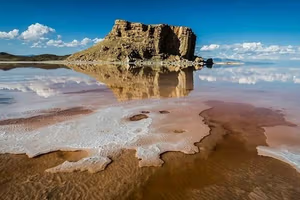
Iran’s AnzaliLagoon, a wetland on the Caspian coast, is facing “serious challenges and human-inflicted wounds” and could disappear without urgent action, provincial governor Hadi Haghshenas said, according to state media.
Haghshenas said restoring the wetland requires $300 million and called for measures to stop industrial, agricultural and household wastewater from flowing into it.
He warned that decades of untreated sewage, sediment and pollution, compounded by falling Caspian water levels, have left the wetland on the brink of ecological collapse.
A
The wetland, registered under the international Ramsar Convention in 1975, is a critical habitat for fish, birds and local livelihoods.
Environmental officials said invasive plants, shrinking water flow and mismanagement have deepened the crisis, but stressed that “Anzali is not dead and can recover” if pollution is curbed and water retained.
In August, a senior Iranian environment official warned that Lake Urmia in northwestern Iran, once the Middle East’s largest, will completely dry up by the end of summer if current conditions persist.
“The lake's water level on August 1, 2025, was 1,269.74 meters, its area had shrunk to 581 square kilometers, and its volume was down to about half a billion cubic meters,” said Ahmadreza Lahijanzadeh, deputy for marine and wetland affairs at Iran’s Department of Environment.
Tehran will not return to the negotiating table under the same conditions that existed before the June war with Israel, Iran’s foreign minister said Saturday, days after Europe triggered the snapback leaving Iran to engage with the US or face UN sanctions.
“We were serious about the negotiations on sanctions relief. We had five rounds of negotiations and had fixed a date for the sixth round, but two days before that Israel launched a military attack and the US joined it,” Abbas Araghchi said.
“After this unjust war, naturally the negotiations will have a different shape compared to before the war. It is not the case that after the war, we would just return to the negotiating table and as you call it 'business as usual'."
"This is certainly not possible as the circumstances have changed. It is not possible to enter negotiations as before the war," he said in an address to a business and investment conference.
The June conflict began with a surprise Israeli strike on Iranian military and nuclear sites on June 13. Tehran said 1,062 people were killed, including 786 military personnel and 276 civilians.
Israel said it killed more than 30 senior Iranian security officials and 11 nuclear scientists. Iran retaliated with missile strikes that killed 31 civilians and one off-duty Israeli soldier.
In his Saturday remarks, Araghchi stressed that while talks have not been taken off the agenda, they will enter a new phase.
“We are not saying negotiations are off the table, but they definitely have a new format and dimensions, and new concerns and factors have entered them that we must understand and design for."
Talks with US and Europeans
Araghchi said Iran is exchanging messages with Americans through intermediaries.
"The day the Americans reach a point where they are ready for dialogue based on mutual interests and mutual respect, we will resume negotiations," he said.
The foreign minister said Tehran's talks with the Europeans are continuing and that he hopes the two sides would reach a mutual understanding.
“I think a better understanding of the situation is emerging," he said, referring to his meeting with EU Foreign Policy Chief Kaja Kallas in Doha and his phone calls with E3 foreign ministers.
Iran 'very close' to deal with IAEA
Araghchi said Iranian diplomats in Vienna continued their negotiations with the UN nuclear watchdog on Saturday to reach a new framework for cooperation.
"As far as I have been informed, they had very good talks," Iran's foreign minister said. "We are very close to reaching an agreement on a new framework of cooperation with the Agency in line with the parliament’s law."
His remarks come as Iran has three weeks to reengage in negotiations with the United States and the UN nuclear watchdog or face the reimposition of UN sanctions, after the Europeans triggered the so-called "snapback" mechanism.
On August 28, Britain, France and Germany triggered the mechanism, demanding that Tehran return to talks, grant IAEA inspectors wider access and account for its uranium stockpile.
Under Resolution 2231, sanctions will automatically return after 30 days unless the Security Council votes otherwise.
At least five people have died in recent months in incidents linked to electricity outages across Iran, the reformist daily Etemad reported on Saturday.
Two children were killed on August 5 in a village in northern Golestan province when a gas leak ignited as power was restored, the paper said.
Ten days later, two youths aged 16 and 18 in Fars suffocated after sheltering from the heat in a running car inside a garage; and a Tabriz resident died in an elevator-related accident as power disruptions multiplied,” according to Etemad.
“I wish we had never had electricity. It took the lives of my two children. They had just begun to live, had just stepped into society full of hopes and dreams. Suddenly, when the power came back, my house exploded. I came and saw the wall had collapsed on my daughter. Blood was coming from everywhere,” the bereaved mother said in a video shared after the Golestan blast.
Fatal incidents and urban hazards
Fire officials in Isfahan reported a 284% jump in elevator entrapments over a one-month period tied to outages. In the southwestern city of Yasuj, up to 20 people were trapped at once during blackouts, while reports from Khorramabad in west put such incidents at three to four times last year’s level, Etemad wrote.
Families sit in a dark hospital corridor during a blackout in Iran
A young woman in Shiraz said a routine 10-minute eye procedure stretched to over an hour because a surgical microscope repeatedly failed.
“Power fluctuations burned the microscope lamp in the middle of my eye surgery,” she said, adding that repeated replacements failed until the device was swapped out, leaving lasting damage to her right eye.
Patients with chronic conditions described blackouts as dangerous and costly. Frequent cuts forced daily dressing changes and purchases of pricier creams, A butterfly disease patient in Yazd said.
A man with a spinal injury in rural Urmia feared his anti-bedsore mattress would fail in surges: without it, he said, pressure ulcers were likely. Others said that when electricity goes, well pumps stop and mobile networks and home internet also drop, compounding risks for those needing help.
Surgeons continue an operation during a blackout in Iran, relying on flashlights for light.
Strain on daily life and business
Shopkeepers and small businesses reported spoiled food and lost inventory; one confectioner filmed trays of discarded cakes, blaming a single outage for rent, labor and waste. Poultry farmers in Dezful, Khuzestan province, cited higher mortality and reduced chick placement amid daily cuts.
Etemad’s reporting underscores how prolonged outages—often four to five hours a day—are cascading through homes, clinics and city infrastructure. The accounts point to a growing public safety challenge where routine power cuts are now measured not just in inconvenience, but in injuries and deaths.
Dozens of Iranians seeking German visas have staged weekly protests outside Berlin’s consulate in Tehran, Shargh reported on Saturday, saying their applications have been frozen since June’s 12-day war with Israel.
The paper said the gatherings take place every Thursday, with around 100 people holding placards demanding clarity on their cases. Many applicants told Shargh they have been left in “suspension,” with neither approvals nor rejections issued.
Some of the protesters are family members applying for reunification visas. “I have been separated from my wife and children for more than three years. I completed my interview in May but since then there has been no answer,” one applicant, Masoud, was quoted as saying.
Students and jobseekers at risk
Others said they risk losing jobs or university placements. Bita, who has an offer to study for a master’s degree in Germany, said her semester begins in October but no interview date has been set. “The risk of missing my term is real, and then I may have to start the whole process again,” she said.
Shargh estimated more than 6,000 people face delays, including some 4,000 in family reunification cases. Applicants accused Germany of discriminatory treatment, pointing to faster processing in neighboring countries.
Reduced embassy services
The protests follow Germany’s announcement last month that its Tehran embassy would operate at reduced capacity after Ambassador Markus Potzel ended his mission, citing “personal reasons.” Berlin said staff cuts would mean stricter visa issuance.
Impact of the June war
Several embassies scaled back or suspended consular services in Iran during and after the June conflict with Israel, leaving thousands of passports stuck in foreign missions. While some countries have since resumed normal operations, Germany has continued to restrict services.
Billions of dollars belonging to South Africa’s MTN Group, the founding investor of Irancell, Iran’s second-largest mobile operator, remain blocked in Iran under US sanctions, the company confirmed in a recent financial update.
MTN now faces a “liquidity dead-end” in Iran after years of trying to withdraw funds, the investment analysis website GuruFocus reported on Friday.
“Our minority stake in Irancell is effectively a frozen asset,” chief executive Ralph Mupita said, citing sanctions that prevent any movement of capital.
MTN has been seeking to exit Iran since 2016, when it announced plans to pull back from the Middle East. While it once repatriated about $430 million in loan repayments and accumulated dividends between 2011 and 2016, its later attempts have failed.
The company’s difficulties deepened with US President Donald Trump’s renewed sanctions against the Islamic Republic during his second term. MTN disclosed in 2021 that it still held $204 million in Iran, largely linked to loan repayments and dividends, but no transfer has been reported since.
Mupita stressed the lack of operational influence. MTN has “zero operational control” over Irancell, GuruFocus cited him as saying, writing that sanctions have left the group powerless to access cash flow from its Iranian venture.
Partnerships under scrutiny
Irancell is majority owned by Gostaresh Electronic Sina, a subsidiary of the Mostazafan Foundation.
The foundation was established in early 1980 following the Islamic Revolution. It succeeded the Pahlavi Foundation and inherited extensive assets confiscated from the Pahlavi era.
Legally, the foundation is neither public nor private—it is a nonprofit entity that answers only to Iran’s Supreme Leader.
It is the second-largest commercial enterprise in Iran—behind only the National Iranian Oil Company—and the largest holding conglomerate in the Middle East.
The foundation controls over 350 subsidiaries and affiliates, employs more than 200,000 people, and its holdings span diverse sectors like agriculture, industry, transportation, tourism, construction materials, mining, and media.
According to the foundation’s 2016 accounts, Irancell was its most profitable asset. The operator is also a major shareholder in the ride-hailing platform Snapp.
MTN’s entanglement with sanctioned entities has drawn international attention. The group is cooperating with a US Department of Justice grand jury inquiry into past dealings in both Afghanistan and Iran, though no charges have been filed and the company says it has made no legal provisions related to the probe.
Broader repositioning
MTN has already divested from Afghanistan and continues to scale back its Middle East exposure, while scanning for growth opportunities in its home market. Mupita has pointed to South Africa’s saturated telecom sector and tighter profit margins as drivers behind potential mergers, including revived talks with Telkom SA, according to Bloomberg.
For now, MTN’s stranded billions in Iran remain a stark reminder of the risks for foreign investors entangled with the Islamic Republic. The company’s minority stake, once a prized foothold in a lucrative market, has instead become a financial liability locked by geopolitics.
A café in northern Tehran was sealed off late Thursday after announcing an event for female motorcyclists scheduled the next day.
The café’s Instagram page had advertised a Friday gathering with a DJ and cash prizes for participants. But it later posted an image of a police closure notice and urged followers not to attend.
Despite extensive legal restrictions, more women have taken up motorcycles in Iranian cities in recent years, particularly since the protests over Mahsa Amini’s death in morality police custody. The trend has spread beyond Tehran to places such as Yazd and other provinces, according to officials.
An Iranian woman riding a motorcycle in Tehran
Under current law, women are barred from obtaining motorcycle licenses. The traffic code amendment passed in 2010 specifies men only, leaving women who ride in a legal vacuum. Driving without a license is an offense, yet enforcement against women riders has been uneven, with police issuing warnings or seizing bikes at their discretion.
Kazem Delkhosh, deputy in the parliamentary affairs office of President Masoud Pezeshkian, said in August the government is considering changes. “We are preparing legislation for women who want to ride and the women’s affairs office is also working on a bill,” Delkhosh told the state-run Iran newspaper.
Lack of licensing carries wider consequences, he added. “If a female rider is injured or causes damage, there is no license to hold her accountable or for insurance to cover losses,” Delkhosh said.
Senior police officials maintain the current ban is binding. “According to existing law, licenses for female motorcyclists cannot be issued,” the deputy head of the traffic police said last month.
Religious ban
Clerics often argue that women riding motorcycles (or bicycles) in public settings may attract male attention, threaten societal morality, and undermine women’s chastity—even if they're fully covered.
Others, however, argue the restrictions are inconsistent. “If a woman can drive a bus or truck and earn people’s trust, why not a motorcycle?” sociologist Maryam Yousefi asked in an interview with Iran newspaper.
Rights groups have repeatedly called for change. On International Women’s Day this year, 30 organizations demanded an end to gender-based discrimination.
The sealing of the café has once more underscored the clash between social realities and restrictions, leaving women riders caught between growing public visibility and an unresolved legal void.