Iran threatens war with US if attacked by Israel again
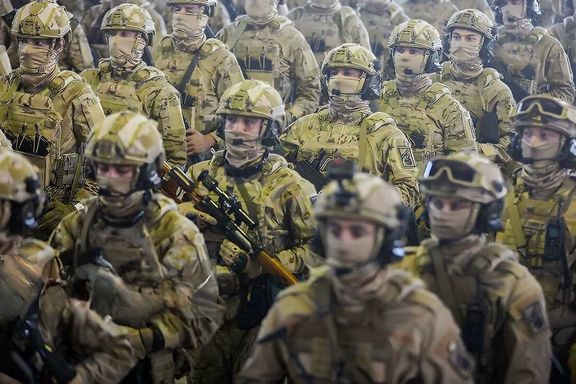
Members of the Revolutionary Guard’s Fatehin Special Forces
Iran will enter a war with the United States if Israel launches a new attack on the Islamic Republic, a senior Iranian official and former chief commander of the Revolutionary Guard said on Sunday.
"The Zionists (Israel) are seeking to try their luck against Iran once again," Major General Mohsen Rezaei told the state TV.
“However, events will soon happen inside Israel that will make this impossible,” he said. “It is not expedient to talk about them now.”
His remarks came hours after Ynet reported Israel is on heightened alert after the United Nations sanctions were reinstated on Iran under the so-called snapback mechanism, amid fears in the Jewish State that Tehran could accelerate its nuclear activities.
The sanctions were imposed despite several rounds of talks between Tehran and world powers aimed at clinching an agreement on Tehran’s disputed nuclear program.
Rezaei said Tehran will not accept further negotiations with Western powers that give Israel time to prepare or strengthen its position.
“Negotiations aimed at giving Israel time or strengthen it are unacceptable,” the veteran general-turned-politician told the state TV as he was once again seen wearing his military uniform.
“If that happens, the moment Israel starts a war, we will also enter a war with the United States,” said Rezaei who is a member of Iran’s Expediency Council.
“Negotiations must not be accepted in any form, at any price, or without conditions,” he said. “If we enter negotiations, military force must in no way be used against Iran. Otherwise, we will retaliate; not only against Israel, but also against American targets in the region.”
The warning followed fresh statements from Iran’s military leadership emphasizing the country’s readiness to respond to any attack.
Earlier on Sunday, Iran’s armed forces chief of staff Abdolrahim Mousavi said the military is fully prepared to respond to any threat or assault.
“Unity between the army and the Revolutionary Guards is the guarantor of preserving Iran’s territorial integrity,” Mousavi said during a meeting with the Guards’ commander.
“The armed forces are fully ready to confront any threat or possible aggression with strength,” he added.
Finnish Foreign Minister Elina Valtonen called Iranian state television’s decision to blur her legs during a broadcast of her UN meeting with Iran’s foreign minister a “sad” reflection of women’s treatment in the country.
“My Swedish colleague sent me the video on Friday. My first reaction was that it was amusing. But I immediately added, 'sad too’,” Valtonen told Helsingin Sanomat, Finland’s largest daily newspaper.
She added that she does not change her clothing based on who she is meeting and avoids events that require covering the face or hair.
Valtonen said she raises women’s rights in every meeting with Iranian officials, including this week’s talks.
Iranian state television blurred Valtonen’s legs in a news broadcast of her meeting with Iran’s Foreign Minister Abbas Araghchi on Tuesday on the sidelines of the UN General Assembly in New York.
Sweden’s Foreign Minister Maria Malmer Stenergard’s legs were also blurred in the same broadcast. The footage was widely shared on social media, including by Iranian women's rights activist and journalist Masih Alinejad.
Finland’s National Coalition Party, which Valtonen represents, also reacted on Instagram, calling the incident “a sad example of the trampling of women’s rights.”
"This is a reminder of how women around the world are still controlled and erased from visibility. Every woman has the absolute right to be seen, heard, and live freely," the party wrote on a post on Instagram.
"The National Coalition Party stands firmly for women’s rights — both in Finland and globally," it added.
A senior adviser to Iran’s Supreme Leader said Tehran should consider joining a new Saudi-Pakistani defense pact while vowing to strengthen its offensive military power after the recent 12-day war with Israel and the United States.
Major General Yahya Rahim Safavi told state television on Saturday night that the agreement between Riyadh and Islamabad was positive and proposed Iran, Iraq and others also take part.
“Iran, Saudi Arabia, Pakistan and Iraq can reach a collective defense pact,” he said, while acknowledging that US influence over Riyadh and Islamabad may limit such moves.
Earlier in September, Saudi Arabia and nuclear-armed Pakistan signed a mutual defense pact in Riyadh, bolstering their decades-old security partnership a week after Israel’s strikes on Qatar. Riyadh insisted the deal was not a response to specific events but the culmination of years of talks.
The agreement, described by a senior Saudi official as a “comprehensive defensive agreement that encompasses all military means,” says that aggression against either country will be considered an attack on both.
Pakistan, the only Muslim-majority nuclear power, has long stationed troops in the kingdom and provides technical and operational support to its military.
Pakistani Prime Minister Shehbaz Sharif and Saudi Crown Prince Mohammed bin Salman signed the pact alongside Pakistan’s powerful army chief Asim Munir.
Elsewhere in his remarks, Safavi said Iran launched more than 500 long-range missiles during the June conflict but admitted weaknesses in air defense and intelligence.
“Foreign assessments show 60% believe Iran won, because Israel did not achieve its objectives,” he said, without mentioning any source.
He added Iran was rebuilding damaged radar and missile systems and would “certainly increase” its offensive capabilities.
“The enemy could not tolerate us striking Haifa’s refinery and power plants,” Safavi said, adding that Iranian missiles destroyed advanced Israeli sites and pilots.
Safavi warned the conflict was “not fully over” and called for strengthening diplomacy, media, and military readiness. “We must continue the path of power-building. Offensive power is not only in air and space but in all domains,” he said.
Israel is on heightened alert after the United Nations reinstated sanctions on Iran under the snapback mechanism, amid fears in Jerusalem that Tehran could accelerate its nuclear activities, Ynet reported on Sunday.
Israeli security officials told the outlet that Iran’s leadership appeared increasingly anxious following the move, raising the risk of “miscalculation” that could spark further confrontation.
The sanctions, which restore an arms embargo, bans on uranium enrichment and ballistic missile activity, asset freezes and travel restrictions, were reimposed after the Security Council rejected a Russia–China proposal to delay them.
The report added that the recent conflict with Iran bolstered international support for sanctions but left open the risk of renewed escalation.
“Iran is still a power,” a senior Israeli official was quoted as saying. “Khamenei could decide tomorrow morning to race for the bomb at any cost.”
Ynet said Israeli officials acknowledged that while the strikes disrupted Iran’s nuclear and missile programs, Tehran retains sufficient material to potentially produce a weapon within a year.
They warned the snapback sanctions, combined with Iran’s missile tests and rebuilding efforts, meant Israel must remain vigilant.
Iran has imposed new limits on stablecoin transactions, capping annual purchases at $5,000 per person and total holdings at $10,000, authorities announced on Saturday, as the rial plunged to a record low on the eve of the return of UN sanctions.
The decision, adopted during the Central Bank’s High Council session this week, applies to all traders and users on licensed digital platforms and must be implemented within a one-month transition period, according to Asghar Abolhasani, secretary of the High Council.
“From now on, the ceiling for purchasing stablecoins is set at $5,000 per user annually, and holdings cannot exceed $10,000,” Abolhasani told Iran's state TV.
He said those already holding stablecoins will have only a brief period to comply.
“The important point is that in regard to stablecoins currently in possession, a maximum one-month transition period has been set, during which the authorized ceiling for holdings must be observed.”
Stablecoins are digital tokens pegged to traditional currencies, with Tether (US dollar) being the most widely used.
In Iran, Tether has become a lifeline for households and traders seeking to protect savings from inflation or to move money abroad, offering the stability of the US dollar without the barriers of the formal banking system.
The new restrictions come as the rial continues to collapse, hitting an all-time low of 1,136,500 per US dollar on Saturday. The national currency is likely to lose further value amid the looming renewal of UN sanctions and worsening public confidence in government controls.
Stablecoins such as Tether have surged in popularity among Iranians since the war with Israel and US earlier this year. For many, converting rials into digital dollars has been the only way to preserve value.
The new cap is expected to affect thousands of small traders who have been making a living in crypto and could now face penalties for exceeding the legal ceiling.
The Central Bank’s move mirrors past efforts to curb demand for foreign currency during sharp market downturns. In earlier crises, authorities restricted access to dollars and gold in hopes of stabilizing the rial, but the measures had little long-term impact and often pushed transactions into black markets.
Iran’s top security official, Ali Larijani, traveled to Beirut on Saturday to attend memorial ceremonies for the slain Hezbollah leader Hassan Nasrallah, announcing his support for Lebanon’s role as a frontline of resistance against Israel.
“We are hopeful for the future of the region. Awareness and vigilance in the region are on the rise,” said Larijani.
“The Israeli regime spares no country as seen in the recent incident in Qatar,” he said.
“Many countries are seeking to establish a joint mechanism for cooperation, and we support this path,” Iranian media quoted him as saying.
Larijani will meet senior Lebanese officials to discuss bilateral relations and regional and international issues of mutual concern, the Iranian embassy in Beirut said.
He is joined by Ebrahim Azizi, head of parliament’s National Security Committee, and Rouhollah Motefaker Azad, a deputy speaker, during his trip to Lebanon.
In his previous Beirut visit in August, Lebanese political figures publicly criticized Tehran’s influence and interference, warning that Iran’s pressure on Hezbollah’s armament threatened Lebanon’s sovereignty.
Though Hezbollah was once seen as Iran’s dominant proxy in Lebanon, it has endured heavy losses. Israeli strikes last year killed thousands of its fighters and senior leaders, with much of its military infrastructure destroyed.
Lebanese officials have said a sovereign, unified Lebanon requires the elimination of foreign influence, adding that Hezbollah’s control over armed power remains a major obstacle.
Founded in 1982 by Iran’s Islamic Revolutionary Guards Corps, Hezbollah has long been Israel’s principal military adversary in Lebanon. Fighting late last year left the group weakened.