Iran gives long prison terms to two French nationals in espionage case
A Tehran Revolutionary Court has handed heavy prison and internal-exile sentences to two French nationals accused of spying for France and collaborating with Israel, the judiciary announced Tuesday.
According to the official Mizan news agency, the pair—described in court documents as French intelligence employees—were convicted of espionage, collusion against national security, and cooperation with Israeli intelligence.
One received six years for espionage, five for collusion, and 20 years in internal exile; the other was sentenced to 10 years for espionage, five for collusion, and 17 years for aiding Israeli intelligence.
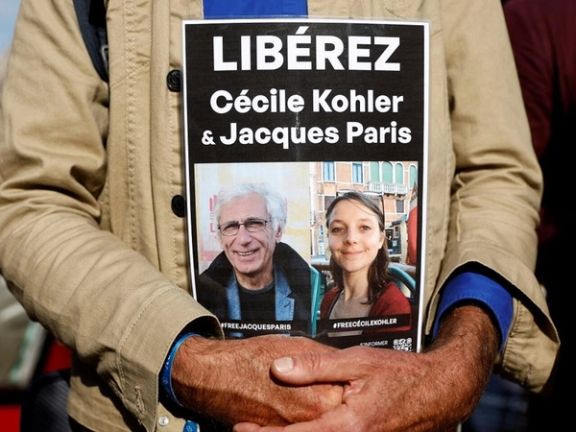
Iranian authorities did not name the two, but the case immediately drew comparisons with Cécile Kohler and Jacques Paris, a French teacher and her partner detained in May 2022 and accused of spying for Israel’s Mossad.
The judiciary said the defendants were arrested in March 2023 and had access to lawyers and contact with family during the proceedings.
They now have 20 days to appeal.
Ongoing dispute over detainees
Earlier Tuesday, judiciary spokesman Asghar Jahangir said Tehran continued to seek the release of Iranian citizen Mahdieh Esfandiari, detained in France on charges of promoting terrorism.
“The Human Rights Headquarters, in coordination with the Foreign Ministry, is making every effort for the unconditional release of our compatriot,” Jahangir said. He described the accusations against Esfandiari as “baseless,” adding that “support for the people of Palestine and opposition to genocide in Gaza cannot be considered a crime.”
In September, France withdrew its case against Iran at the International Court of Justice over the detention of Kohler and Paris. The move followed a meeting between French President Emmanuel Macron and Iranian President Masoud Pezeshkian in New York and was seen as a possible gesture toward reviving prisoner-exchange talks.
Iran maintains that all espionage cases are handled through “legal and transparent” procedures and denies using foreign detainees for political leverage. France, meanwhile, continues to demand the “immediate and unconditional” release of its nationals.
Israel prodded US President Donald Trump into attacking Iran by portraying Tehran as within reach of a nuclear weapon, Foreign Minister Abbas Araghchi said on Tuesday
The remarks appeared to pour cold water on dovish comments Trump had repeatedly made about seeking Iran's participation in Middle East peace the previous day while in Israel and Egypt to clinch a Gaza truce.
“It is more than clear by now that POTUS has been badly fed the fake line that Iran’s peaceful nuclear program was on the verge of weaponization this spring,” Araghchi wrote on X.
“That is simply a big lie and he should have been informed that there is zero proof of that, as confirmed by his own intelligence community.”
Araghchi’s post followed Tehran’s criticism of Trump’s remarks at the Sharm el-Sheikh summit in Egypt and in a speech to the Israeli parliament a day earlier, where he said, “It would be great if we made a peace deal with them, wouldn’t it be nice.”
Trump, Araghchi added, had promised to end “Israel’s serial deception of US presidents” but was now “being misled by the same warmongers who derailed American diplomacy with Iran for many years.”
Trump told reporters on Monday that Iran “has been battered and bruised” by sanctions but would “come along” to negotiations.
Iran’s Foreign Ministry said Trump’s statements were inconsistent with US actions, including the reinstatement of sanctions and joint US-Israeli strikes on Iranian nuclear facilities in June. “How can one speak of peace while attacking residential areas and peaceful nuclear facilities of a country and killing innocent people?” the ministry said on Tuesday.
Tehran calls Gaza summit illegitimate
Foreign Ministry spokesman Esmail Baghaei said Tehran had refused to attend the Sharm el-Sheikh meeting, describing it as “illegitimate” and lacking international credibility because it was not held under United Nations supervision. “Diplomacy will never be suspended,” he said, “but we did not take part in a summit chaired by a party that takes pride in an illegal attack against our country.”
The summit, attended by leaders from the United States, Egypt, Turkey, Qatar, France, Germany and the United Kingdom, followed the signing of a ceasefire agreement between Israel and Hamas that ended two years of war in Gaza and secured the release of 20 Israeli hostages.
Responding to Trump’s remark that Iran had been “the bully of the Middle East,” Araghchi wrote, “The real bully of the Middle East, Mr. President, is the same parasitic actor that has long been bullying and milking the United States,” referring to Israel.
Araghchi said Iran remained open to “respectful and mutually beneficial diplomatic engagement,” but questioned how Washington could extend an olive branch while supporting military action against Iran. “Mr. Trump can either be a President of Peace or a President of War, but he cannot be both at the same time,” he wrote.
He added that Iran agreed with Trump on one point — that Tehran should not be used as a pretext for Arab-Israeli normalization. “If someone wants to throw the Palestinians under the bus while embracing a genocidal entity, they should have the guts to take full responsibility for it,” Araghchi said.
Iran did not attend the Sharm el-Sheikh conference on Gaza because it lacked legitimacy, though the country remains committed to diplomacy, Foreign Ministry spokesman Esmail Baghaei said in an interview on Tuesday.
“Diplomacy will never be suspended, but we did not take part in a summit chaired by a party that takes pride in an illegal attack against our country,” Baghaei said, referring to the Monday meeting in Egypt that was led by US President Donald Trump.
The Sharm el-Sheikh summit, attended by leaders from the United States, Egypt, Turkey, Qatar, France, Germany and the United Kingdom, followed the signing of a ceasefire agreement between Israel and Hamas that ended two years of war in Gaza. The deal included the release of 20 Israeli hostages in exchange for hundreds of Palestinian prisoners.
Baghaei said the meeting “had no international credibility” because it was not held under the supervision of the United Nations and several major countries, including China and Russia, were not invited. “A gathering of limited participants cannot claim to represent the global community,” he said, according to state radio.
He added that Iran viewed the conference as politically one-sided, given that it was chaired by “a party that not only supported but also celebrated illegal strikes against Iran earlier this year.”
In June, the United States joined Israel in a series of attacks on Iranian nuclear sites after indirect talks between Tehran and Washington stalled over enrichment and inspection terms. The strikes destroyed parts of Iran’s nuclear infrastructure and killed scientists and soldiers, according to Iranian officials.
World leaders pose for a family photo, at a world leaders' summit on ending the Gaza war, in Sharm el-Sheikh, Egypt, October 13, 2025.
Baghaei said Iran’s position on Gaza remained unchanged. “Our clear priority is ending the genocide in Gaza, ensuring the return of displaced residents and securing the withdrawal of the occupiers,” he said. “As long as the Palestinian right to self-determination is not recognized, no plan will lead to real peace.”
Iran rejects Trump’s remarks on peace
His remarks came after the Iranian Foreign Ministry rejected Trump’s comments about a possible peace deal with Tehran, calling them contradictory to US behavior. Trump said during the summit in Egypt that “it would be great if we made a peace deal with them,” and later told reporters that Iran “has been battered and bruised” by sanctions but would “come along” to negotiations.
Tehran said such comments could not be taken seriously in light of US sanctions and the June attacks. “How can one speak of peace while attacking residential areas and peaceful nuclear facilities and killing innocent people?” the ministry said on Monday.
Baghaei said Iran continued to rely on diplomacy “to safeguard national interests and promote peace,” emphasizing that participation in international affairs “is not limited to physical presence at summits.”
“The Islamic Republic has always used diplomacy as a tool to protect its sovereignty and to pursue peace and stability,” he said. “This approach will continue, but it will not come at the cost of our national dignity.”
Iran’s parliament on Tuesday voted down a bid to stop the government from seeking to join a United Nations convention against terror financing, Tasnim news agency reported.
Lawmakers rejected the motion with 150 votes in favor, 73 against and nine abstentions out of 238 members present, Tasnim said. The proposal was sent to parliament’s National Security and Foreign Policy Committee for further review.
The bill was introduced by conservative lawmakers seeking to block implementation of Iran’s conditional approval to join the UN Convention for the Suppression of the Financing of Terrorism, one of the Financial Action Task Force (FATF) standards that require countries to monitor and report financial transactions to curb money laundering and terror funding.
Earlier this month, Iran’s Expediency Council, which resolves disputes between parliament and the Guardian Council under Supreme Leader Ali Khamenei, gave conditional approval for joining the treaty after years of delay. The council said implementation would depend on guarantees that Iran’s economic and security interests would not be compromised.
Hardline lawmakers argue that joining the convention could expose Iran’s financial channels used to bypass US sanctions and support regional allies such as Hezbollah and armed groups in Iraq and Yemen. They say Iran should only join once all sanctions are lifted.
Supporters of the treaty, including some moderate lawmakers and economic officials, argue that compliance with FATF standards could help reconnect Iran’s banking system to global financial networks and attract foreign investment amid a severe economic downturn.
The Islamic Republic decided not to attend the Sharm el-Sheikh peace summit after carefully reviewing the potential benefits and risks, Iran’s Foreign Ministry said Monday but insisted the move would not diminish Tehran’s influence in regional or international developments.
The government had received an invitation from Egyptian President Abdel Fattah el-Sisi addressed to President Masoud Pezeshkian, Foreign Ministry spokesperson Esmaeil Baghaei told reporters on Monday. The decision not to attend, he said, was made “after thorough discussions inside and outside the ministry,” with all “positive and negative aspects evaluated before a final choice that serves national interests” was announced.
Responding to suggestions that Iran’s absence could weaken its regional role, Baghaei said, “Iran’s influence and role in regional and international developments go far beyond physical participation in any single event.” Tehran’s presence “cannot be confined to attending or not attending one international meeting,” he added.
“Iran remains one of the most active countries in opposing Israel’s actions in Gaza,” Baghaei added, saying Iran “will continue its work actively and is confident of its impact wherever necessary.”
Iran assessing Trump peace initiative
Asked about the US-led peace proposal and the summit chaired by President Donald Trump, Baghaei said Iran is “closely evaluating the developments” surrounding the plan. “The Islamic Republic is in a position to turn any threat into an opportunity and to chart a course for securing its national interests from within challenges,” he said.
Tehran has long studied every aspect of the Gaza conflict and continues to oppose the ongoing violence, he noted.
“Fortunately, Iran is in a position to counter any sanctions and to identify and use every opportunity arising from challenges in the interest of the nation.”
Other diplomatic matters
Baghaei also confirmed that Iran’s ambassadors to Germany, France, and the United Kingdom — who had been recalled for consultations — have returned to their posts.
Asked about Trump’s recent remarks that US strikes on Iran’s nuclear facilities helped pave the way for the Gaza peace deal, Baghaei said such remarks “should be asked of them [the Americans],” adding that “Iran has always firmly defended its interests and continues to use all its capacities to confront foreign adventurism.”
The state-linked daily Jomhouri Eslami, which operates under the supervision of a representative of Iran's Supreme Leader Ali Khamenei, described Hamas’s October 7 attack as a mistake that undermined anti-Israel movements in the region.
“Contrary to many analyses and comments, the Al-Aqsa Storm operation was a mistake,” the paper wrote in an editorial on Sunday.
The newspaper said the attack caused significant damage to what it described as “anti-Israel movements” across the region, from Iran to Lebanon.
It also cited the death of Hezbollah leader Hassan Nasrallah and the collapse of Syrian President Bashar al-Assad’s government as “major losses” for what it described as the regional anti-Israel front.
It added that the paper's editorial board had believed from “the very first moments” the attack was a miscalculation, adding that, two years later, “our belief in this mistake has only grown stronger.”
The paper said in aftermath of the Iran's 12-day war with Israel in June — including the joint Israeli and US bombings of Iran’s Natanz, Isfahan, and Fordow nuclear facilities — had severely damaged the country’s military and nuclear command structure, setting its nuclear program back “considerably.”
Jomhouri Eslami — like Kayhan and Ettela’at — is overseen by Khamenei’s representative but is known for its more moderate tone under managing editor Massih Mohajeri, a Shia cleric who has at times criticized parts of Iran’s establishment and defended reformist figures such as Akbar Hashemi Rafsanjani and Mir-Hossein Mousavi.
Khamenei has previously praised Hamas’s October 7 attack, calling it a step toward “removing America from the region” and saying the operation “overturned the table of US policies.”