Satellite images show activity at damaged Iranian nuclear site – think tank | Iran International
Satellite images show activity at damaged Iranian nuclear site – think tank
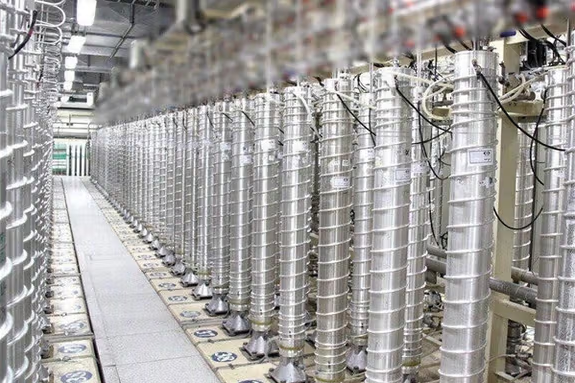
Uranium enrichment centrifuges at Iran's Natanz nuclear facility
Satellite imagery shows new activity at an Iranian uranium enrichment facility damaged during a brief June war, a US-based think tank said on Thursday, raising the possibility that Iran is seeking to recover stocks of its highly enriched uranium.
The Institute for Science and International Security (ISIS) reported that satellite images taken last weekend show activity at the Pilot Fuel Enrichment Plant (PFEP), a key facility at Natanz that was previously destroyed.
“Satellite imagery from December 13, 2025, shows that Iran placed panels on top of the remaining anti-drone structure, providing cover for the destroyed facility,” the think tank said.
Although the structure appears partially sealed, ISIS said that “a large hole remains in the middle where the drone cage was penetrated and damaged.”
The think tank said the new covering suggests Iran may be attempting to access the remains of the facility while shielding the activity from external observation.
“This indicates Iran wants to explore the rubble out of sight of prying eyes."
The PFEP is a sensitive site within the Natanz complex, historically used for advanced enrichment research and development.
According to ISIS, the facility “likely held several kilograms of highly enriched uranium,” a quantity that is small compared with Iran’s overall stockpile of nearly 400 kg but still significant.
The group said the material would be “not negligible” in the broader context of Iran’s nuclear capabilities.
Despite the apparent activity at PFEP, ISIS said it has not observed similar signs elsewhere at Iran’s main nuclear sites including the underground Fordow facility bombed by the United States in June.
Iran has long insisted that its nuclear program is for peaceful purposes, while Western governments and Israel say Tehran’s enrichment activities bring it closer to the capability to produce nuclear weapons.
The UN nuclear watchdog remains unable to access several of Iran's most sensitive nuclear sites following June strikes, International Atomic Energy Agency (IAEA) Director General Rafael Grossi said on Monday.
Grossi told Russia’s RIA Novosti that inspectors had returned to some facilities but were restricted to sites that were not damaged in the attacks.
“We are only allowed to access sites that were not hit,” he said, calling the resumption important but insufficient.
“These other three sites – Natanz, Isfahan and Fordow – are even more significant, since they still contain substantial amounts of nuclear material and equipment, and we need to return there.”
US President Donald Trump made Iran a final offer for a deal which Iran refused in June, the Washington Post reported on Wednesday citing officials, prompting his authorization of a plan to attack its nuclear program.
The Trump administration proposal to Iran dated June 15 demanded Tehran end support for armed allies in the region including Hamas and Hezbollah along with “replacing” the Fordow nuclear site and “any other functioning facility” with sites which do not allow uranium enrichment.
According to the text quoted by the Washington Post, the United States in return would lift “ALL sanctions placed on Iran."
Shortly after it was conveyed via Qatari mediators, the proposed deal was rejected by Tehran, and Washington authorized the attacks which would come the following month, the Post reported citing a senior diplomat involved in the process.
The United States held five rounds of negotiations with Iran over its disputed nuclear program earlier this year, for which Trump set a 60-day deadline.
Trump accused Iran of dragging out the talks while Tehran said Washington's demands were unreasonable and undermined their sovereignty.
When no agreement was reached by the 61st day on June 13, Israel launched a surprise military offensive followed by US strikes on June 22 targeting key nuclear facilities in Isfahan, Natanz and Fordow.
Trump said the attacks "obliterated" Iran's nuclear program, in an assertion disputed by Tehran, which denies seeking a nuclear weapons. Tehran has said war damage means no enrichment is ongoing but the standoff over its nuclear ambitions persists.
The head of Israel's Mossad intelligence agency said Iran will seek to revive its nuclear program if given the chance but that Israel would thwart its ambitions to acquire a weapon.
“The idea of continuing to develop a nuclear bomb still beats in their hearts. We bear responsibility to ensure that the nuclear project, which has been gravely damaged, in close cooperation with the Americans, will never be activated,” David Barnea said at an award ceremony for agents in Jerusalem late on Tuesday.
Iran denies seeking a nuclear bomb but Israel along with the United States and Western countries doubt its intentions.
Israel launched a surprise military campaign on Iran in June which was capped off with US strikes on the country's main nuclear sites.
The conflict came after two months of negotiations which failed to win Iranian agreement to a US demand that it end domestic uranium enrichment.
Israeli attacks killed Iranian nuclear scientists as well as hundreds of military personnel and civilians. Iranian counterattacks killed 32 Israeli civilians and an off-duty soldier.
Despite the military setbacks to Tehran, it insists enrichment is its right and called Israeli and US actions aggression which aimed at its sovereignty and progress.
“The ayatollahs’ regime woke up in a moment to discover that Iran is exposed and thoroughly penetrated, yet Iran has not given up its aspiration to destroy the State of Israel,” Barnea continued.
“Iran believes it can deceive the world again and realize another bad nuclear agreement,” he continued. "We did not and will not allow a bad deal to come to fruition.”
US President Donald Trump said his June 22 attacks had "obliterated" Iran's nuclear program and that any attempt at rebuilding will trigger renewed US strikes.
Iran has rejected US demands that it end enrichment, curb its missile program and rein in support for armed allies in the region, leaving diplomacy at a stalemate.
Iran and Russia signed a cooperation document between their foreign ministries on Wednesday after talks in Moscow, setting out a consultations program for the years 2026 to 2028.
The document was signed by Iranian Foreign Minister Abbas Araghchi and Russian Foreign Minister Sergey Lavrov at the end of their negotiations.
Lavrov said the consultations plan was drawn up following the entry into force of a comprehensive strategic partnership treaty between the two countries earlier this year.
“Without any doubt, the main and key document in our relations is the comprehensive strategic partnership treaty between the Russian Federation and the Islamic Republic of Iran, which was signed this year and has entered into force,” Lavrov offering no details on the consultations agreement.
He said the treaty formally set out the special nature of bilateral relations and established key areas of cooperation and a long-term, 20-year outlook.
'Treaty deepens long-term cooperation'
The comprehensive strategic partnership treaty, signed in January by Russian President Vladimir Putin and Iranian President Masoud Pezeshkian and ratified by both countries’ parliaments, commits Moscow and Tehran to closer cooperation across political, economic, security and technological fields.
While it does not include a mutual defense clause, the agreement provides for expanded military-technical cooperation, coordination on security issues, closer economic ties and efforts to reduce the impact of Western sanctions, including through financial and trade mechanisms outside the dollar system.
Lavrov said the signing of the 2026-28 consultations plan marked a first in the history of ties between the two countries.
“Today, for the first time in history, we are signing a consultations program between the foreign ministries of Russia and Iran for the years 2026 to 2028,” he said, adding that dialogue between the two ministries was regular and highly valuable.
Broader coordination under sanctions
Both countries have stepped up coordination as they face extensive Western sanctions. They cooperate in forums such as BRICS, the Shanghai Cooperation Organization and the Eurasian Economic Union, and have expanded ties in energy, transport, trade, technology and space.
Iran and Russia say the strategic partnership treaty and the newly signed consultations plan provide a structured roadmap for advancing those ties over the coming decades.
Iran's mission to the United Nations signaled its opposition to the head of world body's nuclear watchdog becoming UN secretary general next year, saying Rafael Grossi's silence on US-Israeli attacks on Iran showed he did not value international law.
The replacement for António Guterres is due to be chosen next year and serve from 2027 to 2031. Argentina last month named its native son Grossi, 64, to fill the position and he is considered a top contender.
Since 2019, Grossi has led the International Atomic Energy Agency as it attempted to manage the still festering Iran nuclear dossier, which came to a head last year with surprise US and Israeli attacks on Iran's nuclear sites in a 12-day war in June.
Iran’s Ambassador and Permanent Representative to the United Nations, Amir Saeid Iravani appeared to single Grossi out without naming him in remarks to the Security Council on Wednesday.
“A candidate who has deliberately failed to uphold the UN Charter—or to condemn unlawful military attacks against safeguarded, peaceful nuclear facilities," he said, "undermines confidence in his ability to serve as a faithful guardian of the Charter and to discharge his duties independently, impartially and without political bias or fear of powerful States, as required under the Charter.”
Iran denies seeking a nuclear weapon but Israel and Western states doubt its intentions, especially after Grossi's IAEA flagged in the months running up to the conflict that Iran's enrichment activities were ramping up.
The country's uranium stock refined to up to 60% had hit nearly 275 kilograms, Grossi warned, which according to an IAEA yardstick was enough in principle for six nuclear bombs if enriched further.
No civilian purpose existed for such activities, Grossi warned.
The United States held five rounds of negotiations with Iran over its nuclear program earlier this year, for which US President Donald Trump set a 60-day deadline.
When no agreement was reached by the 61st day on June 13, Israel launched a surprise military offensive followed by US strikes on June 22 targeting key nuclear facilities in Isfahan, Natanz and Fordow.
The attacks killed nuclear scientists along with hundreds of military personnel and civilians. Iranian counterattacks killed 32 Israeli civilians and an off-duty soldier.
Grossi did not offer any assessment of the conflict but has worked to try to restore inspections of stricken sites in an effort Iran has largely opposed as diplomacy stays in a deep post-war freeze.
The United Nations has struggled to influence conflicts which have raged in the Middle East and Europe in recent years, earning the ire of both its critics and advocates who hope it can play a greater role in multilateral peace efforts.
Iran's intervention appeared to be the most substantive challenge yet to Grossi's bid.
Iravani said a UN secretary-general must have “a clear and non-derogable responsibility” to safeguard member states' rights and their equal participation in the global system.
“Failure to do so weakens the United Nations and erodes the principle of sovereign equality at the heart of the UN system,” he said.
Russia’s Foreign Minister on Monday criticized provisions in a 2015 nuclear deal which allowed Europe to trigger UN sanctions on Iran and said it was up to Iran whether to renew talks on its disputed nuclear program.
“When we realized in 2015 that such a solution had been found between the US and Iranian negotiators, we asked our Iranian friends: are you sure this is correct? We were told that Iran does not intend to violate anything, and we believed that as well,” Sergei Lavrov said in an interview with Iran’s state-run TV aired on Monday.
The veteran diplomat directly tied the controversial clause to former Iranian foreign minister Mohammad Javad Zarif’s final talks with then US Secretary of State John Kerry, saying other parties were sidelined as Washington and Tehran closed the deal.
Lavrov’s earlier comments on the issue triggered an unusually public war of words with Zarif, who said the snapback idea was originally pushed by Russian and French negotiators and accused Lavrov of lying about the history of the mechanism.
Asked about criticism that Moscow did not support Iran enough, Lavrov balked.
“Seriously, it must be said that neither current politicians nor former ones have any grounds to complain that Russia failed to support the Islamic Republic at various stages of the negotiations,” he said.
Lavrov described current Western policy towards Iran as built on pressure and said other countries in the region were not fully satisfied with the approach.
“It is very important that, in our assessment, your Arab neighbors do not support efforts to increase pressure on the Islamic Republic,” he added.
‘Our Iranian friends’
Lavrov also signaled support for renewed nuclear diplomacy involving the US and European powers, presenting Russia as ready to help end the standoff.
“Our Iranian friends are aware of our assessments. The decision about whether to resume dialogue with the United States is up to them. We have heard that Iran is interested in resuming such talks, and as for the Agency, whether to restart dialogue with the Agency – we also know Iran wants to revive that, but the decision lies with the authorities in Tehran,” he said.
Asked if it is still beneficial for Iran to remain a signatory to the Nuclear Non-Proliferation Treaty (NPT), Lavrov advised Tehran to stay committed.
“You raised the final question of whether it is worth Iran remaining in the NPT or not. We believe it is worth staying and that one should not try to drag this issue into the public arena by criticizing everything that has happened,” Lavrov said.
Lavrov also raised concerns over Iran’s decision to curb cooperation with the International Atomic Energy Agency (IAEA) under an understanding brokered by Egypt, saying Tehran should take that commitment seriously.
“The actions and positions of the Agency have, to put it mildly, generated very unpleasant feelings in Iran, and this is completely understandable to me,” he said.
“But this is a question that should be put more directly to (IAEA chief Rafael) Grossi and his colleagues, so that the principle of neutrality is fully respected and they do not, at certain moments, take political steps that help one side or the other.”
Tehran and the IAEA inked a deal in Cairo in September aimed at resuming full IAEA access but little progress appears to have been made.
Iran suspended cooperation with IAEA inspectors after a 12-day war in June against Israel and the United States in which they attacked Iranian nuclear sites, codified via a new law passed by parliament.
US President Donald Trump said last week Iran's nuclear program is "gonzo" after air attacks he ordered in June and that it faced "obliteration" if restarted, telling Tehran they could avoid more destruction with a nuclear deal.