Election boycotted by Iranian dissidents, challenging regime's legitimacy
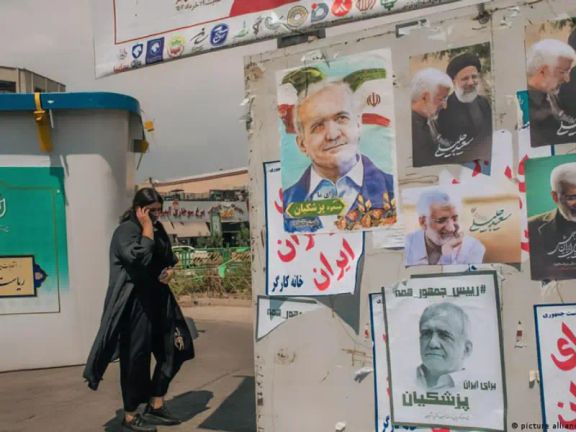
A woman walks past a wall covered with campaign posters for the upcoming presidential election runoff in Iran, featuring candidates Masoud Pezeshkian and Saeed Jalili.
Influential Iranian figures, from those in prison cells to those on social media, are boycotting Friday's presidential election runoff, casting doubt on its legitimacy and branding it as a farce.
Amirsalar Davoudi, a lawyer incarcerated in Evin Prison, denounced the election as a "selection" in a letter from prison. He declared his refusal to participate, asserting that the Islamic Republic pursues only a path of "lies and deceit."
In recent weeks, many dissidents have expressed publicly that the upcoming election is a manipulated facade rather than a genuine democratic process.
In his letter, Davoudi pointed out that there is disagreement among some intellectuals and advocates who want a fundemantal change in the country, about whether they should participate in the election or not.
The lawyer and dissident has been sentenced to imprisonment for advocating for a total system overhaul through the empowerment of the people.
In his fifth year of a 10-year sentence, Davoudi is widely regarded as embodying resistance to a government criticized for suppressing genuine democratic expression.
Sepideh Gholian, another political prisoner, described abstaining from voting as a form of "civil resistance" under current conditions.
Given the absence of a democratic mechanism in Iran, elections are widely believed to be predetermined outcomes by the country's Supreme Leader, Ali Khamenei.
She says that participating in the elections allows Tehran to present a false image of "legitimacy," especially in international forums.
Gholian emphasized that the Islamic Republic is striving to be perceived as legitimate following its "severe and bloody" crackdown on the nationwide protests in 2022.
In direct contrast, those boycotting the election at great risk say that their protest is intended to signal to other countries that the state lacks legitimacy among the broader populace.
Gholian expressed hope for the eventual "overthrow" of the Islamic Republic, illustrating the deep-seated desire for systemic change among many Iranians.
Farhad Meysami, a civil activist and former political prisoner, denied reports of his participation in the elections. In an Instagram post, Meysami declared that he did not need an attorney or guardian to express his views. His response was prompted by claims from some reformist political activists, including Mohammadreza Jalaeipour, about his alleged participation.
This incident highlights the presence of manipulation and misinformation in political discourse in Iran, with false narratives potentially swaying public perception.
Meysami called on those spreading the "false news" to correct it, emphasizing the importance of truthful representation in the fight for genuine democratic processes.
Former political prisoner Abolfazl Ghadiani also called for a boycott of the election. He emphasized that the solution to Iran's problems lies in transforming the “ruling religious dictatorship” into a “democratic secular republic” through “civil and political resistance.”
Ghadiani’s stance echoes a broader sentiment among activists who believe that superficial electoral changes are insufficient and that only a complete overhaul of the political system can address the root issues facing the country.
Motahareh Gounei, an exiled student and detainee from nationwide protests, reiterated her stance on not voting in a post on X.
She stressed that her red line is "human dignity" and the “defense of civil rights,” not the whims of the leadership and the policies of the Islamic Republic.
Gounei’s message also highlighted the personal sacrifices and risks undertaken by activists who oppose the current government, often enduring imprisonment and exile. She emphasized that a bright future will be built by people who no longer have faith in the government, underscoring the profound disillusionment with the existing political framework.
Many observers say that this collective and unprecedented action represents a complete rejection of the current political system, aiming to communicate to both domestic authorities and the international community the pressing need for real change.
Canada has ordered the deportation of Bagher Ardeshir Larijani, a member of Iran's once powerful Larijani family, turning him into the latest individual affiliated with the Islamic Republic being removed from the country.
As part of efforts to remove Iran's regime-affiliated individuals from Canada, the Canada Border Services Agency (CBSA) had earlier requested the Immigration and Refugee Board (IRB) to conduct hearings on five individuals with senior positions in Iran’s government.
However, Bagher Larijani does not seem to be one of those five individuals, as he is being removed from Canada not for his affiliation with Iran's rulers, but for his failure to spend at least "730 days in the preceding five years in Canada".
A brother of Iran's US-designated Expediency Council chief Sadegh Amoli Larijani and former Parliament Speaker Ali Larijani, the 62-year-old national of Iran "was landed as a permanent resident (PR) of Canada in September 2017," a Canadian Immigration and Refugee Board document shows.
Larijani, a former advisor to Iran's health minister, arrived in Canada along with his wife and son and "qualified for permanent residence as a skilled worker through his experience as a doctor," the IRB said.
The document reveals that he "spent some time in Canada with his family every year from 2017 until 2022. He last returned to Canada on October 15, 2022, just 12 days before his PR card was about to expire. He underwent an admissibility examination at Vancouver International Airport and was issued a Departure Order for failing to reside in Canada for at least 730 days in the preceding five years" as required under the law.
Larijani's son "is now a Canadian citizen, and his wife has a Canadian citizenship application in process. The Appellant’s daughter who also became a permanent resident in her own right in 2017, has been residing in the United States for the past several years," it added.
The hearing for Bagher Larijani was held on November 29, 2023, and the IRB made its decision on January 25, 2024, according to hearing documents seen by Iran International.
The Canadian government has started deporting Iranian regime-affiliated individuals in response to ongoing appeals from the Iranian diaspora to bar regime-affiliated officials from entering the country, particularly in light of the Iranian authorities' brutal crackdown on the nationwide Woman, Life, Freedom protests in 2022.
"Canada stands with the people of Iran, who continue to fight for their rights,” the Canada Border Services Agency (CBSA) told Iran International. “The Government of Canada has taken action to stop senior members of the Iranian regime from seeking or finding safe haven in Canada.”
However, it said it does not provide comment or details on specific individual cases as an individual’s border and immigration information is considered private and protected by the Privacy Act.
The policy previously resulted in deportation orders for Majid Iranmanesh, a science advisor, and Seyed Salman Samani, a former deputy interior minister, according to Global News.
The European Union has accepted a request from Germany to consider designating Iran's Revolutionary Guard as a terrorist entity at a time when Iran-backed plots across Europe continue to be revealed.
According to Germany's Süddeutsche Zeitung, the legal department of the European Union's foreign action service has officially begun the process to possibly designate the IRGC.
It is a victory for advocacy groups after at attempt by the European Parliament to press the European Union to designate the IRGC failed last year.
It also comes as a stream of Iranian plots have been foiled in recent months in countries including Sweden and Belgium. As far back as 2022, a plot to attack a synagogue in Germany led to the latent summoning of the Iranian ambassador this year as more of Iran's covert activities come to light.
Germany’s largest opposition party, the Christian Democratic Union, is one of the players which has been pushing the European Union to take a tougher position on Iran, including designating its IRGC.
The US designated Iran’s military apparatus in 2019 and the latest country to join ranks, was Canada, where Iranian dissidents have also been targeted by IRGC plots to kill and kidnap.
In addition to demanding action to curb Iran’s ongoing nuclear program, in the face of global sanctions, the CDU wrote a position paper calling for a dramatic change in path as Iran’s proxies wreak havoc across the Middle East and beyond.
Lawmakers suggest a policy aimed at further isolating Iran, which is also under sanctions for supporting Russia’s war on Ukraine. They suggest working with moderate Arab states to form an ‘anti-Iran coalition’, including signatories of the Abraham Accords such as the United Arab Emirates, and Saudi Arabia.
Confronting Iran's nuclear ambitions, the CDU lawmakers call for a total halt to the program. Just weeks ago, the UN’s nuclear chief warned Iran was ‘weeks not months’ from a nuclear weapon.
The CDU has proposed that an alliance between Germany, France, Britain, and the United States, must work harder to prevent Iran’s nuclear armament, including imposing tougher sanctions on countries helping Iran evade their own
The policy recommendations also tackle Iran’s human rights abuses at home, including the disproportionate persecution of women and girls, which the UN has branded "gender apartheid".
The policy document has proposed banning any institution in Germany that serves as an information source or influence channel for the Iranian regime, including the immediate closure of the Islamic Center in Hamburg.
This week, the German Federal Administrative Court ruled that the center was affiliated with the Iranian regime and branded it an "extremist Islamic organization” calling its activities “extremism”, as per the Federal Office for the Protection of the Constitution of Germany.
Currently designated as a terrorist group by Israel, the United States, Bahrain, Canada, Saudi Arabia, and Sweden, the EU has taken a softly softly approach, aiming to continue negotiations regarding Iran’s nuclear program.
The calls to designate the IRGC were echoed this week in a statement by 11 European lawmakers across eight countries and the European Parliament.
At the annual Israel Allies Foundation European Summit, held at the Dutch Parliament in the Hague, lawmakers addressed the threats the IRGC poses specifically to Jewish and Israeli targets.
In May, Israel’s Mossad security service revealed plots against a string of Israeli embassies, including those based in Europe, in addition to Jewish and Israeli targets.
“We recognize the importance of addressing state-sponsored terrorism by the Iranian regime against the State of Israel and Jewish communities across Europe and therefore call on the European Commission to list the IRGC on the European terror list,” the statement read.
With representatives from the Czech Republic, Italy, Lithuania, Netherlands, Norway, Slovakia, Portugal and Estonia, it comes as Iran’s proxies continue to wage war on Israel.
Since the October 7 atrocities of Iran-backed Hamas, where at least 1,200 mostly civilians in Israel were murdered and another 250 taken hostage, Iran’s proxies in Lebanon, Yemen, Syria and Iraq have launched attacks on Israel from across its borders.
They have also targeted US positions in the region in retaliation for President Joe Biden’s support of Israel’s right to self defense.
The groups all say their attacks will not stop until a full ceasefire is achieved in Gaza. Israel says the military campaign in the strip will continue until the full eradication of Hamas and the return of the remaining 120 hostages, over 40 of them are known to have died in captivity.
Eighteen shops in Tehran Province have been given warning of closure while several shop managers face legal action for selling clothing described as “satanic".
The shops are accused of selling clothes that run counter to Islamic values. The city’s police commander, Mohammad Ghasem Tarhani, described them as containing "unconventional logos and symbols."
"Considering that one of the goals of the sworn enemies of the Islamic Republic of Iran is to lead the youth astray and exert influence through cultural and religious means, authorities are acting on information received about several shops and garment production units," stated Tarhani, according to Mehr News Agency on Wednesday.
As if a national emergency, he warned the public to “avoid unusual clothes for yourself and your children and inform the police by calling 110 if you see any sale or production of unusual clothes".
In mid-May, Iranian authorities arrested over 260 people at an underground rock music festival near Tehran. The Islamic Revolutionary Guard Corps (IRGC) affiliated Tasnim News Agency labeled the festival as a “Satanist” gathering.
Those detained had "signs and symbols of satanism on their clothes, head, face, and hair," according to Tasnim. In their report, Tasnim also released photos of masks, model skulls, and t-shirts depicting skulls.
As criticism of Iranian state television grows over perceived bias against reform-oriented candidate Massoud Pezeshkian, snippets of the debate have gone viral on social media.
Meanwhile, concerns are rising within Iranian society about the ability of both candidates to tackle the country's problems. Another heated discussion centers on the reaction of those who boycotted the election or abstained, who make up more than 60 percent of eligible voters. The key question is whether some of them will support Pezeshkian in the runoff on Friday.
This concern was evident in the remarks of Prince Reza Pahlavi, who called for a national boycott and Supreme Leader Ali Khamenei, who acknowledged the low participation rate in what some observers dubbed a humiliating admission.
Pro-reform politicians and social media users have suggested that ultraconservative candidate Saeed Jalili's brother, who heads the state television, may have used his influence to shape the debate's questions and answers.
Mohsen Hashemi, the chairman of the central council of the pro-reform Executives of Construction Party, charged in an interview with Khabar Online that the questions asked by the state TV presenter were designed to tarnish Pezeshkian's image and create doubts about his integrity.
Hashemi added that Jalili's influence on state television is deep-rooted, thanks to his brother's position as the head of the country's sole broadcaster.
Meanwhile, he dismissed accusations that members of the Rouhani administration are running Pezeshkian's campaign and that his possible government would be a continuation of former President Hassan Rouhani's presidency.
Hashemi claimed that the questions were given to Jalili beforehand to better prepare him for the debate. Nonetheless, he opined that the two rounds of debates between the runoff candidates are likely to boost election participation by 10 percent.
Like many others, Hashemi noted that both candidates were more polite in the first debate, while the second debate was marked by agitation and anger from both sides.
Khabar Online wrote in another reportthat Jalili used the same tactics as former President Mahmoud Ahmadinejad, i.e., trying to make his opponent angry and at the same time smile at him.
The report added that the state TV and its presenters clearly favored Jalili and nearly all of the staff members present on the set supported the ultraconservative candidate. The website characterized, particularly the second debate, as quarrels rather than a conversation.
The website noted that Jalili was utterly nervous and even hysteric during the debate and raised his vice at several points and frequently interrupted Pezeshkian. At times, both candidates clenched their fists, noted the website.
A point made by other observerswas that none of the candidates showed any interest in the key issue of the environment in the two debates.
Some observers continued to express concern for the perils of the possible election of hardliner Jalili as Iran's next president. One of them was Abdolreza Faraji Rad, Iran's former ambassador to Norway and Hungary, who said Jalili's possible win will be too costly for Iran's foreign policy.
On the same note, Hamid Hosseini an expert on energy has also warned that a country of 80 million population cannot be run on barter trade involving sheep and mango. He was referring to a recent transaction between Iran and Pakistan.
The concern is also evident among the public. Journalist Roozbeh Bolhari quoted pro-government reformist activist Saeed Laylaz as saying that Iran's reformists were hoping that another 10 million would vote to finish the election in the first round, but they did not. As a result, Laylaz pointed out,
Iran's acting president reassured Russian president Vladimir Putin that regardless of the incoming president, ties with Iran would remain "deep".
“The Supreme Leader of Iran wanted me to convey that the relationship between Iran and Russia is very deep and will not be affected by changes in government,” Mohammed Mokhber said.
Mokhber and Putin met on Thursday in Astana, Kazakhstan's capital, during the Shanghai Cooperation Organization summit.
During the meeting, Putin emphasized the unity of Russia and Iran's international agenda, stating that “our approaches towards key issues of the international agenda almost completely coincide.”
Mokhber stated that the "strategic relationship" between Iran and Russia has "completely disrupted the global balance of power," adding that "there is no longer any talk of a unipolar world."
According to Russia's foreign ministry, Moscow and Tehran are negotiating a comprehensive bilateral cooperation agreement that reflects the "unprecedented upswing" in their relations.
However, conflicting accounts emerged regarding the status of the agreement, with some Russian officials hinting that the delay might have been due to the change of government in Iran, potentially affecting the deal.
In June, Russia's foreign ministry announced a temporary suspension of work on the comprehensive cooperation agreement, while Iranian authorities maintained no interruption in its preparation.
Zamir Kabulov, a Russian foreign ministry official, remarked, "This is a strategic decision made by the leadership of both countries. The process has halted due to issues faced by our Iranian partners."
Subsequently, Iranian and Russian officials issued statements reaffirming that efforts to finalize the agreement were ongoing and dismissing reports of its suspension as exaggerated.
During late president Ebrahim Raisi's tenure, efforts to bolster ties with Russia intensified, resulting in numerous contracts aimed at expanding cooperation across various sectors.
However, tangible progress was limited as Russia, embroiled in the Ukraine conflict, faced financial constraints following global sanctions that hindered its investment capabilities in Iran.
Tehran and Moscow first established a long-term agreement in March 2001, officially known as the Treaty of the Foundation of Mutual Relations and the Principles of Cooperation between the Islamic Republic of Iran and the Russian Federation Act. Initially set for a decade, this treaty was subsequently extended twice, each time for five-year terms.
In 2021, Iran’s ambassador to Russia confirmed that both nations had agreed to extend the agreement for an additional five years, with the new expiration date set for 2026.
However, Iran has become a key supplier of drones to Russia in its war on Ukraine, building a production plant as the war looks to have no end in sight, deepening military ties between the two sanctioned states.