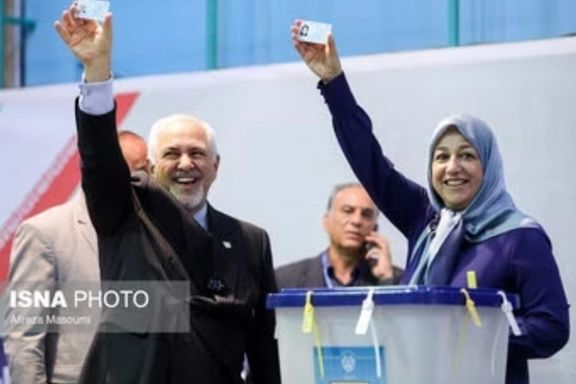
Iranian officials make last efforts to rally voters for Friday runoff
Former FM Javad Zarif and his wife voting in first round of presidential election on June 28, 2024
As the runoff race of the presidential election in Iran approaches, the government and its media are trying to create the illusion of a contested political atmosphere, to attract disillusioned voters.
With over 60% of the electorate abstaining in the first round on June 28th, the Islamic Republic faces a crisis of legitimacy. The boycott and abstention by a sizeable majority has highlighted public disillusionment with both 'revolutionary' and 'reformist' factions, which many Iranians view as two sides of the same coin. The two handpicked candidates have engaged in a series of provocative statements and what many observers call "theatrical infighting" to reignite public interest.
Supreme Leader Ali Khamenei, in his speech on Wednesday, tried to downplay the significance of the low turnout. He suggested that the lack of participation was not an indication of opposition to the Islamic Republic, but rather a sign that people were preoccupied with their personal lives. Yet, this attempt to save face seems to have done little to mask the regime's growing insecurity. Khamenei's directives to both political factions—who, as critics point out, cannot make a move without his approval—are clear: they must rally the disillusioned masses back to the ballot box to restore the government's “dignity."
Adding to the electoral maneuvering, Ali Akbar Salehi, former Foreign Minister and ex-head of the Atomic Energy Organization, entered the fray with comments about Saeed Jalili, the hardline presidential candidate. Responding to allegations that Jalili obstructed the revival of the JCPOA (Joint Comprehensive Plan of Action) during President Ebrahim Raisi's administration, Salehi revealed that “the agreement was nearly finalized and that former Foreign Minister Hossein Amir-Abdollahian was poised to sign it.”
The revelation was an implicit nudge to the electorate: a vote for Masoud Pezeshkian might revive the nuclear deal, although the real obstacle, as everyone knows, is Khamenei himself.
Salehi didn't stop there. He disclosed that the Supreme National Security Council had proposed an additional demand in the last moment that derailed the agreement. Jalili, as leader’s man in the council, he claimed, misrepresented Khamenei’s stance on secret negotiations with the United States. The narrative paints Jalili not just as an obstructionist but as someone who viewed possible diplomatic successes by others as personal competition rather than national imperatives.
The tensions within the government's ranks were further highlighted by Mohammad Javad Zarif, the former foreign minister who has been campaigning for Pezeshkian.
In an Instagram live session, Zarif criticized Jalili, questioning the origins of his "falsehoods" and suggesting they might “come from Israel.” Zarif, who was once criticized for glossing over government policies during Hassan Rouhani’s presidency, is now trying to get more people to vote, accusing Jalili of dishonesty and being responsible for brining on sanctions.
Zarif's plea to the public to reject Jalili on Friday might seem like a genuine call to action. However, many remain skeptical, seeing Zarif's efforts as yet another maneuver orchestrated to lure voters back to the polls. The fear voiced on social media is that, regardless of the election's outcome, the cycle of betrayal will continue—citizens' demands and freedoms will be forgotten, much like during the terms of presidents Rouhani and Mohammad Khatami.
As the second round of voting looms, the government's attempts to stage-manage the election underscore its vulnerability. The Iranian public, increasingly aware of the manipulations, faces a stark choice: participate in what many see as a sham process or continue to express their discontent through abstention. One thing is clear—the facade of electoral democracy in Iran is wearing thin, exposing the government's struggle to maintain its grip on power.
Iran's exiled prince, Reza Pahlavi, has called on Iranians to stay away from ballot boxes Friday, when Iran's next president will be determined in the runoff between Saeed Jalili and Masoud Pezeshkian.
"Put aside the false hopes and fears and join the decisive majority who consciously and courageously said no to the Islamic Republic," Pahlavi said in a video message Wednesday. "Don't let them kill our children in your name and on the back of your vote."
Official figures released by Iran's Interior Ministry put the turnout in the first round held on July 28 at 39.92 percent, the lowest recorded since the establishment of the Islamic Republic in 1979.
Reza Pahlavi on Wednesday quoted a tweet by Iran's Supreme Leader Ali Khamenei about the people's low turnout in the Friday's vote, and said, "Last week the Iranian nation humiliated your illegitimate regime. This week Iranians will again say no to your Election Circus as they seek to reclaim the freedom, dignity & prosperity you have stolen."
"Iran will succeed and relegate your dictatorship to the ash heap of history," he added.
Pahlavi's call for election boycott echoes that of many other Iranian activists who have boycotted Iran's presidential elections, making the turnout the central theme of this campaign.
Another prominent exiled opposition figure, Hamed Esmaeilion, had earlier published a post on X, praising those who did not vote in the first round last week, and inviting them to stay the course.
"We will not return from our path," he wrote. "Iran deserves democracy, and democracy is not achieved by manufactured votes, but by moving on from the Islamic Republic."
On Wednesday, Iran's Sureme Leader admitted that the voter turnout last Friday was "less than expected", but dismissed the idea that those who stayed away from the polls are against the "system."
"Some people may dislike certain officials or even the Islamic system," Khamenei said in a meeting with officials, "but the idea that everyone who did not vote is aligned with these individuals and this mindset is completely wrong."
Since last Friday, the two contenders in the runoff have tried to engage ordinary Iranians in the hope that a portion of the abstaining 60 percent would turn up this week and vote for them.
Canadian immigration authorities have initiated deportation proceedings against five suspected senior Iranian government officials residing in Canada.
The Canada Border Services Agency (CBSA) has alleged that these individuals held senior positions in Iran’s government and has requested the Immigration and Refugee Board (IRB) to conduct hearings on these cases, as reported by Global News.
This move is seen as the Canadian government's response to ongoing appeals from the Iranian diaspora to bar regime-affiliated officials from entering the country, particularly in light of the Iranian authorities' brutal crackdown on the nationwide Woman, Life, Freedom protests in 2022.
The unprecedented protests in Iran were sparked by the death of Mahsa Jina Amini while in custody of the so-called morality police. Iranian security forces crackdown, resulting in the deaths of at least 550 protesters, was condemned as a crime against humanity by a UN fact-finding mission.
The policy previously resulted in deportation orders for Majid Iranmanesh, a science advisor, and Seyed Salman Samani, a former deputy interior minister, according to Global News.
In a departure from previous cases, the hearings for the five latest deportation proceedings are being conducted behind closed doors, with the government withholding their names.
The deportation hearings are typically public unless the individual has filed a refugee claim, as reported by Global News, citing CBSA.
In March 2024, CBC Radio exclusively reported that the Aban Families For Justice, representing victims of the 2019 Iranian protests, were appealing to Canada's Justice Minister Arif Virani to halt the deportation of Salman Samani.
They allege that Samani, a former Iranian deputy interior minister, was complicit in the brutal crackdown that led to the deaths of 1,500 protesters in 2019.
One of the group's founders, Soran Mansournia, told CBC Radio that he hopes Canada would hold Samani accountable for human rights abuses, using "universal jurisdiction."
Despite their letter, Samani's deportation has reportedly not been halted and the group did not receive a response from the Canadian government.
In 2012, Canada severed diplomatic ties with Iran and closed its embassy in Tehran, citing multiple concerns. These included Iran's support for the Assad regime during the Syrian civil war, non-compliance with UN resolutions on its nuclear activities, persistent threats against Israel, and the safety of Canadian diplomats following attacks on the British embassy in Iran.
Further straining bilateral relations, Canada recently escalated its stance by designating Iran's Revolutionary Guards Corps (IRGC) as a terrorist organization. This decision, announced on June 19, was strongly supported by the families of the victims of Ukraine International Airlines Flight PS752, which the IRGC downed in January 2020.
The designation of the IRGC as a terrorist entity, as articulated by a Public Safety spokesperson to Iran International’s Negar Mojtahedi, targets individuals who have actively engaged in or significantly contributed to terrorism and acts of violence. This classification enables Immigration, Refugees and Citizenship Canada (IRCC) to deny visas, entry, or continued residence to these individuals in Canada.
Bashir Biazar, a former Iranian official with links to the IRGC Quds Force who was detained in France for acting as "an agent of influence and agitator" returned to Iran where he received a hero's welcome.
A short clip released by Iran's state-run media showed Biazar getting off a plane in Tehran and being greeted by an Iranian official.
Biazar was an "agent of influence, an agitator who promotes the views of the Islamic Republic of Iran and, more worryingly, harasses opponents of the regime," a French Interior Ministry representative told a hearing in Paris Wednesday.
It is unclear if he has been deported or has willingly returned to Iran on a different arrangement after the end of his "administrative detention."
The decision to release Biazar has sparked criticism from activists who say the French government could have exchanged him with French prisoners held "hostage" in Iran.
Cécile Kohler, Jacques Paris, and Louis Arnaud are among the unknown number of foreign and dual nationals held by Iran, but it is not clear if Biazar's released is linked to any swap deal between Tehran and European countries.
Biazar and his family had lived in France since 2022. Last week, Iran International reported that he had been detained and was about to be deported for his IRGC connections. But Iran's state news agency dismissed such reports, saying Biazar was a "musician."
Iran International has seen official documents from France's Interior Ministry in which Biazar is described as a "former director of Iran's state broadcaster". He is also said to be connected with Unit 840 of the Quds Force, whose mission is to conduct covert operations outside Iran, including the attack and intimidation of dissidents.
Iranian activists in France attempted to keep Biazar in France so that he could be tried for alleged role in broadcasting forced confessions of dissidents on Iran's state TV.
Iran’s Supreme Leader Ali Khamenei admitted on Wednesday that the low participation rate in the first round of presidential elections on Friday was "less than expected" after more than 60% refused to vote.
Despite evidence that many Iranians are deeply disenchanted with the Islamic government, Khamenei dismissed the idea that those abstaining are against the governing regime.
"Some people may dislike certain officials or even the Islamic system itself, just as they freely express these views, but the idea that everyone who did not vote is aligned with these individuals and this mindset is completely wrong," he said in a meeting with officials.
"Maybe they didn't participate in the elections because they had problems, were busy with work, were not in the mood, or simply didn't have the time," Khamenei said, expressing hope that the second round would see more enthusiastic participation.
Since the record low turnout in the March parliamentary elections, Khamenei has consistently attributed non-participation to "laziness," downplaying any deeper societal or political reasons.
Khamenei's rhetoric aims to frame voter apathy as a simple lack of effort rather than a response to underlying discontent or dissatisfaction with the government. A five-year-long economic crisis as well as ever-harsher government suppression of dissent have led to deep dissatisfaction among voters.
While casting his own ballot on Friday, Khamenei emphasized action over inaction. He urged, "Don't be lazy, don't neglect, don't underestimate; participate in all corners of the country."
In a speech leading up to the election last week, Khamenei highlighted the significance of voting, stating, "For us Iranians, voting day is a happy day. The 'Republic' in the Islamic Republic means that the presence of people in the system is integral."
He further questioned reluctance, asserting, "Why would there be doubt? It’s an easy thing to do. Why would anyone not do something that is free, easy, and not time-consuming but has many benefits? Participation is essential for the continuation of the establishment."
Nevertheless, Khamenei has not entirely abandoned hope that the populace will heed his call, even though the nation at large is aware of the sham nature of the polls, when only handpicked candidates were allowed to run amid government control of the media and hundreds of dissidents in prisons.
In a short statement published on his website, Khamenei said of the upcoming Friday voting: "The second round of the presidential election is crucial. Those who love Islam, the Islamic Republic, and the country's progress should demonstrate this by participating in the election."
His comments come amidst Iran's ongoing repression of dissenters. Since its establishment in 1979, the Islamic Republic has consistently violated human rights, often imprisoning and executing those expressing contrary views.
The government employs harsh measures such as arbitrary detention, torture, and unfair trials to silence activists, journalists, and political opponents. International human rights organizations frequently condemn Iran’s crackdown on freedom of speech, assembly, and belief, highlighting Iran's oppressive control over its citizens.
An Iranian judicial official has issued a warning that Tehran will file “criminal cases” against anyone who “obstructs voting” in its presidential election at designated polling stations abroad.
Kazem Gharibabadi, the Deputy of International Affairs of the Judiciary, announced on Wednesday that "criminal cases will be filed and pursued against any Iranian or non-Iranian person abroad who, through "insult and threat or creating fear and intimidation," prevents Iranians from participating in the presidential election voting."
The announcement follows a note of protest sent by the Iranian Embassy in London to the British government on June 30. The embassy claimed that there were "attempts to disrupt the presidential voting process and cause trouble for the voters."
It came after the first round of the presidential election, where some individuals in the UK protested outside Iran's missions against Iranians participating in the polls, urging them to boycott the elections as 60 percent of the populace did.
Opposition activists and many regime critics both within Iran and abroad say that the election is a sham exercise by the government, which has denied real freedom of choice to voters and has brutally suppressed dissent.
Since its establishment in 1979, the Iranian government has faced extensive criticism for its human rights violations, including numerous executions and extrajudicial killings. The government has consistently used the death penalty as a means of political repression, targeting dissidents, activists, and minorities. Widespread reports of torture, arbitrary detention, and unfair trials highlight the methods employed by security forces to suppress critics.
Human rights organizations continue to document the abuses, underscoring the government's ongoing crackdown on freedom of expression, assembly, and belief. Despite international condemnation, the Iranian government persists in these practices, creating an environment of fear and repression for its citizens.