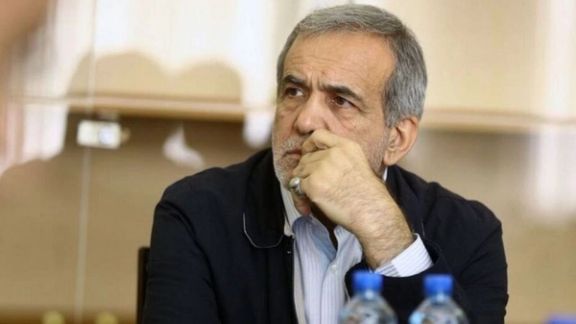
President Masoud Pezeshkian has entrusted the task of selection of three nominees for every position in his cabinet to five committees. Some names are mentioned more than others in Iranian political circles now.
The reform-oriented Pezeshkian’s proposed cabinet must first and foremost meet Supreme Leader Ali Khamenei’s criteria. Additionally, it should not alienate the array of political groups that supported him, nor the ordinary Iranians who voted for change. Furthermore, his proposed cabinet must secure a vote of confidence from a parliament dominated by ultra-hardliners and hardliners.
The president’s powers in the appointment of ministers and even deputy ministers of foreign affairs, interior, intelligence, and defense are particularly limited since these ministries are considered as Khamenei’s domain according to an unwritten law.
These officials are also members of several high state councils by virtue of their position including the Supreme National Security Council.
The following are some of the names flying around more than others in Iranian political circles and the media as nominees for the positions of foreign, interior and intelligence minister.
Foreign minister
Former Foreign Minister Mohammad-Javad Zarif campaigned relentlessly for Pezeshkian. He was largely believed to be offered a prominent position in the cabinet. Zarif announced that he has no intention of accepting any positions in Pezeshkian’s cabinet including the position of first vice president. Reports indicate that he will be a top strategic advisor to the president.
Nevertheless, Zarif who advocates normalization of relations with the West and revival of the 2015 nuclear deal was likely to be fiercely opposed as foreign minister, particularly by supporters of rival presidential contender Saeed Jalili in the parliament. There are some suggestions that he may be appointed as Iran's UN ambassador.
His former deputy Abbas Araghchi who also served as a member of his nuclear negotiation team is among diplomats whose name is most brought out in discussions over the appointment of Pezeshkian’s foreign minister. Araghchi is currently the secretary of the Strategic Foreign Relations Council, a think-tank formed by Khamenei’s order.
Former foreign minister Ali-Akbar Salehi under populist Mahmoud Ahmadinejad (2011-2013) is another candidate suggested for the post. Salehi headed Iran's Atomic Energy Organization from 2013 to 2021.
Intelligence minister
Candidates for the position must be qualified to pronounce independent interpretation of the law Sharia (ijtihad).
One of the figures that meets the criterion is Mostafa Pourmohammadi, the only conservative approved to run in the snap elections. The former deputy intelligence minister who served as minister of justice under Hassan Rouhani from 2013 to 2017 surprised the public during election debates where he defended better relations with the world, more social freedoms for Iranians, andan end to Internet bans.
Iran's new interior minister will be facing many challenges including the issues of hijab enforcement and illegal Afghan immigration.
Some Iranian politicians and journalists claim Pezeshkian has chosen politician and former lawmaker Elias Hazrati as interior minister.
Hazrati served as a division commander in the Revolutionary Guards (IRGC) during the Iran-Iraq War (1980-88) and is currently a member of the central council of the reformist Etemad Melli Party formed by Mehdi Karrubi, one of the leaders of the Green Movement in 2005.
Mostafa Pourmohammadi and Mahmoud Alavi who served as intelligence minister under moderate Hassan Rouhani from 2013 to 2021 have also been suggested as a possible candidate. The latter, also a conservative, supported Pezeshkian in the elections and appeared alongside him at one of the campaign meetings. Alavi is a former member of the Assembly of Experts.
Some have also suggested former reformist lawmaker and politician Majid Ansari as a possible nominee. Ansari, the secretary of the reformist Combatant Clerics’ Association, served as the legal and parliamentary deputy in the cabinet of the reformist Mohammad Khatami and is currently a member of the Expediency Council by Khamenei’s appointment.
Human Rights Watch (HRW) says incoming Iranian President Masoud Pezeshkian must address widespread human rights violations by government agencies, including Iran’s security forces and judiciary.
On July 5, 2024, Pezeshkian won the runoff race of Iran’s presidential elections, defeating his hardline rival Saeed Jalili.
“Incoming Iranian President Masoud Pezeshkian should confront Iran’s egregious human rights abuses, including alarming rates of executions, systemic oppression of women, and brutal repression of ethnic and religious minorities,” said Nahid Naghshbandi, acting Iran researcher at Human Rights Watch on Friday.
“Ending impunity for these injustices is essential for Pezeshkian to show Iranians that the government can address their legitimate, widespread grievances and demands for fundamental change.”
Many Iranian people and civil society groups boycotted the election. State media reported a voter turnout of 39.96 percent in the first round, the lowest in Iran’s presidential election history, though the second round saw an increase to 49.8 percent. The Guardian Council disqualified numerous candidates without explanation, including several prominent government officials.
Pezeshkian will begin his presidency in August, facing significant challenges. Major domestic issues include considerable social discontent, reflected in low election participation and repeated protests, along with a weak economy. The Woman, Life, Freedom movement and the government's response have highlighted the dire state of human rights.
A recent Amnesty International report stated that Iran executed 853 people in 2023, the highest in eight years. By March 20, at least 95 executions had been recorded in 2024.
The Baluch ethnic minority, which makes up five percent of Iran's population, constituted 20 percent of those executed in 2023. A report by Iran Human Rights revealed increased executions targeting ethnic minorities.
A representative of Iran's Supreme Leader Ali Khamenei on Friday called for stricter measures against “improper” hijab and dog walking, as the country's new president prepares to take office.
Yousef Tabatabaie Nejad, the representative of Khamenei in Isfahan province, said in his Friday prayers sermon that “addressing social corruption is essential to curb moral decay in society.”
Recent reports and social media images show "hijab patrol" vehicles and agents back on the streets, a reminder of the Islamic Republic's oppressive tactics. The patrols had been withdrawn after the death of Mahsa Amini, a 22-year-old who died in the custody of the morality police in September 2022, sparking months of protests.
The clerical ruler's new hijab crackdown, dubbed the Nour project, has been plagued by reports of police extortion, theft, and sexual harassment. Human rights organizations, student groups, and activists have condemned these actions as violations of basic freedoms and human rights.
In his Friday remarks, Tabatabaie Nejad insisted that crackdown on "social corruption" including improper hijab and dog walking is necessary.
Muslim clerics claim dogs are unclean, leading to crackdowns that have caused conflict between pet owners and officials.
As Pezeshkian prepares to take office, the renewed focus on hijab enforcement and moral policing highlights the Islamic Republic's relentless control over personal freedoms, further proving that the country's major policies are dictated by Khamenei, leaving presidents with little room for change.
Although some try to present Pezeshkian as a reformist, he has a history of enforcing strict hijab policies. Despite publicly criticizing the treatment of women during his campaign, his voting record in parliament reveals support for restrictive laws on women's rights.
He was recently accused by his former classmate and Germany-based Iranian dissident Mina Ahadi of violently enforcing the hijab on women at a university in 1979, well before it became mandatory.
Ahadi, who studied medicine at the University of Tabriz alongside Pezeshkian, told Iran International that after the Islamic Revolution, a radical group declared that women should wear the hijab, and it was Pezeshkian who was responsible for this group.
Iran's top military commanders from the Revolutionary Guard and the traditional army, met with President-elect Masoud Pezeshkian on Saturday, a week after he won a runoff against a hardline candidate.
The military leaders included Chief of Staff Mohammad Bagheri, IRGC Chief Hossein Salami, Army Commander Abdolrahim Mousavi, Police Chief Ahmad-Reza Radan, and Defense Minister Mohammad Reza Ashtiani.
Despite a history of tensions with some past governments, Bagheri declared, "The armed forces are ready to assist the new government in advancing the country's affairs."
Last week, the IRGC chief-commander had congratulated Pezeshkian on his election victory, stressing the Revolutionary Guard's "all-out preparedness" for enhanced cooperation with the incoming administration.
President-elect Masoud Pezeshkian during a meeting with senior IRGC commanders in Tehran, July 14, 2024
The IRGC, founded after the 1979 Islamic Revolution, has grown into a powerful entity with substantial military, economic, and political influence. Its hardline stance contrasts sharply with the reformist agenda of greater political openness, economic liberalization, and improved relations with the West.
Administrations, like those of Presidents Mohammad Khatami and Hassan Rouhani, pushed for engagement with the West, while the IRGC remains committed to preserving revolutionary principles and resisting Western influence. This has led to frequent power struggles, with the IRGC often undermining their policies and supporting hardline candidates.
Former centrist President Hassan Rouhani sharply criticized the IRGC in 2017 for exerting influence over political and economic affairs. However, Pezeshkian, who is presented by some as a reformer, has pledged to follow policies charted by Supreme Leader Ali Khamenei.
Economically, reformist attempts to curb the IRGC's dominance in sectors like construction, telecommunications, and energy have been met with resistance, as the IRGC seeks to maintain its economic stronghold.
Iran has slammed what it calls "Iranophobic" statements by the office of the Argentine president, as Javier Milei doubles down on countering potential threats from Iran.
Argentina designated Hamas a terrorist organization on Friday and ordered a freeze on the financial assets of the Iran-backed Palestinian group.
President Milei's office highlighted the Palestinian militant group's deadly cross-border attack on Israel last October, which resulted in 1,200 deaths and 250 hostages taken, marking the deadliest assault in Israel's 76-year history. The statement also underscored Hamas' close ties to Iran, which Argentina blames for two deadly attacks on Jewish sites in the country in the 1990s.
Nasser Kanaani, the spokesperson for Iran's Ministry of Foreign Affairs, stated on Saturday that "uncovering the truth and resolving the case definitively is only possible if the relevant parties in Argentina distance themselves from political motives and remain uninfluenced by the interference of third parties."
Kanaani also urged Argentine officials to refrain from anti-Iranian statements and actions, warning against exposing Argentina’s national interests and bilateral relations to the "Iranophobic scenarios of the Israeli-American axis of evil."
Argentina's statements and designations come just days before the 30th anniversary of the AMIA bombing, which killed 85 people and injured hundreds more in Buenos Aires, marking the worst such attack in the country’s modern history. The other attack, on the Israeli Embassy in Buenos Aires in 1992, killed over 20 people. Argentina’s judiciary has accused members of Lebanon’s Iran-backed Hezbollah of carrying out both attacks.
The US, European Union, and several other countries have long designated Hamas, which rules the Gaza Strip, as a terrorist organization.
Since Javier Milei took office as Argentina's president in December 2023, there has been increased focus on national security, especially regarding potential threats from Iran through its alliances with Bolivia and Venezuela.
The Argentine government has expressed concerns about the potential introduction of Iranian agents into the country via Bolivia and Venezuela. Iran has been using these countries as bases to conduct activities linked to terrorism and drug trafficking.
The Milei government has heightened surveillance and border controls to prevent the infiltration of Iranian agents. This move follows the broader strategy of ensuring that the country's security apparatus is robust against any covert operations that might be directed from Iran through its Latin American allies.
The country has formally requested Interpol to arrest Iran’s interior minister, Ahmad Vahidi, for his alleged role in the attack that claimed 85 lives. Argentina has taken a significant step in its pursuit of justice for the victims of the 1992 Israeli embassy and 1994 bombing of AMIA - a Jewish community center in Buenos Aires.
The Iranian pharmaceutical industry is facing a dual crisis of currency shortages and frequent power outages, significantly impacting production and operations.
Mahmoud Najafi Arab, head of Tehran Chamber of Commerce for Industries, Mines and Agriculture (TCCIMA) stated that Iran’s pharmaceutical and medical equipment sectors are struggling to secure both foreign currency and local rials, in an interview with state-affiliated ILNA News agency on Saturday.
"There is a problem of foreign currency supply in all industries, and the pharmaceutical and medical equipment industries are no exception," he stated. This financial strain hinders the companies' ability to obtain the necessary working capital and import essential medicines.
Iran's export revenues have drastically declined because of US oil and banking sanctions. The stringent government control over imports and the private-sector also exacerbates these difficulties, making it increasingly challenging for the industry to operate smoothly.
Adding to the financial woes, power outages have become a regular occurrence, affecting drug production units across the country. "This industry, like other industries in the country, is affected by power shortages, and spends these hot days of the year with power outages," Najafi Arab said. These blackouts, occurring twice a week, disrupt manufacturing processes and contribute to the industry's ongoing struggles.
Persistent power cuts due to aging infrastructure and natural gas shortages have caused significant disruptions in Tehran's industrial hub. Each outage severely impacts industries, taking about 24 hours to restart operations, thereby increasing losses.