Iran’s FM-designate pledges to uphold Khamenei’s policies
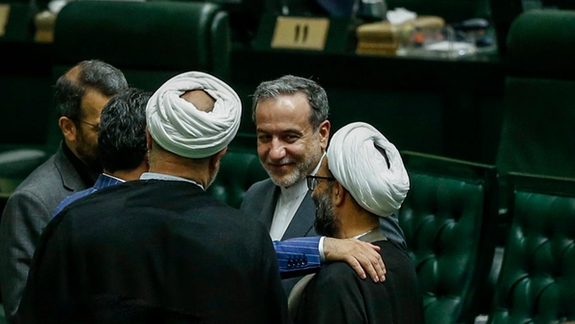
Abbas Araghchi among lawmakers in parliament on Sunday
Parliamentary committees gave their seal of approval to Abbas Araghchi, the foreign minister-designate, as he vowed to uphold the Supreme Leader's policies and continue supporting Iran’s "Axis of Resistance."
During the second day of hearings for President Masoud Pezeshkian’s proposed cabinet, two key ministers received votes of confidence from relevant parliamentary committees. First was Intelligence Minister Esmail Khatib, and during the afternoon session, former nuclear negotiator Abbas Araghchi.
The 63-year-old diplomat, who has served for almost 40 years in the foreign ministry, left no doubt that his duty is to carry out the Islamic Republic’s policies under Ali Khamenei’s direction. "The 'Diplomacy of Resistance,' which is derived from the 'School of Resistance' and the result of the heroic efforts of Martyr Qasem Soleimani in designing the 'Axis of Resistance,' will be at the forefront of the foreign policy of the fourteenth government,” he said.
Araghchi emphasized: We will not lose our way, and unwavering, continuous, and comprehensive support for the cause of Palestine and the Lebanese Resistance, as well as other resistance movements fighting against the oppressive and criminal policies of the Zionist regime, will be at the top of our agenda.
He also vowed to "utilize all our political and diplomatic capacities to…garner support from regional countries and achieve the recognition of the Axis of Resistance actors on the international stage as popular and liberation movements."
Araghchi informed lawmakers that during the six rounds of nuclear talks with the West in 2021, he strictly adhered to Khamenei’s directives and the December 2020 parliamentary law requiring the lifting of US sanctions. He emphasized that, in line with Khamenei’s guidance, his foreign ministry would pursue "an honorable path" to lifting the sanctions. Notably, the foreign minister-designate consistently referred to these efforts as "sanctions-lifting talks" rather than nuclear negotiations.
He also vowed to do his utmost to circumvent sanctions or work to have them lifted. “Regarding sanctions, our policy is based on the recent guidance of the Supreme Leader in his meeting with the honorable members of parliament, focusing on neutralizing the impact of sanctions while simultaneously working to have them lifted. Foreign policy efforts aimed at neutralizing and rendering sanctions ineffective will support the government's objectives,” he stated.
Some regime politicians in Iran have argued that Araghchi’s appointment signals Tehran’s readiness for negotiations with the West. In an earlier meeting with parliamentary committees last week, Araghchi made two points: the 2015 nuclear deal (JCPOA) is beyond revival, and Iran should temper its hostility toward the United States.
However, there was another angle in Araghchi’s remarks last week. He did not mention the need for reaching any agreement that could address the concerns of the United States. Instead, he underlined that diplomatic and military pressure is needed to have the sanctions lifted.
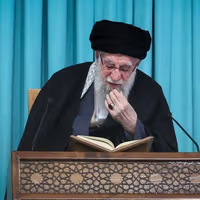
On Sunday, Araghchi emphasized that he will be Khamenei’s “soldier” and expressed pride that Iran’s power has increased in the region and beyond. He also indicated his full agreement with Khamenei’s policy of alliance with China and Russia. "China, Russia, and other countries that have stood by us during difficult times and sanctions, as well as emerging powers and new arenas in Africa, Latin America, and East Asia, will be priorities in the foreign relations of the fourteenth government.”
Regarding relations with Europe, Araghchi repeated Tehran’s position, which aims to de-couple the Europeans from the United States. “If Europe corrects its improper and hostile behavior towards the Islamic Republic of Iran, it will be included in our list of priorities. Finally, our policy toward the United States will be one of 'managing hostility’."
Iran’s new president, Masoud Pezeshkian, was scheduled to present the core of his executive plan during a 2.5-hour speech on the first day of the parliament proceedings to review his plan and cabinet.
However, due to the commotion and disorder in the parliamentary session, he reduced his speech to just 53 minutes, struggling to even read his notes correctly. He ceded the remainder of his time to parliament members to defend him, despite there being ample time under parliamentary rules for both support and opposition.
In his speech, Pezeshkian did not outline a specific plan, contrary to the parliament's expectations. Instead, he stated that his plan is the Seventh Development Plan (approved by the parliament) and the policies endorsed by Ali Khamenei—documents that no one in the current parliament would dare to review or criticize. Moreover, Khamenei’s declared policies and the development plan are general wish lists, not road maps to get things done.
Yet, his remarks, much like his statements during the debates, reveal four key confusions and contradictions that are likely to trouble his administration over the next four years, some of which are already evident in the composition of his cabinet.
Tribe or nation-state
To persuade his Islamist audience, Pezeshkian frequently cites passages from the Qur'an and centuries-old Shiite texts to justify his decision-making process. However, he seems unaware that the words of the Prophet of Islam and the First Shia Imam were articulated within the context of a tribal society in Hijaz, Arabia, 14 centuries ago. Even if these teachings were effective in that era, they cannot serve as a roadmap for the present day. Pezeshkian fails to grasp that Islamism and strict textualism reduce the worldview of Islamists to that of a single Arab tribe, the Quraish, which no longer reflects the complexities of modern life.
Religious texts offer guidance and sermons, not blueprints for effective governance. They do not address the complexities of legislative processes, policy-making, or decision-making in response to evolving needs, principles, institutional contributions, and public opinion.
Foreign enemy or internal ruling class?
Pezeshkian frequently oscillates between blaming imperialism and sanctions for hindering "Islamic rights and justice" and acknowledging the weaknesses, problems, and incompetence of Iran’s rulers. This back-and-forth leaves his administration's direction unclear—whether its focus will be on combating the "system of global domination" or addressing corruption, inefficiency, discrimination, and waste within the ruling class.
As a result of this back and forth, Pezeshkian sidesteps the root causes of the country's problems—namely, anti-Western foreign policy, regional expansionism, and the nuclear agenda. He avoids addressing the diversion and expenditure of resources toward international conflicts and propaganda, the more than one trillion dollars lost due to the nuclear program, and the economic isolation that has shuttered trade opportunities with the world. These issues go far beyond mere differences or incompetence within the ruling class; they are systemic flaws that cannot be ignored.
National unity or gang cohesion
In defending his cabinet and governance approach, Pezeshkian portrays his administration as a government of national unity. However, his unwavering adherence to the opinions and policies of Ali Khamenei and the composition of the cabinet suggest a factional and clique-driven government. Ali Khamenei has consistently represented the interests of Iran's most totalitarian and authoritarian factions, never playing a cross-factional role.
In Pezeshkian’s proposed cabinet, influential factions and mafias within the government have been allocated power in proportion to their influence within Khamenei’s office and the IRGC’s economic empires, military-industrial complexes, and the repression and propaganda apparatus. As a result, Pezeshkian’s administration is neither a government of national unity nor one representing the unity of the Islamic Ummah; rather, it is a government of factional cohesion. In this view, the "nation" is synonymous with the ruling elite and the factions within its ranks.
Implementation or non-implementation: that's the question
Whenever Pezeshkian addresses the country's problems and crises, he retreats to the Islamic idealism of the 1970s. This idealism holds that all issues stem from neglecting Islamic principles, which lead to "wrong and injustice." Khamenei paved the way for Pezeshkian to assume the presidency and secure victory in the engineered elections, aiming to revive this failed Islamic idealism.
In Pezeshkian’s view, the ultimate remedy lies in the word of God, as conveyed by the Prophet, the first Shia Imam, and today, by the Supreme Leader whose decrees are enforced by the state. However, the lived experience under the Islamic Republic has demonstrated that Iran’s current problems and crises are rooted in a government that enforces Sharia orders and rulings to secure absolute, unaccountable power. This approach is at odds with modern common sense, meritocracy, the rule of law, and the principles of limited government.
Amid an escalating electricity crisis in Iran, several citizens have reached out to Iran International, sharing accounts of continuous power outages amid the oppressive heat gripping the country.
These audio and video messages, sent in from various regions, underscore a growing public sentiment that attributes the widespread electricity shortage to what they describe as the "incompetence of Islamic Republic officials."
Over the past several years, the Islamic government has struggled to meet the nation's electricity demand, with repeated failures plunging hundreds of cities and villages into darkness each summer.
This year, however, the situation appears to have reached a critical juncture, as the frequency and duration of blackouts have intensified as the gap between supply and demand has widened.
Citizens, in messages and videos sent to Iran International, have highlighted the ongoing disruptions and expressed their frustration and anger toward the authorities.
Many view the government's mismanagement and misallocation of resources as the root cause of the current predicament.
One resident poignantly remarked, “These officials talk about waging war against Israel, yet they have squandered Iran's resources by funneling money to groups like Hamas and Hezbollah, leaving the nation to suffer the consequences.”
Another citizen from Shahin Shahr, Isfahan, central Iran, sent a video to Iran International highlighting the recurring power cuts in the area. Addressing the country's leadership, he lamented, "For years, you have been waging a global battle over nuclear energy, yet you cannot even ensure a stable electricity supply for the nation." He criticized the government for years of “empty promises about building power plants,” which he says have “only burdened the people with substantial costs.”
"We have made the entire world our enemy—for nothing," he continued. "How long must we live in humiliation? The Islamic Republic only refrains from missteps when it faces external pressure."
On Friday, the ILNA News Agency reported on the growing complaints from residents of Shiraz, who have been enduring frequent and unannounced power outages. These sudden blackouts have disrupted daily life and inflicted heavy financial losses. The report highlighted the cascading effects of these outages, which are manifold—ranging from damage to electrical appliances to the crippling of local businesses.
In some areas, frustration has spilled onto the streets. On Thursday, merchants at the Noor commercial complex in Tehran protested after enduring a six-hour power outage. When their appeals went unanswered, they took their grievances public, blocking traffic and disrupting bus lines until law enforcement arrived and the power was restored.
It appears that the government has prioritized religious ceremonies despite the widespread hardships faced by ordinary citizens and businesses.
On the same day as the Tehran protest, Mohammad Moradi, CEO of the Kermanshah Province Electricity Distribution Company, announced that power supply for Arbaeen pilgrims in the province had been secured. Ninety billion rials had been allocated to ensure stable lighting along pilgrimage routes and facilities.
This announcement has been met with mixed reactions, particularly as it comes at a time when many Iranians are struggling with basic electricity needs.
Each year, Shia pilgrims converge on the Iraqi city of Karbala to observe Arbaeen, a significant religious commemoration. In recent years, many Iranians have begun their pilgrimage from the western regions of Iran, undertaking a long walk to Karbala.
On Tuesday, Tehran City Council member Habib Kashani confirmed that the Electricity Distribution Company had resorted to planned power cuts, acknowledging the necessity of informing residents in advance due to the impact on water supplies in buildings with electric pumps. This admission reflects the broader challenges local and national officials face in managing the country’s energy needs.
In response to the ongoing crisis, some provincial governments have taken drastic measures, continuously shutting down or partially closing government offices since early July. This approach, however, needs to do more to alleviate the underlying issues.
Experts have identified several factors contributing to the current electricity shortfall, including inadequate investment in the power sector, a lack of power plant development, an aging production and transmission infrastructure, and energy prices that have exacerbated the supply and demand imbalance.
As the electricity crisis deepens, the voices of those affected continue to grow louder, painting a stark picture of the challenges facing Iran's energy infrastructure and the mounting public frustration with the government's handling of the situation.
Despite President Masoud Pezeshkian’s defense of his proposed ministers during the first parliamentary confirmation hearing, several lawmakers criticized him for a lack of planning and the "incongruous mix" within the cabinet.
To shield themselves against criticism, Pezeshkian and his ministers emphasized the implementation of the general policies of the Islamic Republic and Supreme Leader Ali Khamenei.
Over the next four days, lawmakers will debate the nominees in alphabetical order by ministry, culminating in a vote of confidence for the entire cabinet on Wednesday.
For each nominee, the relevant parliamentary committee(s) will present their reports, followed by lawmakers speaking for or against the proposed minister after the nominee delivers their address.
Alireza Kazemi, nominated to lead the Ministry of education, was the first nominee to be reviewed. He is one of Pezeshkian’s most controversial nominees for whom reformists have widely criticized him.
In his speech to lawmakers, he enumerated the problems the educational system is facing including lack of money and human resources. He stressed that under his leadership, the ministry would address the “religious identity crisis” and that the “collaboration of home, school, and mosques can create a happier atmosphere for students.
“With Jihadi efforts”, he said, his ministry will educate students to be patriotic and obedient to the Supreme Leader.
Kazemi is an advocate of compulsory hijab and its enforcement in schools.
The Parliament heard from the Education, Research, and Technology Committee's spokesman that the majority of its members had approved Kazemi’s nomination.
Kazemi, who served as acting education minister in President Ebrahim Raisi’s cabinet for several months, met no opposition from the lawmakers none of whom had signed up to speak against him.
Kazemi’s brother, Mohammad Kazemi, heads the Intelligence Organization of the Revolutionary Guard (IRGC).
The second minister to be debated was Sattar Hashemi, the youngest member of the proposed cabinet, nominated to lead the Ministry of Communications and Technology.
The Parliament’s Cultural Committee, dominated by ultra-hardliners from the Paydari (Steadfastness) Party, rejected Hashemi’s nomination in their report to lawmakers, offering little criticism of his plans but presumably opposing him due to his character and political/ideological views.
In contrast, the Industries and Mines Committee unanimously endorsed Hashemi's plans and qualifications in their report.
Several lawmakers who spoke for and against Hashemi brought up the problem of internet anti-filtering software which most Iranians, including online and other businesses, are forced to use to access thousands of blocked websites including social media platforms such as Instagram.
In his speech, Vali Dadashi, an independent who had signed up to speak against Hashemi’s lack of relevant plans to expand access to fast internet, demanded action from the future minister against the so-called “mafia” that controls the hugely profitable anti-filtering software trade.
Many believe those who benefit from the trade have used their influence to impose restrictions on Internet access and will oppose Pezeshkian and his government if they try to lift Internet bans.
The need for anti-filtering software, Dadashi said, doubles the cost of access to the Internet. “Why do people have to pay for anti-filtering software?” he asked.
“Hashemi’s first step should be increasing the speed of the internet and his second to convince the members of the Supreme Cyberspace Council to lift filtering,” Ahmad Fatemi, a lawmaker who supported Hashemi’s nomination, told the Parliament.
The Council formed by Supreme Leader Ali Khamenei’s order in 2012 consists of the president who heads it, the speaker of the Parliament and chief justice, the head of the state broadcaster, and several ministers including the ministers of intelligence and defense. The commanders of the Revolutionary Guards and Police also sit on the Council.
Pezeshkian criticized filtering policies in his campaign speeches and debates. His supporters expect him to oppose these policies as the head of the Council in which hardliners and ultra-hardliners have a near absolute majority now.
A recent phone call, a tweet, and a meeting have sparked hope among supporters of Mohammad-Javad Zarif for his potential return to President Masoud Pezeshkian's cabinet.
Zarif announced his departure from the cabineton August 11, less than two weeks after his appointment to the specially created position of “strategic deputy”. He further said in a tweet Wednesdaythat the President had “graciously” phoned him and the two had held a “sincere conversation”, but he fell short of indicating a change in his circumstances.
Twenty-four hours later, the media reported a meeting between the two men and released a short video that showed Zarif leaving the President’s office with a big smile, saying “I have always been, and will be, an admirer of Dr. Pezeshkian.”
Reformists were struck by Zarif’s resignation, which he described as ‘returning to the academia’, and his allusion to Pezeshkian’s controversial choice of a ‘Principlist’ (right-winger) close to Parliament Speaker Mohammad-Bagher Ghalibaf as his interior minister, which many supporters have criticized.
Reportedly, Pezeshkian has not yet accepted the resignation
Zarif’s meeting with Pezeshkian Thursday evening has given them hope that he and the former Communications Minister Mohammad-Javad Azari-Jahromi who campaigned tirelessly alongside Zarif for Pezeshkian will return to the cabinet.
Some media outlets in Tehran denied any rift between Pezeshkian and Zarif, attributing the latter’s resignation to his disqualification rather than a personal choice. Despite his carefully worded expression of deep dissatisfaction with the composition of Pezeshkian’s proposed cabinet, Zarif clarified that he was not leaving due to "disillusionment or disappointment."
They argued that Zarif’s appointment had to be annulled based on an “overlooked” law passed in 2022 prohibiting individuals with dual citizenship, or those whose family members are dual citizens, from being appointed to "sensitive" positions.
The ban applies to Zarif because his children were born in the United States when he was a member of the Iranian delegation at the United Nations in New York and had “acquired US citizenship”.
Many among Pezeshkian’s supporters have since appealed to him not to let Zarif go, or have expressed deep disappointment with him for allowing his departure. Others who believe Zarif resigned due to his discontent with Pezeshkian’s cabinet have appealed to him not to leave Pezeshkian alone.
Zarif would have had a very slim chance of getting a vote of confidence from the hardline-dominated Parliament if he had been proposed as foreign minister.
His appointment as deputy, for which the approval of the Parliament is not required, had initially appeared as a great initiative by Pezeshkian to give him a high position in his cabinet until the “overlooked” law came into the picture.
Referring to the obstacles Pezeshkian will be facing in choosing his men, including possible objections of security and intelligence agencies, the reformist Ham-Mihan newspaper said in an editorial Wednesday that the President not only has to lift Internet filtering but also the “filtering of human resources” that can bar his allies from his government.
“Contrary to many people’s beliefs, our governance system is very exact. For instance, it doesn’t matter what Mr. Zarif has done in the highest and most sensitive positions in the foreign ministry and how he has defended national interests in the past 46 years. What matters is what kind of passport his children who were born two decades ago when he served in the United States hold,” prominent reformist pundit Sadegh Zibakalam sarcastically said in a tweet Thursday.
An online petition addressed to Zariflaunched on August 13 urged him to “stay and to steer this storm-wrecked ship to a safe shore, for the sake of the people, for the sake of Dr. Pezeshkian, and for the sake of honoring the promises that you made.” The petition was signed by 13,500 on August 16.
OpenAI said on Friday it had deactivated several accounts linked to an Iranian group allegedly exploiting its ChatGPT chatbot to create content to influence the US presidential election and other issues.
The operation, known as Storm-2035, was identified as a covert Iranian influence campaign that utilized ChatGPT to produce and disseminate content on various politically sensitive topics.
According to the Microsoft-backed artificial intelligence company, these included commentary on both sides of the US elections, the Israel-Hamas conflict, Israel's participation in the Olympic Games, and issues related to politics in Venezuela.
The content was shared through social media accounts and websites designed to mimic legitimate political news outlets, aiming to sway US voters.
OpenAI reported that the operation seemed to have had minimal impact in terms of audience engagement. The majority of the identified social media posts garnered little to no interaction, with few likes, shares, or comments. Additionally, there was no significant evidence of the associated web articles being circulated on social media platforms.
Earlier in August, a Microsoft threat intelligence report highlighted Storm-2035's activities, among other things, in orchestrating influence campaigns designed to sway voters, particularly in critical swing states.
These operations also included efforts to gather intelligence on political campaigns, potentially laying the foundation for future interference. The report disclosed that Storm-2035 established covert news sites aimed at left-leaning and conservative US voters, utilizing AI to plagiarize content and propagate polarizing political narratives.
Additionally, another group, Sefid Flood, has been preparing since March for potentially extreme influence operations, including intimidation or incitement of violence against political figures, with the intent to create chaos, undermine authority, and erode confidence in the integrity of elections.
Also, in May, OpenAI published an unprecedented report revealing that it had identified and disrupted five online campaigns that sought to deceptively manipulate public opinion and influence geopolitical dynamics. These efforts were orchestrated by state actors and private entities across Russia, China, Israel, and Iran.
This development unfolds against the backdrop of an increasingly competitive race between Democratic candidate Kamala Harris and her Republican opponent Donald Trump, as they approach the pivotal November 5th presidential election.
Last week, Trump disclosed that his campaign had been compromised in a cyberattack, which he attributed to a phishing email orchestrated by an Iranian hacking group.