Ceasefire in Gaza 'unrelated' to Iran's retaliation plans, says Tehran
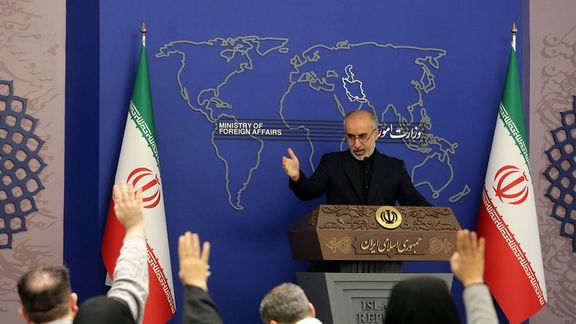
Iran's Foreign Ministry Spokesman Nasser Kanaani during his weekly briefing on August 19, 2024
Iran's Foreign Ministry said on Monday that the ongoing discussions for a ceasefire in Gaza have no bearing on Tehran's plans to retaliate against Israel for the killing of Ismail Haniyeh in Tehran on July 31.
The ministry's spokesman Nasser Kanaani's comments reflect Iran's position amid escalating tensions in the Middle East, as the country remains determined to avenge the killing of Haniyeh.
"We are not looking for intensification of insecurity in the region. We support efforts with good intentions regarding the ceasefire. Meanwhile, we insist on Iran's legal right in realizing its rights and punishing the aggressor and creating deterrence against a terrorist regime. We will use it at the appropriate time," he said.
The assassination of Haniyeh in the Iranian capital has not been claimed or denied by Israel, a move that only heightens the already tense relations between Tehran and Tel Aviv.
The conflict in Gaza, which began on October 7 of last year with an attack by Hamas militants on Israeli soil killing almost 1,100 people, has dragged on for ten months. Over 40,000 people have been killed in the Gaza Strip according to Palestinian health authorities. Despite ongoing negotiations, the prospects for a lasting peace remain bleak, with both sides entrenched in their demands.
The US, under the leadership of Secretary of State Antony Blinken, has been pushing for a ceasefire, labeling it "probably the best, maybe the last opportunity" to achieve peace in the region. However, Kanaani accused the US and Israel of using the negotiations as a tactic to further their own political goals. "The ball is in the US and the Zionist regime’s court," he asserted.
“The US government must show whether the holding of these negotiations is a political maneuver to achieve its own political goals and buy time for the Zionist regime (Israel) to continue the killing of the Palestinian people or is actually meant to create conditions to establish a ceasefire,” Kanaani went on to say.
Amid the diplomatic maneuvers, Iran's defense policy and its support for Hamas and Hezbollah remains unchanged. Proposed Defense Minister Aziz Nasirzadeh for President Pezeshkian administration reiterated on Monday Iran's support for the "Resistance Front." Nasirzadeh pledged to bolster military exports to Iran's allies, despite international sanctions imposed on Tehran for its involvement in the Ukraine war, where it supplied explosive drones to Russia.
“The Resistance Front is not separate from us; when we talk about the armed forces, the Resistance Front is also included," Nasirzadeh declared, signaling Iran's intention to continue its controversial military activities.
He also underscored Iran's military strength as a key factor in deterring enemy aggression: "Our deterrence and power prevent the enemy's audacity."
Yasser Hashemi, the son of Iran’s former president and influential cleric Akbar Hashemi Rafsanjani, publicly criticized ex-President Hassan Rouhani's handling of his father's death.
In a note, he accused Rouhani's administration of rushing to close the case surrounding Rafsanjani's death.
Hashemi's criticism came after the resignation of former Foreign Minister Mohammad Javad Zarif from Masoud Pezeshkian’s Strategic Council for Transition.
On August 11, Zarif posted on Instagram, expressing his dissatisfaction with the lack of progress in the ministerial selection committees and his inability to make a difference in this regard. He wrote, "I am ashamed... These shortcomings have set the course for me to continue at the university."
Addressing his note to Zarif, Hashemi did not shy away from drawing parallels between the treatment of his father by Rouhani’s inner circle and the actions of Masoud Pezeshkian’s allies.
Photos of former President Ali Akbar Hashemi Rafsanjani on the cover of Iranian newspapers to mark his seventh death anniversary (January 2024)
According to him, Rafsanjani, who played a crucial role in supporting Rouhani during the 2013 presidential election, was met with disrespect by Rouhani’s close associates after the election.
Hashemi singled out Hossein Fereydoun, Rouhani's brother, as well as Mahmoud Vaezi the chief of staff of Rouhani and Mohammad Baqer Nobakht, the Head of Plan and Budget Organization, for their behavior towards his father, noting that even Rouhani himself had shown "unkindness" and "ingratitude" towards Rafsanjani.
On January 8, 2017, it was announced that Rafsanjani had suddenly died after swimming at the Koushk pool, a facility belonging to the Expediency Discernment Council he chaired. Officially, his death was attributed to a "heart attack," but suspicions quickly arose, fueled by Rafsanjani’s complex political legacy.
Former President Ali Akbar Hashemi Rafsanjani's son Yasser Hashemi
Yasser Hashemi suggested that the intelligence ministry under Rouhani, along with other security agencies, was more concerned with swiftly closing the case than with providing a thorough and transparent investigation.
“The intelligence ministry of the eleventh government, instead of convincing Iranians and the world, alongside other intelligence and security agencies in the country, hurried to close that perpetually open case,” he added.
Rafsanjani's family has consistently voiced concerns that he may have been murdered, citing several suspicious factors. These include delays in transporting him to the hospital, the lack of access to CCTV footage from both the swimming pool and his office, the absence of a post-mortem examination despite their requests, a hurried burial, and the disappearance of highly confidential documents, such as his diaries and last will and testament, from his office safe shortly after his death.
In 2019, Rafsanjani’s daughter, Fatemeh Hashemi, revealed in an interview with Etemad newspaper that two months before her father's death, two individuals had approached her at the university, warning that her father “would be killed in a way that would make it appear as a natural death.”
Fatemeh Hashemi, the daughter of the former President Ali Akbar Hashemi Rafsanjani, speaking during a ceremony to mark the seventh death anniversary of her father in Tehran (January 2024)
Despite the warnings, the official investigation, led by Ali Shamkhani, then Secretary of the Supreme National Security Council, concluded that Rafsanjani's death was "completely natural, without any ambiguity."
Rafsanjani's other son, Mohsen Hashemi, stated in an interview published by the reformist Etemad Online website on January 15, 2022, that the Islamic Republic had adopted a policy of attributing his father's death to natural causes. He further criticized the investigation conducted by the Supreme Council of National Security, describing it as "superficial."
Mohsen Hashemi in front of a portrait of his father
Rafsanjani's death is not an isolated case. The Islamic Republic has a history of suspicious deaths among its officials. One such case is that of Mohammad Rouhani, the son of President Hassan Rouhani, who was murdered in his home located on a military base in southern Tehran in 1996. At the time, Mohammad Rouhani was a flight student, and his death has been shrouded in secrecy. Hossein Mousavian, a former Iranian diplomat and deputy to Rouhani when he headed the Supreme National Security Council, told the Time magazine that Mohammad Rouhani was killed for political reasons. Yet, the details of his murder have never been fully disclosed.
Mousavian revealed that Hassan Rouhani pursued the matter for years but eventually decided to remain silent and not pursue the issue further.
As the US gears up for the 2024 presidential elections, Republicans are amplifying Iran concerns with GOP leaders saying Tehran may declare itself a nuclear weapons state this year.
On Sunday, Rep. Mike Turner, Chairman of the House Intelligence Committee, warned that Iran could declare itself a nuclear power "by the end of the year," a development he attributed to the Biden administration's lenient policies towards Tehran.
"What we see now with this administration, [Iran] might declare themselves a nuclear weapons state by the end of this year, with the reports have been- news reports have been out stating that there is a possibility," Turner said Sunday on CBS.
Turner, a Republican from Ohio, defended recent comments by former President Donald Trump, who has taken a softer tone on Iran while emphasizing the necessity of preventing the country from obtaining nuclear weapons. Last week, Trump said, "They can't have a nuclear weapon, and we were all set to make sure that they don't have a nuclear weapon," adding that the situation would drastically change if Iran were to achieve nuclear capability.
Iran's nuclear program has been a persistent source of global concern. While Tehran maintains its nuclear activities are purely civilian, the accelerating pace of uranium enrichment to levels far exceeding those required for energy production raises serious questions.
The International Atomic Energy Agency (IAEA) has repeatedly reported that Iran is not completely transparent about its nuclear advancements, but the international community's response has been largely limited to US-led sanctions.
Iran International reported last week that the country is intensifying its covert nuclear weapons program, bringing it closer than ever to developing a nuclear bomb. These claims echo earlier statements by high-ranking Iranian officials. Ali-Akbar Salehi, former head of Iran's nuclear agency, cryptically implied in early 2024 that Iran possesses all the components necessary for a nuclear weapon. Similarly, Kamal Kharrazi, a top advisor to Supreme Leader Ali Khamenei, admitted in 2022 that Iran has the technical capability to build a nuclear bomb but insisted it has no such intention.
These statements, coupled with the regime's increasingly assertive rhetoric, paint a disturbing picture of a country determined to expand its nuclear capabilities.
Islamic Republic officials have repeatedly stated that according to a fatwa (Islamic decree) by the Supreme Leader, the construction of an atomic bomb is not on Tehran's agenda. However, few in the international community believe in a fatwa that can be revoked at any moment.
According to Rep. Turner, "There is a possibility" that the Supreme Leader changes his decision and “Iran declares itself a nuclear weapon state by the end of the year.”
The concern over Iran's influence extends beyond its nuclear program. Turner highlighted recent reports of Iranian cyberattacks targeting the Trump and Biden-Harris campaigns, as well as an alleged Iranian plot against Trump.
He criticized the Biden administration for not holding Iran accountable for these actions, suggesting that the lack of a strong response has emboldened Tehran. “The Biden-Harris Administration must hold Iran accountable and make it clear that any attempt by Iran to murder former President Trump or members of his administration is an act of war.”
Critics of the Biden administration, including Turner, argue that the current US leadership has given Iran the "flexibility and freedom" to advance its nuclear ambitions and meddle in US elections.
Turner contrasted this with Trump's "maximum pressure campaign," which he claims had Iran "on the ropes" economically and militarily.
Another facet of the Iran issue that has captured media attention in recent weeks is Tehran's influence network in Washington. The controversy gained momentum as Vice President Kamala Harris has been accused of stonewalling questions about her national security adviser's purported ties to Iran.
Senator Tom Cotton accused the Biden-Harris administration of appeasing Iran, even as its proxies continue to attack Israel with impunity. "The ayatollahs should not have sympathizers in the White House," Cotton asserted.
As the election season heats up, the Republican focus on Iran is likely to intensify, with GOP candidates framing the issue as a matter of national security and a referendum on the Biden administration's foreign policy.
The Iranian government executed at least eight more prisoners early Monday morning, according to reports from human rights groups, with hundreds already hanged in 2024.
This latest round of executions, which took place in Yazd and Shiraz prisons, is part of a broader trend that has seen the number of state-sanctioned killings skyrocket in 2023 and 2024, drawing international condemnation and sparking renewed calls for an end to the death penalty in Iran.
The systematic execution of prisoners has become a routine practice, drawing condemnation from international human rights organizations. As the Iranian government intensifies its crackdown on dissent, political prisoners in the women's ward of Evin Prison have vowed to continue their fight against the death penalty, despite the brutal pressures they face.
Haalvash, a website dedicated to Baluch community news, reported that five individuals were executed in Yazd Prison. These included three Baluch citizens and two Afghan nationals, all condemned on charges related to drugs or murder. The Oslo-based Iran Human Rights organization confirmed that three more people were executed in Adelabad Prison in Shiraz too.
A masked executioner prepares a noose for a public hanging in Iran
Amnesty International says 853 people were executed in Iran in 2023, marking the highest number of executions in the country in the last eight years. This figure represents a 48% increase from 2022 and a 172% spike from 2021. Iran's Islamic government executed 345 people this year, until August 9. The only time when there were fewer execution was during election periods in March and June.
This wave of executions is part of a broader strategy by the Iranian government to instill fear and suppress any form of resistance. Since the nationwide protests in 2022, triggered by the death of Mahsa Amini in morality-police custody, Iran has weaponized the death penalty as a means of crushing dissent and tightening its authoritarian grip on the nation.
Meanwhile, Maryam Yahyavi, a political prisoner in Evin Prison, confirmed reports of a recent raid by guards on women protesting death sentences. In a letter published Sunday, Yahyavi described the violent crackdown: "They gathered all their strength in their arms and struck us down."
The women had gathered as part of the “No to Executions Tuesdays” campaign, protesting the execution of Reza Rasaei, a 34-year-old Iranian arrested during the 2022 anti-government protests in Kermanshah. Rasaei was executed earlier this month, and those who dared to protest his death faced repercussions, including beatings and a ban on visits and phone calls.
Despite the measures, the resolve of political prisoners remains unshaken. Yahyavi stressed that their opposition to the death penalty would continue unabated.
Another political prisoner, Golrokh Iraee, also emphasized in a letter published Monday that all citizens, regardless of their political stance, must condemn and actively oppose the death penalty.
The UN High Commissioner for Human Rights, Volker Türk, recently expressed deep concern over the ongoing executions in Iran.
Over the past decade, the Middle East has witnessed a surge in drug manufacturing and trafficking, largely fueled by the Syrian conflict, with Iran proxies playing a major role.
The security vacuum and collapse of government control have turned the country into a fertile ground for this illicit trade, with Syria and Iran establishing it as a central hub for drug production and distribution in the region.
Captagon, a drug combining amphetamines and caffeine, plays a pivotal role in the illicit drug trade orchestrated by the two countries. These allies appear to have strategically identified Captagon as the most effective substance for penetrating markets in Saudi Arabia, the UAE, and other Arab states bordering the Persian Gulf, owing to its low production cost and widespread availability.
As the world's leading producer of Captagon, Syria in all likelihood uses the drug trade as a crucial revenue stream for Bashar al-Assad's regime. Smuggling operations, facilitated by Iran-linked militias, channel Captagon into Persian Gulf countries, turning this trade into more than just an illicit economic activity – serving as a major financial lifeline for numerous armed groups, further fueling violence and instability across the region.
Iran-aligned militant groups in Lebanon and Iraq, including Hezbollah, Kata'ib Hezbollah, and Asa'ib Ahl al-Haq, play a significant role in smuggling Captagon, capitalizing on their influence over local governments. Despite concerted efforts by Jordan, Saudi Arabia, and the UAE to combat the Captagon trade—ranging from airstrikes to targeting traffickers and their warehouses—these measures have had limited success in curbing the flow of the drug.
Addressing the growing challenge of Captagon may require Arab countries to consider adopting new strategies, such as shifting the focus from punishment to treatment for users, enhancing law enforcement practices, and improving intelligence-sharing among regional nations.
The situation could also benefit from increased support and assistance from the United States. With the looming threat of Captagon being overtaken by even more destructive substances like methamphetamine, there is a sense that efforts to combat drug trafficking may need to be intensified. This could include targeting methamphetamine labs, cutting off supply chains, and closing avenues that might exacerbate the drug problem.
The rise of Captagon
Since the onset of the Syrian conflict in 2011, the country has experienced a severe decline in security and a loss of government control across vast regions. This security vacuum has allowed warlords and armed groups to take over key areas, exploiting them for various illicit activities. In the absence of government oversight, drug production factories have rapidly proliferated throughout Syria. These facilities have become major producers of Captagon, often referred to as the "poor man's cocaine," a drug containing amphetamines, caffeine, and theophylline.
Numerous reports suggest that Syria is responsible for producing around 80% of the world's Captagon, solidifying its status as the undisputed "Captagon capital." The Syrian regime stands accused of actively facilitating the production and export of Captagon to generate economic profits, particularly in the face of international sanctions, though the government continues to deny these allegations.
These factories are often operated by armed groups affiliated with the Syrian regime or supported by Iran, further complicating efforts to combat the Captagon trade. The drug trade has evolved into a crucial source of funding for military activities within Syria, exacerbating the conflict and prolonging its duration. Captagon is primarily smuggled into Jordan and Gulf countries, where authorities are intensifying efforts to curb the trade through stricter laws and large-scale seizures. The impact of the Captagon trade, however, extends well beyond Syria's borders, threatening the social and economic security of neighboring countries and the broader Persian Gulf region.
Warlords and drug lords
Warlords in Syria have become key organizers of the manufacturing and distribution networks within the drug trade. Captagon has become one of the most important sources of income for these warlords, providing them with the necessary funding to continue their military and political operations.
These chieftains have established a complex network of factories and logistical routes to smuggle drugs out of Syria. Their networks include alliances with other armed groups, human traffickers, and external parties, making tracking and stopping their operations extremely difficult. The operations are often managed by individuals with military and political influence in their areas of control.
Iran, playing a crucial role, uses the drug trade as part of a broader strategy to destabilize the region, exploiting weak security apparatuses and ongoing wars to expand its influence. Tehran’s proxy militias use profits from the Captagon trade to fund their terrorist and military activities, further complicating the security situation in the region.
Captagon is predominantly smuggled into countries such as Saudi Arabia and the UAE through intricate land and sea routes. The regular seizure of hundreds of millions of Captagon pills underscores the vast scale of production and the significant demand for this drug in the region.
Exacerbating violence and instability across the region, the implications of the Captagon trade naturally reach far beyond Syria's borders. This makes the fight against the Captagon trade a pressing regional security challenge, necessitating international cooperation and coordinated efforts among the affected countries.
Target markets
Driven by their dense populations and robust economies, the countries bordering the Persian Gulf represent a lucrative market for drug trafficking networks – making them prime targets for illicit activities.
Iran also plays a pivotal role in this context. International reports implicate Iran as a key player in smuggling networks, with drugs being routed through Iranian territory to reach Persian Gulf countries.
In response to the growing drug trafficking challenges, particularly from sources like Lebanon and Syria, Persian Gulf countries have taken several measures, such as banning imports from these regions and tightening inspection procedures at border crossings. The formation of joint task forces aimed at dismantling smuggling networks and prosecuting offenders on an international scale reflects a concerted effort to address the issue. However, the escalating Captagon trade presents significant obstacles, with corruption, strained resources, and the complexity of smuggling routes complicating enforcement efforts.
Despite ongoing security campaigns, the difficulty in curbing the trade underscores the challenges these countries face. There is a noticeable focus on enhancing security coordination with neighboring states and developing comprehensive strategies to combat drug trafficking. This includes investment in modern technology and increased cooperation with international organizations for intelligence sharing. The multifaceted approach highlights the complexity of the issue and the need for sustained, collaborative efforts to mitigate its impact.
Impact on healthcare systems, communities
The drug trade, particularly the proliferation of Captagon, has profound impacts on communities in Persian Gulf countries and Syria. Users face severe health consequences, including addiction, loss of functional capacity, and a rise in drug-related crime. The financial strain on healthcare systems, as they attempt to manage the fallout, further exacerbates the burden on public institutions.
In light of these challenges, there is a growing recognition of the need to bolster preventive and treatment strategies to mitigate the effects of addiction on communities.
One key indicator of Iran’s prolonged economic struggles is the government’s reliance on borrowing from its own banks and printing money, a practice that intensified after the re-imposition of U.S. sanctions in 2018.
Iran's state debt to the banking system has surged by 138% over the past three years, reaching 15,600 trillion rials (approximately $32 billion at the official exchange rate and $26 billion at the open market rate), according to Central Bank statistics.
During his presidential campaign, Ebrahim Raisi—who died in a helicopter crash on May 19, 2024—had pledged not to borrow from the country's banking system. However, Central Bank data reveals that government borrowing from banks nearly doubled, increasing 2.5 times since Raisi assumed office in August 2021.
Raisi administration officials repeatedly claimed that the administration ceased borrowing from the Central Bank. However, statistics from the institution show that government debt to the Central Bank has not only continued but surged by 72% year-on-year as of June 2024 in the last year of his presidency.
In addition, the government has intensified its indirect borrowing from the Central Bank. This approach involves the Central Bank providing substantial loans to domestic banks, enabling the government to borrow extensively from these institutions alongside its direct borrowing.
For example, borrowing by domestic banks from the Central Bank in June 2024 was 2.7 times higher than in the same month the previous year and nearly 5.5 times higher compared to when President Raisi's administration took office.
During this period, the Central Bank lent 5,440 trillion rials (approximately $9 billion at the open market exchange rate) to the country’s banks, which then loaned 6,260 trillion rials to the government.
The potential consequences remain uncertain, especially given that the Iranian rial has lost more than half of its value over the past three years. The cycle of loans between the Central Bank and domestic banks, eventually funneling to the government, could have significant repercussions. A substantial portion of the funds received by the government has effectively diminished in value due to the severe devaluation of the rial during this period.
Moreover, seven of Iran's major banks have collectively accumulated losses totaling 4,600 trillion rials, casting doubt on their future stability.
In summary, despite the Raisi administration's pledge to avoid borrowing, the government has taken out loans exceeding 9,000 trillion rials from the Central Bank and other domestic banks over the past three years. Most of this borrowing was done directly by the government, with the remainder undertaken by state-owned companies and organizations.
The primary driver of this extensive borrowing is the persistent and severe budget deficit. While the Central Bank has stopped publishing reports on the government’s budget performance since June 2022, its latest available data indicates that in the first year of Raisi’s presidency, the government faced an operational deficit of approximately 4,730 trillion rials ($8 billion). Even after accounting for the sale of capital assets, the budget deficit remained at 2,160 trillion rials ($3.6 billion).
The government's reliance on borrowing to cover budget deficits is not unique to the Raisi administration; it has been a common practice since the imposition of U.S. sanctions in 2018, dating back to President Hassan Rouhani's tenure.
Liquidity and Inflation
The extensive borrowing in recent years has resulted in a staggering liquidity level of 83,540 trillion rials (approximately $139 billion at the open market exchange rate), which has doubled since 2021. This surge in liquidity has contributed to an annual inflation rate exceeding 40% in Iran in recent years.
It’s important to note that only a few countries worldwide experience such high and persistent inflation. For context, the global average inflation rate last year was 6.8%, while Iran’s was 41.5%. The relatively high global inflation rate is largely attributed to Russia’s invasion of Ukraine and ongoing tensions in the Middle East; otherwise, it has typically hovered around 3% in previous years. The International Monetary Fund (IMF) forecasts global inflation to decrease to 4.5% next year, while Iran's inflation is projected to remain high at 32.5%.
Additionally, the National Development Fund of Iran reports that the government has borrowed $100 billion from this institution and is currently unable to repay it. The total debt owed by the government to banks and the National Development Fund now amounts to three years' worth of the government's general budget, with no clear plan for how these debts will be settled.
Beyond these borrowings, the government also owes significant amounts to private companies across various sectors, including construction, pharmaceuticals, private electricity plant owners, and wheat farmers.
According to the Central Bank's report, the Raisi administration has managed to settle approximately $4.5 billion in external debt. As of June this year, Iran's foreign debt stands at around $4.363 billion, with commitments to repay $2 billion of this debt in the short term and the remainder in the medium term.