Russia uses large number of Iranian drones in attack on Ukraine
People take cover inside a metro station during a Russian missile and drone strike, amid Russia's attack on Ukraine, in Kyiv, Ukraine August 26, 2024.
Russia has carried out another round of large-scale attacks on Ukraine, using Iranian-supplied drones and possibly North Korean missiles to strike important infrastructure and cities across the country.
The sound of explosions rang out in central Kyiv on Monday morning during rush hour as Ukraine's military warned of a massive Russian missile attack following waves of drone attacks in the early hours. According to reports by Ukraine’s air force, Russia had 11 TU-95 strategic bombers in the air to launch cruise missiles.
At least three people were killed, and several were wounded with reports of damage to energy infrastructure.
The Russian military launched missiles from the Caspian Sea, with aircraft taking off from several airfields. Additionally, missiles were launched from Black Sea carriers, and a massive raid by Russian attack drones was reported in various regions in Kyiv and other cities.
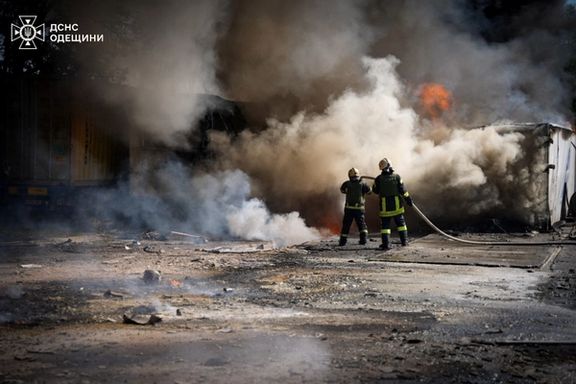
Firefighters work at the site of a Russian missile strike, amid Russia's attack on Ukraine, in Odesa region, Ukraine August 26, 2024.
More than a half of Ukraine's regions were struck Ukraine's Prime Minister Denys Shmyhal said.
"Today, 15 regions were affected by a massive Russian attack. The enemy used various types of weapons: drones, cruise missiles, and Kinzhals (supersonic missiles). There are wounded and dead," Shmyhal said on the Telegram messaging app.
President Volodymyr Zelenskyy said that Russia attacked Ukraine with over 100 missiles, and about 100 drones, confirming that the country’s energy sector saw a lot of damage.
Russia primarily employs Iranian drones, particularly Shahed models, as suicide drones in its conflict against Ukraine. The exact number of Shahed drones used in the Monday attack is not released yet. Iran's support for Russia's military actions has drawn significant international scrutiny.
Since mid-2022, Iran has reportedly supplied Russia with over a thousand kamikaze Shahed UAVs, which have been extensively used to target civilian infrastructure and cities across Ukraine.
In March, British Defense Secretary Grant Shapps accused Iran of supplying Russia with ballistic missiles for use in Ukraine, claiming the regime is a "bad influence" not only on the Middle East but also in Europe.
Approximately 15 missiles and 15 drones targeting the capital of Kyiv were downed, Serhiy Popko, head of Kyiv's military administration, wrote on Telegram Monday.
Additionally, the Ukrainian president's chief of staff, Andriy Yermak, called on Kyiv's allies to allow long-range attacks on Russia with Western-supplied weapons. "Such a decision will accelerate the end of Russian terror," Yermaksaid on Telegram messenger.
The Operational Command of the Polish armed forces said on X that Polish and allied aircraft had been activated after Russia launched the attack which also targeted regions in Ukraine's west near the Polish border.
Ukrainians have been expecting a major Russian missile attack for some time. The US embassy issued a warning last week of an elevated risk of attack around Ukrainian Independence Day, which Ukraine marked on Saturday.
Ukraine has itself stepped up its long-range drone attacks on Russia striking military and industrial targets. Ukraine had no powerful long-range weapons at the start of the war, but has since developed many models of long-range attack drone and used them to hit targets deep inside Russia, ranging from oil refineries, weapons depots, to military airfields.
Over the weekend, Zelenskiy said Ukraine had developed a new "drone missile" that had been used to attack Russia and was more powerful and faster than other hardware in Kyiv's arsenal.
Abbas Araghchi, the newly appointed Iranian Foreign Minister, has declared that the revival of the 2015 JCPOA nuclear deal with the six major world powers is "untenable in its current form."
In a Friday interview, Araghchi stated that rather than merely reviving the deal, "the agreement needs to be reopened" to allow for essential amendments. However, he clarified on Saturday that this does not imply the deal's "death."
However, Iranian experts permitted to speak in Tehran's media offer differing solutions. One expert advocates for comprehensive negotiations between Iran and the United States to resolve all outstanding issues, while another suggests that the West should accept the reality of Iran's uranium enrichment and focus on securing an agreement that prevents the development of nuclear weapons.
In 2015, Iran and major world powers (P5+1) signed the Joint Comprehensive Plan of Action (JCPOA), aiming to curb Iran's nuclear activities in exchange for sanctions relief, with Araghchi playing a key role in the negotiations. In 2018, President Trump unilaterally withdrew from the accord, citing its shortcomings, including its failure to address Iran's missile program.
Efforts to revive the deal in 2021 and 2022 under the Biden administration, which opposed Trump's withdrawal, were unsuccessful. Western countries accused Tehran of rejecting proposals mediated by the European Union.
Araghchi pointed to two significant shifts in the international political landscape—the wars in Ukraine and Gaza—as key factors that have rendered the revival of the JCPOA impossible. He remarked, "The current picture differs from what it was before.”
Since mid-2022, Tehran has provided Russia with weapons, including Shahed drones used in the Ukraine conflict, prompting sanctions from the US, UK, and EU for violating UN Security Council Resolution 2231.
Following Hamas' attack on Israel on October 7, Iran intensified its activities against American and Israeli interests by deploying armed groups it supports across the Middle East. Consequently, in May, the EU broadened its sanctions to include drones, missiles, and Iran's backing of armed groups in the Middle East and the Red Sea region, where Iran-backed Houthi forces have disrupted global shipping since November.
However, a former Iranian diplomat contends that Araghchi's reasons for not reviving the JCPOA are less significant than two other critical factors that complicate any attempt to restore the deal.
“First, Iran's substantial advancements in enrichment technology and related equipment over the past five years may make it challenging, if not undesirable, for Iranian officials to revert to the JCPOA's restrictions. Second, the US may struggle to re-establish the so-called one-year nuclear breakout time, potentially leading to a reluctance to reengage with the JCPOA,” Kourosh Ahmadi, a former Iranian diplomat in United Nations, told Entekhab, a Tehran-based relatively independent outlet.
In July, US Secretary of State Antony Blinken remarked that Iran's nuclear breakout time—the period required to produce sufficient amount of 90% enriched uranium for a bomb—has likely been reduced to "one or two weeks."
Earlier this year, Rafael Grossi, the head of the UN's nuclear watchdog, warned that Iran could be capable of producing a nuclear weapon within weeks rather than months. Meanwhile, under the terms of the JCPOA, uranium enrichment was strictly limited to a cap of 3.67 percent.
In the interview, Ahmadi reiterated his longstanding belief that a broader, more holistic approach would best serve Iran's interests. However, in this latest discussion, he conceded that Iran may not be ready for such an expansive strategy, suggesting that the most practical step would be to rewrite the JCPOA.
Ahmadi’s holistic approach involves negotiating with the US on various issues rather than focusing solely on the nuclear file. He argued that the JCPOA was a "single-issue" agreement centered on nuclear concerns, while sanctions related to terrorism and human rights violations remain in place.
In a bold statement during a July interview, Ahmadi had gone even so far as to describe Donald Trump as a "practical" man, suggesting that Iran could have potentially struck a deal with him.
"Putting aside Trump's shortcomings, we must focus on what our national interests demand. Those interests may require us to engage in dialogue, even with adversaries. After all, even North Korea sat down to negotiate with Trump,” Ahmadi said.
Another foreign policy expert in Tehran, Abdolreza Farajirad, told the semi-official ILNA website that it would be unacceptable for the Islamic Republic to give up 60% enrichment and return to the 3.67% JCPOA limit. Therefore, the West should drop the issue of enrichment in its quest to reach an agreement with Iran. Instead, the emphasis should be a ban on developing nuclear weapons.
Farajirad also acknowledged that Iran's regional activities are a matter that must be addressed. However, his proposal for a ban on nuclear weapons overlooks the fact that if Iran is allowed to maintain a breakout time of just a few weeks, there is no guarantee it won't catch the world off guard in the future.
Iran congratulated the “government and people of Ukraine” on their Independence Day. Some have interpreted this as a response to Russia’s recent shift of policy about the Zangezur transport corridor.
The congratulatory message was postedby the official account of the Islamic Republic’s foreign ministry on X Saturday. Although not unprecedented, the message this year has angered pro-Russia ultra-hardliners in Iran. They accuse the ministry of “humiliating” the country and interpret the move as “self-abasing signals to the West”.
Similar congratulatory messages were sent to Ukraine in 2021 and 2022, but none was extended in 2023. Relations between Tehran and Kyiv have deteriorated significantly since the Revolutionary Guard (IRGC) shot down a Ukrainian airliner in January 2020, killing all 176 people on board. The situation has further worsened due to Tehran's provision of hundreds of Shahed suicide drones to Moscow over the past two years, which have been extensively used to target civilian infrastructure and urban centers in Ukraine.
Pro-Russia ultra-hardliners who are already critical of the newly appointed foreign minister, Abbas Araghchi, and accuse him of following a “diplomacy of indignity” as opposed to his predecessor’s “dignified diplomacy”, have strongly criticized what appears to be an overture to Ukraine on social media.
“Araghchi has revived the diplomacy of humiliation right away!! The congratulatory message on the Independence Day of Ukraine, despite this country’s hostility to Iran and when it is at war with the Russians on behalf of the West, has an important message to the West and Russia!!,” an angry ultra-hardliner took to X to complain.
Baku has been demanding a corridor southern Armenia to connect Azerbaijan’s proper with its Nakhchivan enclave separated by Armenian territor. Moscow and Baku want Russia to monitor and control the corridor, but Yerevan and Tehran are opposed to such a scheme, and argue that even if a transport route were to be established, Armenia should have control over it.
“Observance of Russia’s current behavior indicates that Moscow is probably anticipating some kind of control over Zangezur corridor and reviving its influence in the Caucasus which albeit will not be an easy task,” moderate conservative Entekhab news website which called it “Putin’s green light for geopolitical suffocation of Iran”.
Entekhab suggested that the Islamic Republic not delay launching diplomatic efforts to avoid the loss of its current “geopolitical advantage” threatened by the establishment of the transport corridor.
Iran has always opposed the establishment of the transport corridor which will eliminate Iran's direct access to Armenia, if the corridor is not controlled by Yerevan. In a meeting with Armenian PM Nikol Pashinyan on July 30, Supreme Leader Ali Khamenei reiterated Iran's opposition to Zangezur corridor which he said the Islamic Republic considers it “detrimental” to Armenia’s interests.
It is not clear if the congratulatory message to Ukraine was because of a rift between Tehran and Moscow, or simply an attempt to somewhat improve Islamic Republic's image under a new president.
In December 2023, Moscow also repeated its support for negotiations between Iran and the UAE over the three disputed Islands of Abu Musa, the Greater Tunb, and the Lesser Tunb in the Strait of Hormuz, infuriating the Islamic Republic. Tehran summoned the Russian envoy after Moscow signed a joint statement with Arab nations calling for negotiations.
Russia’s long delay in signing a 20-year comprehensive cooperation agreement with Iran despite the aid Iran has offered to Russia in its war against Ukraine has also irritated the Islamic Republic.
The Iraqi militia group Kata’ib Hezbollah, backed by Iran's IRGC Quds Force, has been linked to recent terrorist plots targeting Jewish centers in Uzbekistan and Kazakhstan, as Tehran seeks to expand its influence beyond the Middle East.
Kata’ib Hezbollah, also known as Hezbollah Brigades, is an Iraqi Shia militia formed in 2007. Aligned closely with Iran, the group is a part of the Popular Mobilization Forces (PMF) in Iraq. The US-designated group's activities are heavily backed by Iran through training, weapons, and financial support.
Beyond Iraq, Kata’ib Hezbollah has extended its operations to Syria, where it fights alongside other Iranian-backed militias in support of the Bashar Al-Assad regime, and now to Central Asia.
Sources have confirmed to Iran International that Kataib Hezbollah has been carrying out terrorist activities in Uzbekistan and Kazakhstan through a Tajik operative identified Muhammad Ali Burhanov, also known as Sayed Hamid al-Tajiki.
The Iraqi militant group's operation in Central Asia was first reported by Terror Alarm on X earlier this month.
Burhanov, who has been linked to multiple attacks in Central Asia, reportedly studied at Al-Mustafa University in Iran—a known recruitment hub for Tehran-backed militant groups. This university, operating under the Islamic Propaganda Bureau of the Qom Seminary, has branches in nearly 60 countries and serves as Iran's primary instrument for spreading Shi'ism internationally.
Al-Mustafa University had earlier drawn scrutiny, particularly in 2020 when it was allocated a budget of nearly 5 trillion rials, or approximately $100 million at the time, making it the most heavily funded university in Iran. The United States sanctioned the university in December 2020 for recruiting Afghan and Pakistani students to fight in Syria, with Canada following suit in October 2022 for its role in recruiting foreign fighters.
The involvement of Burhanov and his operatives in Central Asia is reportedly supported by the IRGC Quds Force’s Department 400, with direct involvement from senior officials such as Hossein Rahmani and Hossein Rahban. These figures are instrumental in recruiting young militiamen and collaborating with various extremist groups, including Jihadists, ISIS, and the Taliban.
Recent operations linked to Burhanov for Kata’ib Hezbollah have included a failed gunfire attack on the Jewish Agency offices in Almaty, an attempted arson at the Ohr Avner Jewish Center in Almaty, and arson attacks on a farm owned by Saxovat Broyler Co. in Tashkent and a warehouse owned by Neostream Co. in Almaty.
Iran has a long history of hostility towards Jews, often manifesting through both direct and indirect actions. Since the 1979 Islamic Revolution, the Iranian government has embraced an openly anti-Israel stance, which has frequently spilled over into broader anti-Semitic rhetoric and actions.
The government has supported and funded various proxy groups, such as Hezbollah and Hamas, which have carried out attacks against Jewish targets, both in the Middle East and globally. Iran's involvement in bombings, such as the 1994 attack on the AMIA Jewish community center in Buenos Aires, which killed 85 people, highlights its longstanding agenda of targeting Jewish communities far beyond its borders. The Islamic Republic's anti-Semitic propaganda, denial of the Holocaust, and calls for the destruction of Israel further fuel this deep-seated enmity, creating an environment where anti-Jewish violence is not only tolerated but encouraged.
Israel and the Iran-backed Hezbollah exchanged messages on Sunday signaling that neither is seeking further escalation, with both parties conveying that the recent clashes are "done.”
According to two diplomats who spoke to Reuters, the two side are not interested in more escalation but the potential for further conflict remains, with the specter of Iran's influence hovering over the situation.
In one of the most significant escalations in the ongoing border conflict, Hezbollah launched a large barrage of rockets and drones at Israel early on Sunday. Minutes before, Israel preempted with a wave of airstrikes, deploying approximately 100 jets to target Hezbollah launchers in an effort to prevent a larger attack.
This latest clash marks the most intense fighting between the two sides in over ten months, igniting fears of a broader regional conflict that could draw in Hezbollah's backer, Iran, and Israel's key ally, the United States.
Despite the fierce exchanges, both Israel and Hezbollah have signaled a desire to avoid further escalation for now. Hezbollah’s leader, Sayyed Hassan Nasrallah, stated in a televised address that the group's attack, which was a retaliation for the assassination of senior commander Fuad Shukr last month, had been carried out "as planned." Nasrallah denied Israeli military claims that their pre-emptive strikes had thwarted a more extensive Hezbollah offensive, insisting that the group had not intended a larger attack. However, he warned that Hezbollah would assess the impact of its operation before deciding on any further action.
The potential for a wider conflict remains palpable. Any significant spillover in the fighting, which runs parallel to the ongoing war in Gaza, could lead to a regional conflagration involving Iran and the United States, which stands as Israel's principal ally.
As the death toll rises, with three confirmed fatalities in Lebanon and one in Israel, both sides have expressed a cautious willingness to de-escalate but have left the door open for future strikes.
Reports from Israel’s Channel 12 indicate that Israel has communicated to Hezbollah that it has no interest in escalating the conflict further and that the recent attacks were aimed solely at neutralizing a significant threat. Israeli officials have echoed this sentiment, with former Foreign Minister Eli Cohen emphasizing that Israel is not seeking a full-scale war.
In one of the rare Iranian reactions to the Hezbollah attacks, Parliament Speaker Mohammad-Bagher Ghalibaf said Hezbollah "successfully targeted Israel's sensitive military and intelligence sites" in its Sunday operation. "Today's defeat of Israel is on par with its defeat in the 2006 operation, and they cannot cover up this loss."
Iran's Supreme Leader Ali Khamenei avoided talking about the Hezbollah operation and the ongoing fight against Israel but made ambiguous comments about war during a religious ceremony. "War and fighting in the time of sword and blade took another form and at the time of atoms, virtual space and artificial intelligence, has taken another form...This battle takes different shapes based on the conditions and requirements [of time and place]."
In another part of the speech, he said, "In this prayer you vow to 'fight, whomever fights [the front of Islam] until judgment day'. This fight is eternal."
The Israeli ambassador to the United States, Michael Hertzog, told CBS News that he believes Iran is "contemplating an attack on Israel, but decided for now to put it on hold," citing a strong US military presence in the region as a key deterrent.
The Pentagon announced on Sunday that US Defense Secretary Lloyd Austin has directed two aircraft carrier strike groups to remain in the Middle East, bolstering the US military presence. This decision marks a shift in strategy, as the initial plan had been to deploy the Abraham Lincoln carrier strike group to replace the Theodore Roosevelt carrier strike group in the region.
Earlier, General Charles Brown, the top US military official and Chairman of the Joint Chiefs of Staff, arrived in Israel just hours after significant cross-border clashes between Israel and Hezbollah in Lebanon. Brown is scheduled to meet with senior Israeli military officials during his visit.
Iran-backed Hezbollah has drawn on a greatly expanded arsenal during more than 10 months of cross-border hostilities with Israel. One of the world's most heavily armed non-state groups, it says it has used just a small part of its weaponry so far.
It launched hundreds of rockets and drones against Israel on Sunday in retaliation for the assassination of a senior commander in Beirut last month, the Iranian-backed movement said. The Israeli military said it had thwarted a much larger attack with pre-emptive strikes.
Here are some facts about Hezbollah's weapons:
Arsenal overview
The Iran-backed group possesses upwards of 150,000 missiles and rockets, according to the World Factbook of the US Central Intelligence Agency.
Hezbollah says it has rockets that can hit all areas of Israel. Many are unguided, but it also has precision missiles, drones and anti-tank, anti-aircraft and anti-ship missiles.
Hezbollah's main supporter and weapons supplier is Iran. Many of its weapons are Iranian, Russian or Chinese models.
Hezbollah leader Sayyed Hassan Nasrallah said in 2021 the group had 100,000 fighters. The CIA World Factbook says it was estimated in 2022 to have up to 45,000 fighters, roughly 20,000 of them full-time.
Land-attack rockets and missiles
Unguided rockets comprised the bulk of Hezbollah's missile arsenal in the last war with Israel in 2006, when the group fired about 4,000 into Israel - mostly Katyusha-style missiles with a range of 30 km (19 miles).
Nasrallah has said the biggest change in Hezbollah's arsenal since 2006 has been the expansion of its precision guidance systems and that the group has the ability to retrofit rockets with guidance systems within Lebanon.
Hezbollah has Iranian models, such as Raad (Arabic for Thunder), Fajr (Dawn) and Zilzal (Earthquake) rockets, which have a more powerful payload and longer range than Katyushas.
Rockets fired by Hezbollah at Israel during the Gaza conflict since October have included Katyushas and Burkan (Volcano) missiles with an explosive payload of 300-500 kg.
Iranian-made Falaq 2 rockets, used for the first time in June, can carry a bigger warhead than the previously used Falaq 1.
Anti-tank missiles
Hezbollah used guided anti-tank missiles extensively in the 2006 war and has deployed them again, including the Russian-made Kornet.
It has also used an Iranian-made guided missile known as "al-Mas", according to a report by the pro-Iran Arabic broadcaster al-Mayadeen. The al-Mas can hit targets beyond the line of sight following an arched trajectory, enabling it to strike from above, a report by Israel's Alma Research and Education Center said.
The missile is part of a family of weapons made by Iran through reverse engineering based on the Israeli Spike missile family, the report said.
Iranian-made guided missile al-Mas on display
Anti-aircraft missiles
Hezbollah has downed Israeli drones several times during this conflict using surface-to-air missiles, hitting Israeli Hermes 450 and Hermes 900 drones. Though Hezbollah was long believed to possess anti-aircraft missiles, these attacks have marked the first time the group had used this capability.
In another first, Hezbollah has said it fired at Israeli warplanes, forcing them to leave Lebanese airspace, without saying what type of weapon it used. It has not hit any.
Drones
Hezbollah has mounted numerous attacks with one-way explosive drones and has said it is using drones that drop bombs and return to Lebanon.
In some attacks, drones have been sent to distract Israeli air defences while others were flown at targets.
Hezbollah's arsenal includes the locally assembled Ayoub and Mersad models, which analysts say are cheap and relatively easy to produce.
Anti-ship missiles
Hezbollah first proved it had anti-ship missiles in 2006, when it hit an Israeli warship 16 km (10 miles) off the coast, killing four Israeli personnel and damaging the vessel.
Since the 2006 war, Hezbollah has acquired the Russian-made Yakhont anti-ship missile with a range of 300 km (186 miles), sources familiar with its arsenal say. Hezbollah has not confirmed it has the weapon.