Survey finds over 90% of Iranians dissatisfied and feeling hopeless
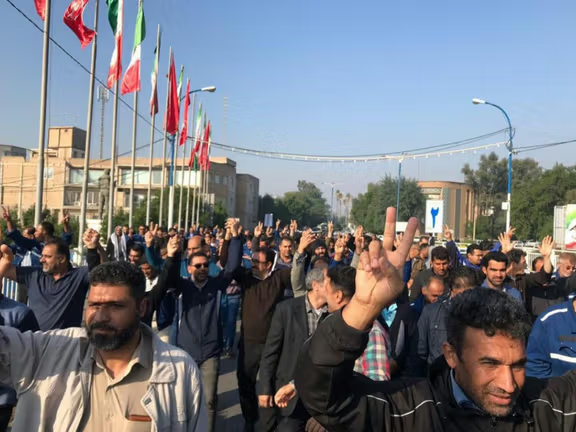
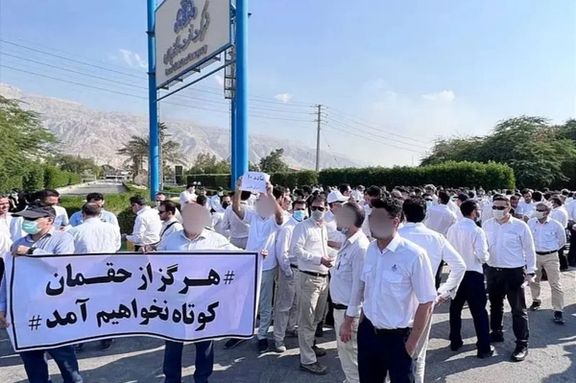
Labor protests in Iran
Over 90% of Iran’s population is dissatisfied with the country’s current state, with a significant portion believing that the situation is 'beyond repair' amid authoritarian crackdowns and an economic crisis.
The revealing insight comes from a new survey conducted by a department affiliated with the Ministry of Culture, published by the pro-reform daily Ham-Mihan on Sunday.
The results, part of the Fourth Wave of the National Survey on Values and Attitudes of Iranians, offer a rare glimpse into public sentiment in a system that often avoids transparency about the true depth of dissatisfaction among its citizens.
Conducted in November 2023 by the Office of National Plans of the Research Institute of Culture, Art, and Communications, the survey polled 15,878 Iranians over the age of 51 across 15 provinces.
Iran's oil workers in a strike rally in the south of the country on December 17, 2022
While the full survey results have not yet been made public, sections of the data have been released to researchers and are slowly being published. According to Ham-Mihan, 92% of respondents expressed dissatisfaction with the country’s current trajectory, with about one-third of them going so far as to state that “the country’s situation is beyond repair.”
This figure comes as no surprise in a country that is in the midst of the worst economic crisis since the founding of the Islamic Republic, international isolation, and rising authoritarianism.
Among the most pressing issues identified by respondents were inflation and high prices (81.9%), unemployment (47.9%), addiction (26.9%), corruption (13.1%), housing shortages (12.1%), and, notably, the issue of the hijab (11.9%).
The prominence of the hijab issue, which has risen to become the sixth most important concern, reflects a dramatic shift in public sentiment following the death of Mahsa Amini in 2022 while in the custody of the morality police.
Protests that erupted after her death challenged the Islamic Republic’s dress codes and have since shifted the national debate on personal freedoms, particularly for women.
The survey also underscores the growing sense of insecurity among Iranians, with 54.8% of respondents stating that their property and belongings are not safe. Women, in particular, expressed concerns about safety, with 14% stating they feel "very little" safety in public, and 21.5% indicating they feel "somewhat unsafe."
Sociologists warn that this overwhelming sense of hopelessness could lead to greater unrest. Speaking to Ham-Mihan, sociologist Simin Kazemi pointed out the fact that 60% of eligible voters did not participate in the first round of the 2024 presidential election, a sign of widespread political disillusionment.
“If the new government fails to seize this opportunity and address the concerns, growing dissatisfaction could spiral into political and social crises larger than anything we’ve seen before,” Kazemi said.
The outlook painted by the survey echoes past studies, including a 2022 poll by the Gamaan Institute, which found that 81% of respondents inside Iran wanted an end to the Islamic Republic altogether. Similarly, a 2021 survey by the Iranian Students Polling Agency (ISPA) revealed that 59% of Iranians had no hope for the future of their country.
A former Iranian MP and commentator Heshmatollah Falhatpisheh has called Iran's latest arms sales to Russia "the dirtiest example of Russophilia" as Iran gets ever closer to its allies in Moscow.
He said Iran's leaders "have turned Iran into a playing card" in the war on Ukraine as Iran already faces global sanctions for providing drones to Russia used in civilian areas of Ukraine.
The outspoken former MP said the latest debacle was part of a "dirty game" as Iran is dragged further into global conflict and sanctions which have led to the country's worst economic crisis since the founding of the Islamic Republic.
"It will continue until the dictator [Putin] leaves the quagmire," he blasted.
The former chairman of the National Security and Foreign Policy Commission, he is now a faculty member of Allameh Tabatabaei University. He has made no secret of his opposition to the government's policies which continue to lead the country closer to conflict with global powers such as the US.
The latest arms sales to Russia were confirmed by an Iranian lawmaker who denied that the delivery of ballistic missiles would risk heavy implications for Iran, also sanctioned for human rights abuses at home and its nuclear weapons program. Iran's supply of kamikaze drones to Russia since 2022 has already angered Western powers that have imposed sanctions against Iranian entities and individuals.
Ahmad Bakhshayesh Ardestani justified it by saying Iran has to subsequently "barter for our needs, including importing soybeans and wheat. Part of the barter involves sending missiles, and another part involves sending military drones to Russia."
When asked whether sending ballistic missiles to Russia might lead to further sanctions or trigger the so-called "snapback" mechanism against Iran, the member of the Parliament's National Security and Foreign Policy Committee replied, "It can't get any worse than it already is. We give missiles to [our proxies] Hezbollah, Hamas, and Hashd al-Shaabi, so why not to Russia?"
On Sunday, Nasser Kanaani, the spokesman for Iran's Foreign Ministry, once again denied being an ally to Russia in its war in Ukraine, saying "the Islamic Republic has never been part of the Russia-Ukraine conflict."
He said that "military cooperation between the Islamic Republic and Russia dates back well before the start of the Ukraine war."
A prominent centrist politician in Tehran asserts that over the years, hardliners endorsed by Khamenei, as well as reformist, conservative, and moderate governments, have all failed to deliver and the nation can hardly trust anyone.
According to Gholamhossein Karbaschi, former Tehran mayor and secretary-general of the centrist Executives of Construction Party, hardliners, reformists, and even the current Pezeshkian administration risk losing public trust unless Pezeshkian fulfills key promises. Karbaschi emphasized that Pezeshkian needs to show he is committed to changes in social media and hijab restrictions, and the release of protest leaders, as he has publicly pledged, in order to distinguish his government and gain credibility.
On foreign policy, Karbaschi emphasized that the public desires leaders to avoid creating tensions and to work on reducing existing ones. He stressed that easing relations, even with the United States, should be a fundamental principle of Iran's foreign policy, advocating for a more pragmatic and conciliatory approach to international relations.
Karbaschi also said in his interview with "reformist" Didar News: "If Pezeshkian fails to deliver, all hope will go out the window," Karbaschi warned. He added that in the recent presidential election, people were fed up by ongoing domestic and foreign policy issues, alongside economic crises. Despite their frustration, it was clear they were ready for change. However, due to past restrictions on candidates, many had lost faith in the electoral process. Karbaschi stressed that Pezeshkian must seize this opportunity to enact meaningful reforms to restore public trust.
Iranian President Masoud Pezeshkian during a visit in Mashhad (September 2024)
He pointed out that the crackdown on women defying the hijab, the poisoning of schoolchildren—allegedly orchestrated by hardline elements—along with worsening social issues and increasing economic hardship, have intensified the public’s demand for change. The stalemate in Iran’s foreign relations has further fueled this unrest. Karbaschi added that the public's reluctance to participate in recent elections reflects their disappointment with all political factions, including the "reformists," whose performance has contributed to widespread disillusionment with the political process.
During this week, Pezeshkian has said that he believes solving the country's economic problems needs an "economic surgery." However, some economists have expressed doubts that the idea which is reminiscent of an expression used by former President Ebrahim Raisi could be a prelude to a new round of price rises.
Meanwhile, National Development Fund Chief Mehdi Ghazanfari quoted Pezeshkian as having said that he will not allow the underprivileged to be crushed under the pressure of any economic reforms. He further warned the President that a less painful road to development is feasible only through oil exports, but did not offer any further explanation.
Discussing ways to address Iran's cultural and economic issues, Pezeshkian recently called for encouraging Iranian expatriates to invest in the country. "We should assure Iranians living abroad that they won’t face harm if they return to Iran," he said. However, social media users quickly questioned why this attitude doesn't start with Iranians already living in the country, suggesting that offering better internet access and social media freedoms would be a good first step in improving the domestic situation.
Karbaschi stated that Pezeshkian may not be able to solve all the problems, but he needs to show that he is doing his best. This will also encourage the people to take part in future elections.
When asked about Pezeshkian's chances of success, Karbaschi noted, "I believe he made those promises based on agreements with key individuals. However, if he fails to fulfill them—such as lifting internet filtering—it will damage his credibility, especially since internet access is crucial to many people's livelihoods." Karbaschi added that failing to deliver on these promises would not only harm public trust in the government but also further diminish hope for the future.
A Paris court has arrested and charged a couple for their involvement in Iranian-backed plots to assassinate Israelis and Jews in Germany and France in Tehran’s escalating campaign of state-sponsored terrorism in Europe.
French police sources told AFPthat Abdelkrim S., 34, and his partner Sabrina B., 33, were detained on May 4, accused of conspiring with a terrorist organization. The pair now sit in pre-trial detention as part of an investigation known as "Marco Polo," a case that underscores the Iranian government’s renewed use of terror tactics on European soil.
According to a report by France’s General Directorate for Internal Security (DGSI), consulted by AFP, Iran has ramped up its policy of targeted killings since 2015. The DGSI highlighted how the threat has intensified in the context of the ongoing Israel-Hamas conflict.
Iran is targeting civilians to spread fear among Europe’s Jewish and Israeli communities, while simultaneously intimidating its political opposition abroad.
Police officers work after police shot dead an armed man earlier who set fire to the city's synagogue in Rouen, France, May 17, 2024.
Tehran is outsourcing its operations to criminal networks, Iranian intelligence agencies having recruited criminals including drug lords to carry out such attacks.
Abdelkrim S., who has a criminal record, was the alleged point-man for an Iranian-sponsored cell. He was previously sentenced to 10 years for a killing in Marseille but was released on probation in July 2023.
French authorities believe he quickly became the linchpin in a terrorist network, tasked with planning violence in both France and Germany. His recruitment by an Iranian-linked drug trafficker in Lyon—who reportedly traveled to Iran in May—underscores Tehran’s use of criminal intermediaries to execute its deadly missions.
Among the cell's plans were attacks on several individuals, including a former employee of an Israeli security firm and three of his colleagues living in the Paris suburbs.
The plot also extended beyond France, with three Israeli-German citizens residing in Munich and Berlin marked as targets. French investigators revealed that despite being on probation, Abdelkrim S. made multiple trips to Germany, including visits to Berlin with his wife, purportedly for "scouting" purposes. He denied the charges, claiming he was merely running errands.
The plot did not end with personal attacks. French authorities have also linked the cell to a scheme to burn down four Israeli-owned businesses in southern France between late December 2023 and early January 2024. Although Abdelkrim S. has rejected the accusations, investigators are confident in his involvement. His defense, that he was only a middleman on the Telegram messaging app for an insurance scam, seems weak in the face of mounting evidence.
The case is far from isolated. As Der Spiegel reported on Thursday, security agencies across Europe have thwarted multiple Iranian-backed terrorist plots this year. Operations have been foiled in multiple European nations including those targeting Jewish and Israeli businesses and communities in Germany and France, in addition to countries such as Sweden and Belgium.
Police secures evidence after two molotov cocktails were thrown at a synagogue overnight in Berlin, Germany, October 18, 2023.
In August, Iran International reported on operations by Kataib Hezbollah, an Iraqi militia group backed by Iran’s Quds Force, targeting Jewish centers in Uzbekistan and Kazakhstan. Earlier this year, Israeli and Swedish intelligence agencies warned of Tehran's use of criminal networks as terrorist proxies in Europe, highlighting a broader pattern of state-sanctioned violence.
In May, Iran International reported that Israeli and Swedish intelligence agencies had warned about the Islamic Republic's use of criminal networks as terrorist proxies in Europe to carry out a series of attacks on Israeli embassies in Europe.
Last year, the US named Iran as the world's number one state sponsor of terrorism.
The accusation of fostering political ‘polarization’ in society, leveled against Iran’s hardliner Kayhan newspaper by an influential politician and cleric, has deeply angered ultra-hardliners.
In a sermon on Wednesday, hardline cleric Alireza Panahian, who has close ties to Parliament Speaker Mohammad-Bagher Ghalibaf, called on the Speaker to ensure that Parliament passes a law to prevent state-funded newspapers from “polarizing” Iranian society. He urged that such outlets should be shut down.
Panahian's call was especially striking given that Kayhan is backed by the office of Supreme Leader Ali Khamenei. The newspaper’s firebrand editor, Hossein Shariatmadari, serves as Khamenei’s representative, making Panahian's criticism notable within hardline circles.
Alireza Panahian (left) and Supreme Leader Ali Khamenei
“Polarization is the fight in our own camp in Iran … in the middle of a full-on war with the enemy,” one of Panahian’s supporters tweeted, insisting that he was reiterating Khamenei’s warnings about divisive politics.
The demand to shut down divisive newspapers, along with the context in which it was presented, infuriated ultra-hardliners. It hinted at a potential political alliance among conservatives against them, a scenario previously considered unlikely. Also, the gathering where the sermon was delivered was attended by President Masoud Pezeshkian and Ghalibaf both of whom had traveled to Mashhad to take part in a religious ceremony.
The new president, advocating for ‘national unity’ as a solution to Iran's challenges, has grown increasingly close to Speaker Mohammad-Bagher Ghalibaf in recent weeks, forming a strategic alliance. Together, they are positioning themselves against ultra-hardliner Saeed Jalili and his supporters in the Paydari Party.
In his sermon a video clip of which has gone viral on social media, Panahian named not only the ultra-hardliner Kayhan, but also Ettela’at and Jomhouri Eslami, two conservative newspapers which are also funded by Khamenei’s office, but unlike Kayhan can even be considered as moderate when it comes to domestic politics.
Of the three newspapers, it was only Kayhan that reacted to Panahian’s sermon. As it was a public holiday, Kayhan protested in a note published on its online portal. Ultra-hardliners also took to social media to defend Kayhan.
In a note titled "Whose Side Are You Taking, Mr. Panahian," the newspaper accused him of being misled by "certain associates" and repeating "the old demands of the Revolution’s well-known enemies" against Kayhan.”
Kayhan claimed to be “always at the forefront” of ‘Vindication Jihad’ -- to counter criticism and attacks against the Islamic Republic by using “hybrid warfare” as ordered by Khamenei –and compared Panahian’s sermon to “similar propaganda of foreign media against Kayhan.”
"Is defending martyr [Ebrahim] Raisi against the cowardly attacks of so-called reformers considered polarization?" Kayhan asked, while renewing its criticism of Pezeshkian for appointing reformists to his administration. The newspaper emphasized that Khamenei has repeatedly warned, over the past two months, against employing "people of ill-repute" and those "out of touch with the Revolution." Kayhan insisted that Pezeshkian's inclusion of such figures in his government undermines the values of the Islamic Republic.
Mohammad Imani, a Kayhan columnist, took to Telegram separately to defend his newspaper against Panahian whom he said had “shot compatriots instead of the enemy.” He, too, accused Panahian of providing ammunition to the opposition media with his accusations against Kayhan.
Ghalibaf’s adviser, Mohammad-Saeed Ahadian, defended Panahian in a Telegram post, stating that Panahian was merely reiterating Khamenei’s warnings about the dangers of "polarization." Ahadian also criticized Kayhan, accusing it of targeting figures like Ghalibaf who support the Pezeshkian government, rather than challenging Khamenei's positions directly. He argued that opposing the Leader's explicit wishes is "costly," suggesting that Kayhan avoids confronting Khamenei's stance while attacking those aligned with his broader message.
An editorial in the reformist Shargh newspaper on Saturday argued that the attacks on Panahian and Ghalibaf are not about their past or current statements. Instead, it contended that powerful ultra-hardliners are frustrated because they can no longer eliminate their political rivals with the support of "certain centers of political power." These hardliners, now in a weakened position, are struggling to maintain their influence and are reacting angrily to the shifting political landscape.
An Iranian lawmaker has confirmed media reports about Tehran's delivery of ballistic missiles to Russia, but downplayed threats from Ukraine and its Western allies to impose "heavy" costs on Iran.
Ahmad Bakhshayesh Ardestani, a member of the Parliament's National Security and Foreign Policy Committee, acknowledged Iran’s military assistance to Russia amid the ongoing war in Ukraine, less than 24 hours after Iran's UN mission denied a report by The Wall Street Journal about the delivery of short-range ballistic missiles to Russia.
"We have to barter for our needs, including importing soybeans and wheat. Part of the barter involves sending missiles, and another part involves sending military drones to Russia," Ardestani told Didban Iran on Saturday.
When asked whether sending ballistic missiles to Russia might lead to further sanctions or trigger the so-called "snapback" mechanism against Iran, the lawmaker replied, "It can't get any worse than it already is. We give missiles to Hezbollah, Hamas, and Hashd al-Shaabi, so why not to Russia?"
"We sell weapons and receive dollars. We circumvent sanctions through our partnership with Russia. We import soybeans, corn, and other goods from Russia. Europeans sell arms to Ukraine. NATO has entered Ukraine, so why shouldn’t we support our ally by sending missiles and drones to Russia?" Ardestani said.
Later on Sunday, Nasser Kanaani, spokesperson for Iran's Foreign Ministry, addressed the reports of ballistic missile shipments to Russia, stating, "The Islamic Republic has never been part of the Russia-Ukraine conflict." He further added, "Military cooperation between the Islamic Republic and Russia dates back well before the start of the Ukraine war." In effect, Kanaani did not specifically deny the report but repeated Iran's standard response that can be interpreted as a denial.
The Biden administration has informed its allies that Iran delivered short-range ballistic missiles to Russia, providing Moscow with a significant new military tool amid its ongoing war against Ukraine, a Friday report by the Wall Street Journal said citing US and European officials.
"The missiles have finally been delivered," a US official said. The shipment reportedly includes several hundred short-range ballistic missiles, capable of reaching up to 500 miles. These missiles could help bolster Russia’s intensified missile attacks on Ukrainian cities and infrastructure, which have recently led to the deaths of dozens of civilians.
"We have been warning of the deepening security partnership between Russia and Iran since the outset of Russia's full-scale invasion of Ukraine and are alarmed by these reports," said White House National Security Council spokesperson Sean Savett. "Any transfer of Iranian ballistic missiles to Russia would represent a dramatic escalation in Iran's support for Russia's war of aggression against Ukraine."
Ardestani’s comments come amid repeated official denials from Iran regarding the shipment of missiles, drones, and other military equipment to Russia.
Just hours after the Wall Street Journal’s report was published, Iran’s United Nations delegation issued a statement denying any missile or weapon transfers to Russia. The statement asserted, "The Islamic Republic has not provided weapons to any party involved in the conflict in Ukraine and has urged other countries to stop doing so."
In reaction to the reported military shipments, European countries are considering banning Iran’s national airline, Iran Air, from flying to European airports. The new sanctions package is expected to target companies and individuals involved in the missile transfers, including transportation companies linked to these operations.
"If civilians in Ukraine die from these missiles (Tehran delivered to Russia), then Iran will pay a double price for that. The response will be severe," a Ukrainian defense source told The Times, but did not elaborate on the nature of that response.
Russia's access to Iranian ballistic missiles could devastate civilian populations, markinga turning point in the conflict, Farzin Nadimi, a Senior Fellow with the Washington Institute, told Iran International.
He said some of these missiles will have enough range to hit Western Ukraine and strike important targets like railway stations. "It's going to have a really bad effect on civilians."