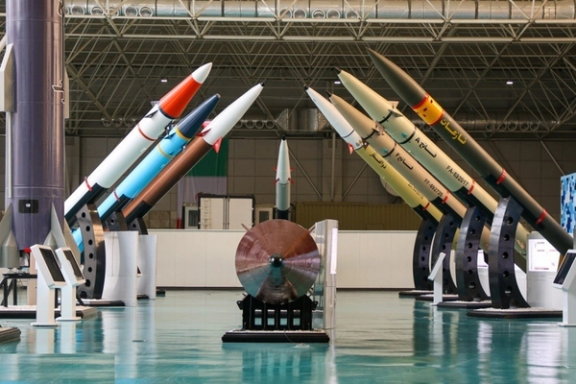
A number of Iranian missiles displayed in an exhibition in Tehran
Iran is technically capable of building a nuclear bomb and the diplomatic impasse over its disputed program could end in a "path of increased military action," including military escalation either by Iran or Israel, a top former UN weapons inspector told Iran International.
Iran's nuclear advancements could spark armed showdown, ex-UN inspector warns | Iran International
Speaking on the Eye for Iran podcast, David Albright said Iran or Israel may accidentally or deliberately engage in such an armed showdown. "Maybe Iran would target Tel Aviv. We know it can hit Tel Aviv and then Israel responds. I think it is a very dangerous time."
If both Iran and Israel feel threatened, then Iran's dash for a bomb and the chance of military confrontation seems more likely than ever, said Albright.
The former UN atomic inspector said Iran’s nuclear program is shrouded in secrecy and that the current measures in place do little to detect suspicious activity.
It would take a week or less for Iran to make enough weapon-grade uranium for a bomb, Albright said. It would take six months to make a weaponized nuclear warhead.
“I feel very, very worried about what’s going to take place in the future,” said Albright.
The International Atomic Energy Agency (IAEA) has grappled with Iran’s lack of cooperation and secrecy for more than two decades. In the past they have found uranium at locations that had not been declared, have been denied access to nuclear sites and faced official resistance to accrediting inspectors.
But the issue of secrecy and the findings of deep underground nuclear facilities that were previously undeclared like Fordow is much more complex and potentially dangerous, Albright told Iran International.
Iranian nuclear decision-makers are not only keeping secrets from the UN’s nuclear watchdog but also hiding it from their own government officials, said Albright.
“The technical people are preparing to build a bomb and if they're going to build a bomb at SPND they want to make sure that it can be done secretly," Albright said, referring to the Organization of Defensive Innovation and Research, known by its Farsi based acronym, SPND, which plays a key role in Iran's nuclear program.
"There's no oversight. They can exclude people in the parliament, in other parts of the Ministry of Defense from knowing what they're doing.”
Iran’s parliament recently expanded the funding and military pursuit of SPND, exempting it from oversight. The complex was previously under the guidance of Mohsen Fakhrizadeh, a mastermind behind Iran’s nuclear program before Israel allegedly assassinated him in Tehran with an AI-powered machine gun.
The SPND initiates projects to work on parts of the bomb, without any government approval, said Albright, who is the founder of the non-governmental Institute for Science and Internatinal Security (ISIS).
Iran maintains that its nuclear program is for peaceful purposes only. However, that’s not how Albright, Israel and the Western powers view it.
Out of 35 member countries on the IAEA's Board of Governors, 19 voted in favor of a censure resolution on Iran on Thursday, urging greater cooperation with the UN nuclear watchdog.
Britain, France, and Germany – dubbed the E3 – said during the IAEA meeting in Vienna that the findings of Director General Rafael Grossi after his recent visit to Iran, were deeply concerning.
Grossi announced that the Islamic Republic had expanded its uranium stockpiles by 60 percent purity, which is just a short technical step away from nuclear weapons.
Thousands of centrifuges
In response to the IAEA censure, Iran said Friday that it is pursuing new advanced uranium enrichment centrifuges.
Behrouz Kamalvandi, the spokesman for the Atomic Energy Organization of Iran, said Iran would retaliate by activating thousands of centrifuges, not just hundreds.
Much like a previous censure in June of this year, the latest resolution repeats its demand that Iran provide explanations for undeclared uranium traces and mandates that IAEA analysts be allowed to take samples.
Albright said Biden’s approach to Iran was a failure. He said the E3 had to trick the US into a censure resolution in June because they were frustrated with the pace of the US.
The former UN inspector who has been warning about Iran’s nuclear ambitions and lack of cooperation for more than 20 years, said he has learned over these years that pressure works.
Albright is a physicist and one of the world's leading nuclear experts. He was one of very few experts in the field who warned to the George W. Bush administration that the intelligence he possessed on invading Iraq on the pretense of weapons of mass destruction was unreliable.
Sanctions will work
In his interview with Iran International, Albright said crippling Iran's economy, like targeting key revenue such as oil sales, will force Tehran to cooperate.
"People always say, sanctions don't have an impact. But if they don't have an impact, why is it every time a deal is brought up as a possibility, the first thing the regime says is you've got to the lift the sanctions," said Albright.
The return of Donald Trump to the White House, the open and direct strikes between Iran and Israel and the weakening of Iran’s deterrence power via depleted armed allies Hamas and Hezbollah put Iran in a vulnerable position.
With geopolitics in the area remaining volatile and the unpredictable and uncanny approach of president-elect Donald Trump to world politics, Albright said the state of play could rapidly change.
"Trump, you don't know what he's going to do. He sent out a signal recently that maybe he wants to make a deal," he said, apparently referring to an alleged meeting between Trump's close ally Elon Musk and Iran's UN envoy.
As daily protests by various groups continue in Iran, the government spokeswoman hinted that, for the first time since the 1979 Islamic Revolution, the Pezeshkian administration might consider respecting the right to protest.
The Iranian constitution formally recognizes the right to peaceful assembly and demonstration. However, many of its provisions are disregarded by the government. Article 27 specifically permits public gatherings and marches, provided they are unarmed and do not contravene Islamic principles.
While supporters of the Islamic Republic can hold large rallies for causes like Palestine or religious and political events, ordinary citizens—such as students, workers, and teachers—are consistently denied permits. This allows the government to label their protests as “unauthorized” and crack down on participants with arrests.
Government spokeswoman Fatemeh Mohajerani told media in Tehran that while the government views the law positively, it is awaiting an "amendment" to guarantee the freedom to hold political protests—albeit "in a different way." While this appears promising, it adds ambiguity to a constitutional article that is otherwise clear and straightforward.
The reference, however, might pertain not to the constitution but to a law regulating political parties, which requires interior ministry approval for gatherings. This regulation has often been cited as a justification for banning demonstrations.
Tehran - Large Woman, Life, Freedom protests begin in September 2022.
Iranian media have interpreted Mohajerani's statement as a sign that the government is preparing to address potential political protests. Authorities expect demonstrations, particularly in Tehran, following significant political or economic developments—or even major football matches.
Many Iranians took to social media, reporting a heavy military presence in Tehran as the country awaited a November 21 resolution by the IAEA, the UN’s nuclear watchdog, against the Islamic Republic. The government likely feared the resolution could undermine its authority and embolden dissidents. However, no significant protests occurred. The heightened security may have simply been a show of force amid ongoing blackouts and rising prices.
Mohajerani, however, told the press that the Pezeshkian Administration recognizes the public's right to protest and that it is seriously looking forward to an amendment to be made in the law by the parliament. However, she did not say what was in the text of the law that needed revision.
Recently there have been more peaceful protests in front of the parliament as well as several other gatherings by pensioners and teachers who are unhappy about their delayed pay adjustment. Interestingly, while supporters of the government censorship of the internet staged two demonstrations without seeking anyone's permission, the Interior Minister said those who call for lifting the ban on social media will not be allowed to protest although they have applied for a permit.
Mohajerani stated that a bill addressing protests had been sent to the Majles for amendment by the previous administration under Raisi. However, the Rouhani administration before that had also sought to revise the law. Rouhani, whose abrupt fuel price hike in 2019 triggered widespread protests, had called for legislation to permit peaceful demonstrations after security forces killed hundreds of protesters and imprisoned many others.
While the Majles had previously refused to amend the law under both Raisi and Rouhani, it has now agreed to review it. This shift may be due to lawmakers' confidence that their decisions are unlikely to affect their electability, with the next election still three years away.
After the 2019 protests, the Rouhani administration proposed creating a Hyde Park-style venue in Tehran for peaceful demonstrations, but the plan was blocked by the Administrative Justice Court. Critics argue that successive governments only consider facilitating peaceful protests in the wake of major social unrest, abandoning such plans once the protests subside.
Some observers suggest that the delays in passing relevant legislation and the Interior Ministry's refusal to issue protest permits stem from the nature of slogans chanted during the 2019 and 2022 protests, which targeted Iran’s leadership and called for the overthrow of the Islamic Republic.
Tehran plans to activate a series of advanced centrifuges in response to the IAEA Board of Governors' resolution censuring Iran for its lack of cooperation, according to the deputy head of Iran’s Atomic Energy Organization.
"We will significantly increase enrichment capacity," Behrouz Kamalvandi said Friday, after earlier threats to respond sharply against a censure resolution.
On Thursday, the International Atomic Energy Agency's (IAEA) 35-nation Board of Governors passed a resolution criticizing Iran and ordering better cooperation with the UN nuclear watchdog.
Nineteen countries voted in favor and three - China, Russia and Burkina Faso - against, with 12 abstaining during the quarterly meeting of the Board of Governors.
"The Westerners are trying to push our nuclear industry backward through pressure tactics. The votes in favor of the new resolution against Iran were significantly fewer than before," Kamalvandi added.
An earlier resolution in June, tabled by France, Britain, and Germany (E3), received significant support, with 20 member states voting in favor. The two countries who voted against the resolution were Iran's allies, China and Russia. The decision saw 12 countries abstaining from the vote.
Kamalvandi said Iran showcased its enrichment complex, equipped with thousands of centrifuges, during International Atomic Energy Agency (IAEA) chief Rafael Grossi's visit to Tehran last week.
"The director-general proposed a temporary pause on reserves of 60% and higher enrichment levels—not a permanent halt, but a temporary measure," Kamalvandi added.
He noted that Iran accepted Grossi's proposal but "with conditions," declining to provide further details.
The latest IAEA Board of Governors' resolution, backed by the E3, follows months of heightened tensions over Iran’s uranium enrichment and a deepening confrontation between Iran and Israel, with mutual missile attacks and air strikes.
Earlier on Friday, an Iranian lawmaker also called for the immediate removal of nuclear enrichment restrictions, following Thursday’s IAEA Board of Governors' resolution against the Islamic Republic.
"We must set aside previous considerations regarding our nuclear issues," Mohammadreza Mohseni Sani, a member of Iranian parliament’s National Security and Foreign Policy Committee said.
Tehran’s interim Friday prayer leader Ahmad Khatami also criticized the IAEA Board of Governors’ resolution, calling it a show of support for the “murderous Zionist regime.” He urged Iran’s foreign policy officials to deliver a "decisive response."
Iranian officials had previously dismissed the resolution, accusing the E3 and their allies of undermining recent diplomatic efforts. Foreign Minister Abbas Araghchi told his French counterpart on Wednesday that the move complicates matters and contradicted the "positive atmosphere created between Iran and the IAEA.”
President Masoud Pezeshkian, in a speech on Friday, highlighted Iran’s significant shortcomings and shortages across various sectors, warning that in some areas, “we are standing on the edge of an abyss.”
The president referred to water, electricity, and natural gas shortages as well as the environmental crisis and emphasized the urgency of dealing with serious problems, and “to be accountable to the people.”
"We are currently facing a variety of problems and significant imbalances in water, electricity, gas, and the environment—some of which are on the brink of collapse," Pezeshkian said.
The Iranian government has been forced to implement rolling blackouts this month as winter approaches and a natural gas shortage jeopardizes the well-being of its 85 million citizens and disrupts industrial production. Meanwhile, it is unable to pay for gas imports from its northern neighbor, Turkmenistan, to sustain supply in nearby provinces.
Pezeshkian highlighted an apparent impasse within the Islamic government, stating, “We must address these imbalances and be accountable to the people, which is not achievable through the current governmental and bureaucratic processes.”
His remarks seemed to suggest the need for grassroots or non-traditional solutions to overcome challenges. However, Iran's economic system remains heavily state-controlled, with centralized decision-making. Compounding the crisis are US and other sanctions that restrict oil exports and isolate Iran from the global banking system. These sanctions are tied to Tehran's contentious nuclear program and regional influence building interventions through armed proxies—issues ultimately decided by its authoritarian ruler, Supreme Leader Ali Khamenei.
Pezeshkian suggested that if the government can successfully tackle the numerous challenges it faces, opposition to the Islamic Republic may weaken. Since 2017, Iran has witnessed multiple waves of popular protests, resulting in thousands of deaths and tens of thousands of arrests. Amid current shortages, media and commentators warn that the possibility of renewed unrest cannot be ignored.
The president’s remarks on Friday came after a one-day visit to the impoverished southeast, a region marked by instability and militant opposition from some Baluch elements in the barren lands bordering Pakistan, who are the majority and predominantly Sunni, in contrast to the Shiite-led government.
Pezeshkian informed the media that he had intended to extend his visit to the region and travel to several towns, but was forced to cut the trip short due to “security reasons.” He did not elaborate on the nature of these concerns or clarify whether they were tied to the region itself or other potential issues requiring his attention in the capital.
Iran's growing gas deficit stems from rising consumption, driven by 8,000 MW of new thermal power plants and increased household use, while gas production growth in the past three years has slowed to a third of the previous decade's rate.
This has resulted in chronic power shortages, blackouts, and significant industrial production losses, compounding the country's struggles under US sanctions. Inflation has remained above 40% for five years, the national currency has halved in value over two years, and at least 30 million citizens now live below the poverty line.
Loss of natural gas production
The South Pars gas field in the Persian Gulf, which accounts for 75% of Iran’s production, has entered the second half of its lifecycle and is experiencing declining output. Due to sanctions, Iran is unable to attract Western companies to install large-scale production platforms equipped with compressors, forcing the country to accept reduced production levels.
Iran holds the world’s second-largest natural gas reserves after Russia and ranks as the third-largest producer, following the United States and Russia. According to BP's statistics, Iran's gas production increased from approximately 157 billion cubic meters in 2010 to 252 billion cubic meters last year, but the growth rate has slowed.
Iran also experiences an annual loss of 28 billion cubic meters of gas during production and distribution stages—a figure not included in the above production figures.
Around 70% of Iran’s energy consumption also depends on natural gas, with no viable alternatives to make up for the shortage. The country is also grappling with deficits in gasoline and diesel supplies, while the highly polluting mazut consumption has tripled in recent years.
The government could potentially compensate a part of energy shortages by halting exports of 6.5 million tons of LPG and 12 billion cubic meters of natural gas annually. However, it heavily relies on revenue from gas and LPG exports.
Impact of gas shortages on industries
This summer, due to electricity shortages, the government halved electricity supplies to industries. According to the World Steel Association, Iran’s steel production fell by 45% in summer compared to spring, dropping to 4.7 million tons (Q3 2024). Since last month, the government has also cut gas supplies to the steel industry by half.
Cement production has also suffered by 7% because of electricity and gas shortages. Plants have not been able to produce the raw material and have used reserves during the summer. However, with an 80% reduction in gas supplies to the cement industry since late September and dwindling raw material stocks, a significant drop in cement output is expected in autumn and winter.
The petrochemical sector, the most gas-dependent industry, operated at only 70% of the capacity last year due to gas shortages. This year, with worsening imbalances, further production declines are anticipated. Iran, which is a small cement exporter, now has to cut back on construction or become an importer.
Last year Iran exported $8 billion worth of crude steel and steel products and $19.5 billion in petrochemical products. Together, the steel and petrochemical sectors accounted for 55% of the country’s total non-oil exports.
Effects on citizens’ lives
Natural gas shortages have forced the government to reduce supplies to power plants, resulting in widespread blackouts. Since early November, rolling blackouts in residential areas of major cities have sparked public anger. The electricity shortage has also disrupted commercial activities, reduced household incomes, and caused industrial production losses, further impacting employment levels.
With the onset of winter, the natural gas-induced power shortages will worsen, affecting citizens more dramatically. While planned gas price increases could boost government revenues, domestic gas prices are so low that even doubling them would barely affect household consumption.
Iran’s daily gas consumption in the fall has reached 820 million cubic meters, with the residential, commercial, and small industrial sectors accounting for 440 mcm/d. During peak winter months, this figure is expected to rise to 650 mcm/d.
Even at current consumption levels, Iran faces a gas deficit of 90 mcm/d. This shortage is projected to reach 300 mcm/d in winter, meaning the government will be unable to meet one-fourth of the country’s gas demand.
Foreign Minister Abbas Araghchi asserted that the Islamic Republic will respond to an October 26 series of airstrikes by Israel but said the retaliation will be calculated and executed under the right circumstances.
Araghchi was speaking with the Tehran-affiliated Al-Mayadeen television as Iran was censured at the meeting of the International Atomic Energy Agency for its lack of cooperation with the UN nuclear watchdog.
The foreign minister asserted that “Israel is well aware that the Islamic Republic poses the most significant threat to its regime.” Clearly linking Tehran and its proxies, he added, “The Resistance is not merely an organizational structure or an institution comprised of leaders and fighters; it is an ideology and a school of thought with broad social foundations.”
The Islamic government in Iran has yet to conduct a military response to Israel’s October 26 airstrikes on its air defenses and military installations. The attack marked the latest in a series of tit-for-tat exchanges between the two arch-enemies in the Middle East, following over a year of conflict between Israel and Iranian proxies; Hamas, Hezbollah, Yemeni Houthis and a variety of militia groups in Syria and Iraq.
Araghchi further emphasized that the Hamas movement remains steadfast, and that halting the war would represent a major defeat for the Zionist regime, which is why it opposes all ceasefire proposals. He added, "I have no doubt that the end of this battle will be a victory for the Resistance."
On Friday, chief commander of the Revolutionary Guard, Hossein Salami warned that the continuation of regional conflict can only result in Israel’s destruction.
Speaking at the venue of large drills by the IRGC’s Basij forces in southwestern Iran, Salami said, “Israeli officials are unsettled and demoralized, their army is exhausted, while, in contrast, Hezbollah and the resistance front have been energized.”
Salami is notorious for frequently issuing threats and declaring victories, a tactic some observers believe is intended to bolster morale among the government’s military and security ranks. Since September, Iran and its allies have suffered significant setbacks from Israel, which has launched an offensive against Hezbollah in Lebanon and carried out a series of targeted assassinations of key leaders.
Salami reassured supporters in his speech that Israel’s destruction is a certainty and stressed that Iran’s allies remain strong, facing a weakened Israel.
At the same time, Israel’s Prime Minister Benjamin Netanyahu sharply criticized the International Criminal Court for issuing his arrest warrant, calling it an antisemitic act.
“No outrageous anti-Israel decision will prevent us — and it will not prevent me — from continuing to defend our country in every way,” Netanyahu said, referring to the Islamic Republic in a video statement. “We will not yield to pressure,” he declared.