Iran’s president appeals to people to help resolve energy crisis
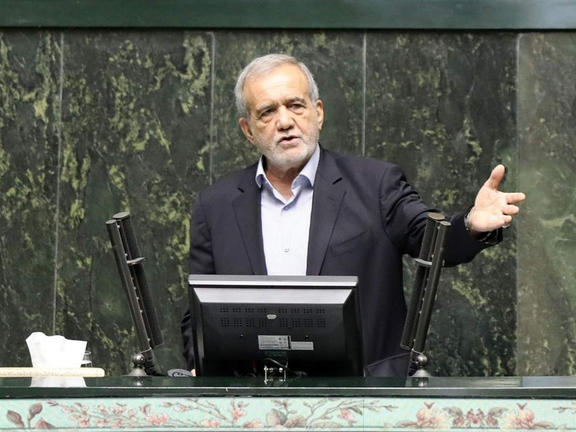
Iran's President Masoud Pezeshkian addressed parliament on December 1, 2024.
In a public appeal, the Iranian president urged citizens to conserve energy, emphasizing their role in mitigating the country’s ongoing energy shortage, a crisis that has intensified in recent months.
Speaking after a closed-door meeting between the government and members of the parliament, Masoud Pezeshkian told lawmakers, “Our need for you to continue on this path is far greater than what has been done so far,” emphasizing that overcoming the shortages in the energy sector required both government and popular cooperation.
The call comes as Iran grapples with widespread power outages, rising fuel prices, and a looming fiscal crisis.
While Pezeshkian stopped short of directly referencing potential increases in fuel prices, his remarks suggest an acknowledgment of the urgency of the situation.
The government’s longstanding narrative, which places the blame for the energy crisis on the people’s excessive consumption, has increasingly fallen flat in the face of growing public frustration.
Calls for citizens to conserve energy have become a familiar refrain, but many Iranians are growing skeptical of these appeals, seeing them as an excuse for government inaction rather than a solution.
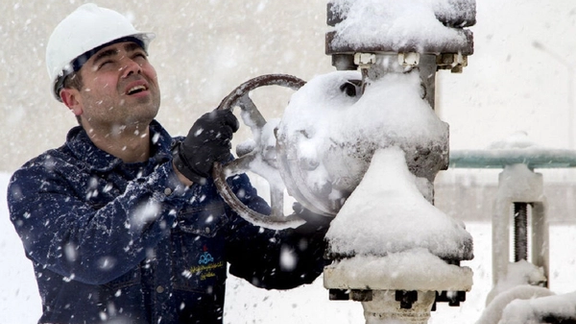
An Iranian energy worker adjusts a valve amid heavy snowfall, highlighting the challenges of maintaining gas flow during winter months.
In September, Hassanali Taghizadeh, chairman of the Iran Electrical Industry Syndicate, dismissed claims of excessively high domestic electricity consumption, saying that Iranian households use roughly half the electricity per capita compared to European households.
"Don't blame the people. Don't falsely claim that people's consumption is high. The average per capita consumption of Iranians is 1,220 kilowatt-hours per year, while in Europe it is 2,120 kilowatt-hours," he said. According to Eurostat, the electricity consumption per capita in the household sector in the EU in 2022 was 1,584 kWh,” he said.
In his speech, Pezeshkian addressed the escalating energy shortages, claiming that they could only be corrected with the collaboration of both parliament and the people.
His rhetoric, however, appeared detached from the reality of the situation, as citizens continue to face power outages, unreliable energy supplies, and skyrocketing living costs.
The energy crisis is compounded by a widening fiscal gap, with the next year’s national budget projected to have a deficit exceeding $30 billion, or more than 30% of total expenditures.
While Pezeshkian briefly addressed the fiscal challenges in his remarks, much of the meeting appeared to be consumed by speeches and vague declarations, rather than solutions.
The government's repeated calls for the people’s help seem more like an attempt to deflect responsibility than an invitation for meaningful dialogue on energy policy reform. Other officials and commentators have argued that Iran has failed to make the necessary investments in oil, natural gas and electricity production and upkeep of the grid.
The potential increase in fuel prices, which has sparked considerable controversy in parliament, was also a central topic of discussion. Some lawmakers expressed strong opposition to the proposed hikes, warning that they could ignite political unrest, much like the 2019 protests that followed a sudden increase in fuel prices.
Adding to the skepticism surrounding Pezeshkian’s remarks, the government’s claim that Iran spends billions annually on fuel imports has been called into question.
Pezeshkian said that the country imports $5 billion worth of fuel each year, but state-run news outlets, including the IRGC-affiliated Tasnim News Agency, disputed this figure, saying that only $2 billion worth of fuel was imported in the past year.
Meanwhile, the country’s chronic problem of fuel smuggling continues to undermine the government’s narrative.
Fuel smuggling in Iran remains a significant issue, with trucks crossing border areas to illegally transport subsidized gasoline to neighboring countries.
Economist Mousa Ghaninejad recently said that an estimated 50 million liters of gasoline are being illegally exported from Iran every day—far more than previous estimates of 20 million liters. Ghaninejad’s figures point to a much larger and more organized network of smuggling, suggesting that the problem is not confined to small-scale operators along the borders, as the government has often said.
As Iran heads into the new year with a deepening energy crisis and growing political tensions, the question remains whether the government can move beyond speeches to implement meaningful reforms.
Iran’s president appeals to people to help resolve energy crisis | Iran International
Iran’s government says it is taking steps to resolve the long-standing problem of being black-listed by the Financial Action Task Force (FATF) but hardliners still staunchly oppose accepting the watchdog's recommendations.
Q: How long has Iran been on the FATF black list:
The Islamic Republic of Iran was on FATF black lists from 2008 to 2016. In February 2020 Iran was black-listed again and has remained so to date.
Q: What does being on the FATF black list mean?
The FATF black list is officially called “high-risk jurisdiction subject to a call for action”.
Countries that fail to address deficiencies in their anti-money laundering and counter-terrorism financing regimes are described as “high-risk jurisdiction subject to a call for action”.
The FATF advises its members and financial institutions to apply “enhanced due diligence” in their dealings with black-listed countries. Enhanced due diligence makes international transactions high-risk, costly, and time-consuming for financial institutions.
Countries may also be called upon to apply “countermeasures” to protect the international financial system from money laundering, terrorist financing, and proliferation financing risks including limiting or terminating business relationships, increased monitoring and reporting, restrictions on correspondence banking relationships, prohibiting certain transactions, and increased external audit requirements, and encouraging the use of alternative payment methods.
Q: What happened in Iran's case between 2016 and 2020:
In June 2016, after the 2015 nuclear deal with world powers and the lifting of UN sanctions, FATF called on its members to suspend the countermeasures they used in their dealings with Iran for twelve months.
This meant being included in the so-called gray list and continuation of due diligence.
Q. Why was Iran put on the gray list?
Iran was temporarily removed from the black list because the country committed to implementing an action plan to address FATF’s concerns regarding the establishment of a cash declaration regime and counter-terrorism financing and anti-money laundering legislation and by-laws.
In February 2020 the FATF noted that there were still items not completed and several requiring to be fully addressed and urged member countries to once again apply countermeasures in their financial dealings with the Islamic Republic, i.e., black-listed Iran again.
Q: How does being black-listed affect Iran?
Without accession to the international financial conventions demanded by FATF, Iran cannot have full access to global banking, normal trade relations, and investments with large global companies. Being black-listed means Iran can also not have access to loans by the International Monetary Fund (IMF) and the World Bank.
Being black-listed has thus caused disruptions to Iran's international trade with most countries over the years and discouraged foreign investment. It has also damaged Iran's reputation and reinforced the impact of previous UN sanctions and sanctions by the US.
Q. How does FATF enforce its decisions?
The FATF is only an advisory body but countries, including Iran, must make their own legislation based on FATF recommendations to ensure compliance and avoid negative assessment of the health of their financial system by the task force.
Q: Is Iran cut off from SWIFT for being on the FATF black list?
Being cut off from SWIFT (Society for Worldwide Interbank Financial Telecommunication) is related both to US sanctions and being black-listed by the FATF.
Banks and other financial institutions that use SWIFT must comply with the anti-money laundering and counter-terrorism funding regulations of their respective countries based on FATF recommendations.
The United Kingdom, for instance, has several laws, such as the Money Laundering, Terrorist Financing and Transfer of Funds (Information on the Payer) Regulations, to ensure compliance with FATF regulations.
Q: What steps did Iran take towards completion of its action plan before being black-listed again in 2020:
The FATF has made 41 recommendations to the Iranian government 37 of which, including a cash declaration regime, it has accepted by passing legislation, although actual implementation remains in doubt.
In a statement in June 2018, the FATF said Iran had introduced draft amendments to its anti-money laundering and counter-terrorism financing laws but had failed to complete its action plan.
The global anti-money laundering task force, therefore, urged its members to continue to advise their financial institutions to apply enhanced due diligence to business relationships and transactions with natural and legal persons from Iran.
Q. What were the four pieces of legislation that Iran planned to introduce?
The Iranian parliament approved the following four pieces of legislation but two of these, the legislations for accession to the Palermo and CTF conventions, have not been finalized to date.
Amendments to the Law on Combating Money Laundering
Amendments to the Law on Combating the Financing of Terrorism
Accession to the International Convention on Combating Transnational Organized Crime (known as the Palermo Convention)
Accession to the International Convention on Combating the Financing of Terrorism (known as CFT)
Q: Why have the laws required for accession to the Palermo and CTF conventions not been finalized?
Iran's hardline-dominated constitutional watchdog, the Guardian Council, rejected the two pieces of legislation. The dispute between the parliament and the Council was referred to the Expediency Council in 2019 for arbitration.
The Expediency Council has stayed the matter since then and neither approved nor rejected them, purportedly due to the objection from hardliners who claim accession will be harmful to Iran's “national security” because the transparency will shed light on the country’s dealings with its proxy forces in the region among other things; exactly the reason for the existence of the international conventions.
Q. What is the approach of Masoud Pezeshkian’s government to the FATF issue?
Unlike his hardliner rivals, Pezeshkian repeatedly called for accession to the FATF’s conventions during his campaign as a crucial move to prevent the country’s financial isolation. His government says a final resolution of the matter may be near. But the presidential administration has little influence in such matters that could impact the country's foreign military projects.
The Iranian foreign minister, reaffirming Tehran's unwavering support for the Syrian military, left Tehran for Damascus on Sunday as opposition forces intensify their offensive against Bashar al-Assad's troops in Syria.
“The Islamic Republic of Iran firmly supports the Syrian army and government,” Abbas Araghchi said during a Navy Day event in Tehran on Saturday, ahead of his visit to Damascus.
“We make no distinction between the Zionist regime and Takfiri terrorists,” he added, referring to Syria's Islamist rebels and denouncing what he described as destabilizing efforts by external actors in the region.
He also added that he is going to deliver Tehran’s message for the Syrian government during his trip.
The comments come as Syria experiences its most significant rebel advance in years. Hay'at Tahrir al-Sham (HTS), an Islamist militant group, is leading an offensive that captured large sections of Syria's second largest city, Aleppo, including its international airport according to their statement, and advanced into neighboring Hama province. This marked the most substantial territorial loss for the Assad government, which is backed by Iran and Russia.
Syrian opposition fighter drives a motorbike in Aleppo, after the Syrian army said that dozens of its soldiers had been killed in a major attack by rebels who swept into the city, in Syria November 30, 2024.
In response, Syrian forces, supported by Russian airstrikes, launched a counteroffensive to regain control. The Russian defense ministry confirmed that its air force has been striking rebel positions, describing the situation as the boldest challenge to Syrian government forces in years.
Araghchi framed the conflict as part of a broader geopolitical struggle, alleging that the United States and Israel were aligned with militant groups in the region.
“The Takfiri terrorist forces are now standing alongside America,” he said, expressing confidence in the Syrian government’s ability to reclaim lost ground.
“The Syrian army will once again, as in the past, overcome these terrorist groups.”
The fall of Aleppo comes after years of Iranian support for Assad’s military, including financial aid, weapons, and personnel from the IRGC and allied militias such as Hezbollah. These forces have propped up the Syrian government in its efforts to reclaim territory since the civil war began in 2011. However, the latest rebel offensive has demonstrated the limits of Tehran’s capabilities that have weakened in recent months because of relentless Israel attacks against Hezbollah.
The fighting in Aleppo, which was firmly under government control since 2016, has disrupted years of relative calm in Syria’s civil war. Over 50 towns and villages fell to rebel forces, with reports of significant casualties among Syrian government troops, who retreated from several areas.
The developments have drawn international attention, with the White House National Security Council condemning the Assad government for its reliance on Iran and Russia.
Rebels led by the Islamist militant group Hayat Tahrir al-Sham drive a military vehicle in al-Rashideen, Aleppo province, Syria November 29, 2024.
Syria’s refusal to engage in a political process and its dependence on Iran and Russia “has created the conditions now unfolding, including the collapse of regime lines in northwest Syria,” said NSC spokesperson Sean Savett.
Meanwhile, the Syrian Democratic Forces (SDF), led by Kurdish groups and backed by the United States, expanded their control in parts of Aleppo as government forces withdrew. The conflict’s resurgence has reignited regional tensions, with its intersections in Gaza, Lebanon, and northwest Syria highlighting the broader geopolitical stakes.
Araghchi’s visit to Damascus forms part of Iran’s broader outreach to save the Assad government. Foreign Ministry spokesperson Esmail Baghaei on Saturday announced plans for Araghchi’s further meetings with Turkish officials after Damascus.
The renewed fighting signals a potential turning point in the 13-year Syrian civil war, as key players reassert their influence in the country’s fragmented political and military landscape.
Iran's minister of education has said that approximately 750,000 students in the country are not continuing their education, though he distanced the issue from systemic failures within the education sector.
Speaking on Saturday, Alireza Kazemi stated that the widespread school dropout rates are largely driven by familial, economic, and social factors, rather than structural shortcomings within the Ministry of Education.
Inflation in Iran has been hovering around 40% for the past five years, impoverishing about one-third of the population. As families find themselves under tremendous financial pressure, they are unable to afford expenses and many children go to work at menial jobs.
Kazemi reported that about 150,000 of these dropouts are from the early primary education level, while the remaining students come from both lower and upper secondary levels.
“The dropout issue is more complex than a lack of school infrastructure. It involves broader socioeconomic factors that extend beyond the ministry’s direct control,” he added.
This statement follows recent comments by Ali Rabiei, advisor on social affairs to President Masoud Pezeshkian, who reported on Thursday that 170,000 children were not attending school at the primary level, with dropout rates increasing sharply after elementary school.
Rabiei’s comments highlight a worrying trend of educational disengagement at a young age, particularly in rural and economically disadvantaged regions.
Kazemi, however, countered statements that the Iranian education system is underfunded or under-resourced.
Iran's education system faces numerous systemic challenges, including outdated curricula, overcrowded classrooms, and underfunded schools, all of which hinder the quality of learning. Teachers often work in difficult conditions with limited resources, struggling to address the diverse needs of students.
The lack of adequate infrastructure, particularly in rural areas, exacerbates these issues, making it harder for students to access quality education.
The minister also pointed to the challenges faced by secondary-level students, many of whom, Kazemi claimed, are seeking employment or vocational training opportunities.
He also identified cultural and gender barriers, particularly for rural girls who are prevented from attending mixed-gender schools.
“There are sociocultural factors at play,” he added, suggesting that these barriers to education are a significant driver of the dropout crisis.
Criticism of the ministry’s handling of the dropout issue has grown in recent months. Farshad Ebrahimpour, a member of the Education Committee in Parliament, said on October 21 that around two million students had failed to register for school this year, largely due to economic constraints faced by families.
Kazemi also dismissed the notion that there is a shortage of schools, teachers, or educational resources, instead arguing that the issue stems from external pressures on families, not the system's capacity to deliver education.
In a provocative response to critics, Kazemi suggested that those questioning the education system could ask children seen working at Tehran’s intersections why they aren’t in school.
A student in rural Iran
"The issue is not one of access," he said. "It is about the choices made by families and communities in the face of economic hardship."
Iran's education system is further undermined by the economic struggles of teachers, whose salaries have not kept pace with inflation, leading to widespread dissatisfaction.
Teachers in Iran face financial hardship, as they earn less than $200 a month. This economic pressure has sparked a series of protests in recent years, with educators demanding better pay, improved working conditions, and greater investment in the education sector.
Despite these protests, the government's response has been largely dismissive, contributing to a sense of neglect and disillusionment among teachers. The lack of attention to their demands has not only affected teachers’ morale but also impacted the quality of education, as many educators seek additional work to make ends meet, diverting their focus from their primary responsibility of teaching.
Data provided by Iranian media in September showed that nearly 790,000 students were out of school this year.
In a separate report, Mohammad Molavi, Deputy Chairman of the Education Committee in parliament, said in July that 911,000 students were not attending school, with 400,000 of them at the primary education level.
Molavi also highlighted that financial difficulties were a major factor behind the dropouts, with 279,000 students leaving school due to their families' inability to cover education-related costs.
As the debate over the country's educational crisis continues, the broader socioeconomic challenges does not mean that parents are opposed to education but they are just poor.
The number of HIV infections in Iran contracted via sexual intercourse has more than doubled according to the country's top research body in the field, highlighting the theocracy's strict policy toward contraception.
“HIV transmission through sexual contact has increased, with 28 percent of the 24,760 individuals who tested positive contracting the virus this way," Ladan Abbassian, the head of the country’s AIDS Research Center told IRGC-affiliated Tasnim on Saturday, without specifying a time period.
"This percentage rose to 65 percent in the first six months (of the Iranian calendar starting in mid-March 2024), indicating a shift in infection patterns.”
Women made up 19 percent of the total who tested positive for HIV, a figure that increased to 32 percent from March to August 2024. This shift marks a significant change in transmission patterns, which were previously dominated by men, Abbasian added.
Nearly three-quarters of those diagnosed with HIV are aged 20 to 45. “This age group should be the primary target for awareness and diagnostic efforts,” she said.
Drug users make up 53 percent of HIV cases, with 10 percent of those diagnosed in the first half of this year reporting injection drug use.
Experts have warned that government-imposed restrictions on contraceptive methods and the discontinuing of free distribution of contraceptives in some health centers could lead to a rise in HIV infections.
In 2021, Masoud Mardani, a member of the National HIV/Aids committee and professor at Shahid Beheshti medical university criticized these policies, saying that restrictions on contraceptive use to boost population growth not only risk unintended pregnancies and sexually transmitted infections but could also trigger a wave of HIV cases due to limited access to preventative tools.
In 2014 Supreme Leader Ali Khamenei announced that Iran should aim to increase the population – which is now around 85 million – to 150 million by 2050.
Despite officials’ efforts to implement directives, the population growth strategy has failed, with many attributing this to Iran’s dire economic conditions, as birth rates continue to fall and the population is projected to halve by the end of the century.
The rise in HIV cases among women and young adults in Iran reflects shifting transmission patterns and may underscore the need for stronger prevention strategies and better access to care to curb the virus's spread.
Syrian rebels stormed the Iranian consulate in Aleppo following their swift capture of Syria's second largest city, Iran's Foreign Ministry confirmed on Saturday, after videos on social media showed armed fighters inside the building.
Iran’s Foreign Ministry spokesperson, Esmaeil Baghaei, issued a statement strongly condemning the intrusion at the consulate, emphasizing that "any violation of diplomatic premises by any individual, group, or government is unacceptable under the 1963 Vienna Convention on Consular Relations."
He said the Consul General and all members of the Iranian consulate in Aleppo are safe and unharmed.
Shortly after the rebels stormed the Iranian consulate, Iran's foreign ministry announced that Abbas Araghchi, the country's top diplomat, will be visiting Damascus on Sunday and Ankara on Monday.
Turkey is known as a key supporter of Syrian rebels who have captured Aleppo over the past few days, and had given a green light to the offensive, opposition sources in touch with Turkish intelligence told Reuters.
Araghchi also had a phone call with his Russian counterpart Sergei Lavrov on Saturday, during which they expressed their "decisive support for Syria's national sovereignty and territorial integrity and for the country's government and army" in countering the armed rebels, according to Tehran's readout of the call.
The capture of Aleppo by Syrian opposition forces, including Hay’at Tahrir al-Sham (HTS), has significantly impacted Iranian-backed troops and raised concerns about Tehran's long-term regional strategy.
Iranian officials have downplayed Aleppo's fall to anti-Assad forces, framing the loss as a minor setback while doubling down on their support for Bashar al-Assad.
However, Kayhan newspaper which is close to Ali Khamenei's office suggested on Saturday that several Iranian forces have been killed over the past days in Aleppo.
"In the past couple of days, during the war in Syria and Aleppo, several Iranians have been martyred. Therefore, the primary and ultimate target of this new conflict is Iran," Kayhan wrote in its article.
Tehran has not yet confirmed the death of any Iranians in Aleppo, except Kioumars Pourhashemi, a senior commander of Iran's Revolutionary Guards (IRGC) who was killed in Aleppo during an attack by Islamist forces opposed to the Syrian government.
The fall of Aleppo comes after years of Iranian support for Assad’s military, including financial aid, weapons, and personnel from the IRGC and allied militias such as Hezbollah. These forces have propped up the Syrian regime in its efforts to reclaim territory since the civil war began in 2011. However, the latest rebel offensive has demonstrated the limits of Tehran’s capabilities that have weakened in recent months because of relentless Israel attacks against Hezbollah.