Iran releases songstress after brief arrest over concert without hijab
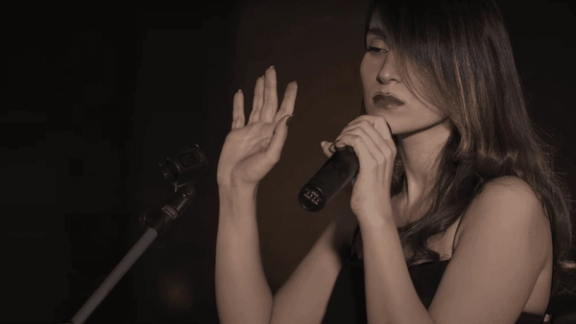
A screengrab of Parastoo Ahmadi's online concert
Iranian security forces arrested and released female singer Parastoo Ahmadi during the weekend, after she livestreamed aconcert without mandatory hijab in defiance of the Islamic Republic's law.
Ahmadi was arrested in Mazandaran, northern Iran, three days after she published on YouTube her unveiled performance in a caravanserai, her lawyer Milad Panahipour told Emtedad news website.
"We have no information about the charges against Parastoo Ahmadi, the arresting authority, or her place of detention," Panahipour said.
Two members of her band, Ehsan Beiraghdar and Soheil Faghih-Nassiri, were also arrested on Saturday, according to the lawyer. All three were released by Sunday morning.
On December 12, the Judiciary of the Islamic Republic issued a statement saying that the concert was held "without legal authorization and adherence to Sharia principles" and that "appropriate action" will be taken against the singer and production team.
The Caravanserai Concert, held on Wednesday night, quickly became one of the most discussed topics on Iranian social media.
Despite YouTube being restricted in Iran, the performance has attracted over 1.5 million views over the past three days, with clips widely shared online.
Ahmadi, in her introduction, described the concert as hypothetical, saying, “I am Parastoo; a girl who wants to sing for the people she loves... this is a right I could not forsake.”
Ahmadi was born in 1997 in Nowshahr in northern Iran. She is a graduate in directing from Sooreh University and spent years playing the piano and doing song covers which she shared on her Instagram page.
Iranian law prohibits women from singing solo or appearing in public without a hijab. Ahmadi’s performance, in which she bared her shoulders, challenged these long-standing restrictions.
Her earlier acts of defiance, including a rendition of Az Khoon-e Javanan-e Vatan (“From the Blood of the Youth of the Nation”) during 2022 nationwide anti-veil protests, had already brought her into conflict with authorities. Following that performance, she was summoned by security officials and her home was searched.
Artistic defiance has become a hallmark of Iran’s protest movements, with musicians such as Shervin Hajipour, Mehdi Yarrahi, Saman Yasin, and Toomaj Salehi facing arrest for their roles in mobilizing dissent. Ahmadi’s concert continues this tradition, positioning her as both an artist and an activist in a country where such roles carry significant risks.
The judiciary’s swift action shows the government’s determination to curb what it sees as cultural transgressions, even as social media amplifies these acts of resistance to global audiences.
Authorities have transferred political prisoner Mohammad-Amin Mahdavi Shayesteh to solitary confinement ahead of his execution for "insulting Islamic sanctities" and "collaboration with the enemy," according to Iran Human Rights (IHR).
IHR noted that the charge of collaborating with Israel against 26-year-old Shayesteh, who was arrested last year, was based on confessions obtained under torture and used to expedite his death sentence. The human rights group emphasized the lack of evidence in the case, pointing out that "an empty handgun magazine" and "a pepper spray" were presented as proof of "possession of illegal weapons" to support the charge of "collaboration with the enemy."
"The Islamic Republic is experiencing its greatest crises in its history and, to prevent public protests and cover up its regional failures, resorts to intimidation through the execution of defenseless prisoners," Mahmood Amiry-Moghaddam, Director of IHR, tweeted on Friday.
In recent months, Iranian authorities have escalated their use of the death penalty, with human rights groups reporting that over 42 political prisoners currently face the risk of execution.
According to a November 21 report by HRANA, at least 133 executions were documented in the past month alone, averaging more than four per day. This follows data from the Iran Human Rights Organization, which recorded at least 166 executions in October.
HRANA’s reports reveal an annual average of 811 executions between October 2023 and October 2024, encompassing both political detainees and ordinary prisoners.
This surge in executions coincides with rising tensions between Iran and Israel, with some suggesting that the government is leveraging geopolitical crises to distract from its domestic repression.
An Iranian female singer is facing legal action after performing an online concert without a hijab, an act which defied the theocracy's Islamic dress mandates.
The judiciary announced on Thursday that the concert, streamed live on YouTube from a historic arched caravanserai, "lacked any legal authorization and did not comply with the country’s legal and cultural standards."
Officials added that a case has been filed against Parastoo Ahmadi and her production team.
The Caravanserai Concert, held on Wednesday night, quickly became one of the most discussed topics on Iranian social media.
Despite YouTube being restricted in Iran, the performance attracted over 150,000 views within 18 hours, with clips widely shared online.
Ahmadi, in her introduction, described the concert as hypothetical, saying, “I am Parastoo; a girl who wants to sing for the people she loves... this is a right I could not forsake.”
Ahmadi was born in 1997 in Nowshahr in northern Iran. She is a graduate in directing from Sooreh University and spent years playing the piano and doing song covers which she shared on her Instagram page.
Iranian law prohibits women from singing solo or appearing in public without a hijab. Ahmadi’s performance, in which she bared her shoulders, challenged these long-standing restrictions.
Her earlier acts of defiance, including a rendition of Az Khoon-e Javanan-e Vatan (“From the Blood of the Youth of the Nation”) during 2022 nationwide anti-veil protests, had already brought her into conflict with authorities. Following that performance, she was summoned by security officials and her home was searched.
Artistic defiance has become a hallmark of Iran’s protest movements, with musicians such as Shervin Hajipour, Saman Yasin, and Toomaj Salehi facing arrest for their roles in mobilizing dissent. Ahmadi’s concert continues this tradition, positioning her as both an artist and an activist in a country where such roles carry significant risks.
The judiciary’s swift action shows the government’s determination to curb what it sees as cultural transgressions, even as social media amplifies these acts of resistance to global audiences.
Iran's Attorney General's Office has warned media outlets and online activists to avoid discussions of the downfall of Tehran's ally Bashar al-Assad in Syria that could undermine domestic security.
The statement, issued Wednesday, emphasized the importance of controlling narratives during what it described as “sensitive internal and regional conditions.”
“Media and online activists in the country should refrain from addressing topics that disrupt the psychological security of society and frighten the public about the situation,” it added.
This announcement follows remarks by Supreme Leader Ali Khamenei, who characterized public discussions about Iran’s weakening position after the fall of Bashar al-Assad’s government in Syria as criminal acts.
“Some do this abroad through Persian-language media, and they must be dealt with differently, but no one inside the country should do this. If someone, in their analysis or statements, speaks in a way that discourages the people, it is a crime and must be addressed,” Khamenei said during his first speech after Assad’s collapse on Wednesday.
This speech by Khamenei, unlike the usual practice of recent years, was not broadcast live on state TV per his office's decision.
Criticism of Iran’s costly support for Assad has surged in recent days, with former officials and commentators questioning the billions spent and thousands of lives lost during Tehran’s involvement in Syria.
The collapse of Assad’s government has undermined Iran’s influence in the region, dealing a blow to what it terms the Resistance Axis, which relies heavily on strategic connections to Hezbollah.
Khamenei, while addressing the Syrian situation, sought to portray resilience and determination. He said that areas in Syria lost to opposition forces would be reclaimed and expressed confidence in the eventual removal of US influence from the region.
However, he also acknowledged potential lapses in Iran’s intelligence communication with Syrian officials.
“Our intelligence apparatus had conveyed warning reports... I do not know if these reports reached high-ranking officials or were lost somewhere in the process,” he said.
The Attorney General’s call to action highlights a renewed focus on controlling internal discourse amid mounting criticism.
Western observers, including European Union foreign policy chief Kaja Kallas, have framed Assad's downfall as evidence of declining influence for his allies, including Iran.
This crackdown underscores the challenges faced by Iran’s leadership in maintaining its regional aspirations while managing domestic criticism, leaving journalists and activists facing increasing risks for their reporting.
A prominent centrist figure in Iran says that the ongoing deadlock over enforcing the new hijab law and lifting censorship on the Internet has effectively paralyzed the Pezeshkian administration.
Meanwhile, Reformist commentator Abbas Abdi argues that these issues highlight the hard-liners’ resistance to Masoud Pezeshkian's efforts to bridge the gap between the people and the government.
Abdi also criticized the President, holding him personally accountable for the continued censorship of social media in Iran.
Ali Rajaei, a centrist figure within Iran's Islamic political establishment, stated in an interview with the Khabar Online website in Tehran that no significant progress has been made in Iran's foreign relations or the government's cultural and economic policies since Pezeshkian assumed office four months ago. However, he emphasized that all Iranians should work together to strengthen the government and help it preserve its social capital.
"People measure the government's success by seeing how it tackles the problems of hijab and filtering [of the Internet]. At the same time, the government's opponents do not allow it to solve the problems," Rajaei said, adding that "the President cannot do much about other problems if he cannot stand by his promises to lift the filtering and prevent violent hijab enforcement."
He also argued that Iranians see no change in the situation of their livelihood and the government, and the parliament have done very little to improve the situation.
Rajaei said that he does not see any bright prospect for the hijab problem as the President appears to be lacking the bargaining power to convince the hardliners to step back from the new hijab enforcement law.
Meanwhile, Khabar Online website quoted Vice President Mohammad Jafar Ghaempanah as saying that at least 60 percent of Iranians oppose internet restrictions and collectively spend approximately 200 trillion rials (around $300 million) annually on VPNs to bypass the filtering. Ghaempanah also told the Reformist daily Arman Melli that all 15 members of the Supreme Council of Cyberspace are opposed to lifting the restrictions.
According to Reformist commentator Abbas Abdi, the statements by the vice president indicate that there is no short-term solution for the problem of filtering. Abdi added that President Pezeshkian and his administration should be hold accountable. "If there are individuals who can continue to enforce the filtering against the calls made by the President and his aides to lift the censorship, this means that other promises made by Pezeshkian are unlikely to be met," Abdi said.
Abdi further argued, "If a government backed by the people's vote cannot fulfill its promises, it might as well step aside and allow the hardliners to implement their policies." He questioned, "Did Pezeshkian not realize he couldn't uphold his promises when he made them? His excuses now are unacceptable." Abdi added, "It is not enough for the President and his aides to merely oppose internet filtering. People voted for them with the expectation that they would bring about meaningful change."
Motahaeh Shafiei, the lead columnist for Arman Melli newspaper, wrote that based on the Vice President's remarks and Pezeshkian's track record, lifting internet censorship is likely to become increasingly challenging.
Meanwhile, hardline commentator Abbas Nalimi-Namin suggested that the executive and legislative branches should postpone implementing the new hijab enforcement law, as both have acknowledged ambiguities in its enforcement. He further argued that hardliners like Ahmad Alamolhoda, the Friday Prayers Imam of Mashhad, who demand the law's immediate implementation, do so from within an insular circle disconnected from Iranian society and public sentiment.
Iranian authorities have tightened control on media and public figures in the aftermath of Bashar al-Assad’s fall and warned them not to draw any parallels between Syria under his rule and the situation in Iran.
In recent days, some state-controlled media and authorized public commentators have emphasized Assad’s unpopularity and the Syrian people’s unwillingness to defend his rule as rebels advanced toward the capital.
Some also reflected on the lessons the Islamic Republic should take from the events in Syria and suggested in mostly veiled terms that the same fate may befall the Islamic system if it fails to meet popular demands for social and political freedoms.
Some of the more outspoken views about Assad, which could be seen as indirect criticism of Iran's Supreme Leader Ali Khamenei, were conspicuously deleted after a few hours on Sunday and Monday without explanation.
Mahmoud Sadeghi, an outspoken reformist politician and former lawmaker, said the intelligence ministry contacted him and other unidentified political figures to warn them about “drawing a parallel between the deposed Syrian regime with the Islamic Republic of Iran's system.”
Sadeghi made the revelation in an open letter published on his Telegram channel Tuesday addressed to Supreme Leader Ali Khamenei.
“Public opinion has unfortunately made such an analogy.” Sadeghi wrote.
“This call made me wonder what has happened to our intelligence apparatus that instead of facing a grim reality such as the sudden and unexpected fall of Bashar al-Assad to properly analyze and understand its roots and dimensions and to seek help from political analysts, it is trying to cover it up and orders political activists to analyze the events according to (authorities’) wishes and views,” he wrote.
Sadeghi added that he had humbly warned the officer who contacted him, apparently by phone, that imposing these restrictions on the public would lead them to see “certain similarities with the deposed Syrian regime which bore the name of a republic but acted like a despotic monarchy and suppressed all voices of dissent instead of listening to those who protested and to carry out reforms.”
He also warned Khamenei that the Islamic Republic may have the same fate as Syria if the Supreme Leader does not take action to correct these wrongs during his lifetime.
The outspoken former lawmaker also said the Islamic Association of University Professors, of which he is a member, is prepared to offer a more comprehensive, confidential analysis of the current circumstances in the country and propose solutions to the Supreme Leader.
The news portal of the Association has run Sadeghi’s letter with the headline “Our System May Have the Same Fate as the Syrian One if You Do Not Correct these Wrongs” but besides the reformist Jamaran news website, no other Iranian newspaper or news website has so far given it coverage.
Dozens of Iranian activists and journalists have in the past four months also reported that authorities have blocked their cellphone SIM cards as an alternative to arresting them or other methods that require official action to force them into submission.
In a tweet on 5 December, a former journalist with the reformist Shargh newspaper, Elahe Khosravi, recounted how her friend’s registered SIM card had been blocked because of his social media activities. According to Khosravi, they were unable to acquire another SIM card because activating the new SIM card required confirmation of a code sent to the blocked registered number.
Others have reported that unexplained blocking of their SIM cards has deprived them of access to many online facilities including internet banking, academic platforms, and using two-step verification of their different online accounts.