Taliban diverts Helmand River water again, satellite images show
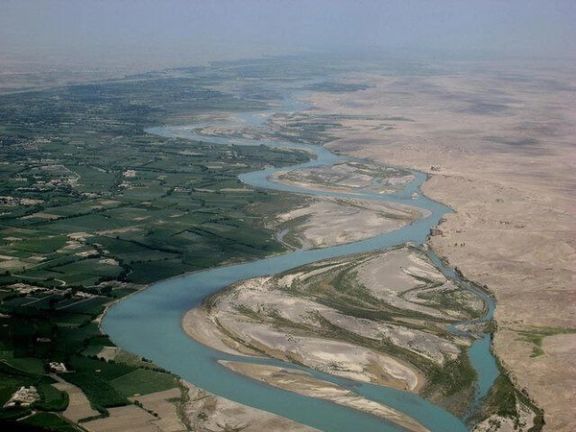
A view from Helmand (Hirmand) river in Afghanistan
The Taliban has diverted water from the Helmand River (known as Hirmand in Iran) despite previous promises to release Iran’s share, according to satellite images cited by Tehran-based Shargh newspaper.
The images show that Afghanistan is diverting the water into its Godarzeh salt flat instead.
The move exacerbates severe drought conditions in southeastern Iran's Sistan and Baluchestan province, a region heavily reliant on the Hirmand.
The Taliban's repeated obstruction of Iran's water access since 2021 has become a major point of contention between the two nations.
The report comes amid escalating tensions over the construction of dams on transboundary rivers, which has significantly reduced water flow to Iran’s drought-stricken eastern provinces.
In January, a member of Iran’s Parliament National Security and Foreign Policy Committee said the Taliban’s governance in Afghanistan has hindered regional cooperation on critical issues like shared water resources.
Potato prices in Iran have surged by a staggering 217% in the past year, according to the Statistical Center of Iran, highlighting a sharp increase in the cost of essential food items.
The sharp rise in the price of a staple food, now a lifeline for an increasingly impoverished population, has become a major public concern in recent weeks, a trend now confirmed by official data.
The average price of potatoes reached over 500,000 rials (about 54 US cents) per kilogram in February, up from approximately 150,000 rials a year earlier. Today, the average Iranian worker earns roughly $120-170 per month, while official estimates suggest that a minimum of $500 is needed for the basic survival of a family of three.
The surge positions potatoes as the food item with the highest price increase in the past 12 months, significantly exceeding the country's general inflation rate, which according to official figures hovers around 35%.
Attributing the sharp rise in potato prices to increased exports and smuggling, Agriculture Minister Gholamreza Nouri Ghezeljeh said on Sunday that exports have been halted. "More potatoes were exported this year compared to last year, and some were also smuggled," he said.
Due to fuel and other government subsidies, it is cheaper to produce food staples in Iran than in some neighboring countries. Also, as Iran's currency has lost 50% of its value since September, exporting any homegrown product for foreign currency has become more rewarding.
Paradoxically, Deputy Agricultural Minister Akbar Fat'hi announced in January that Iran was importing 50,000 tons of potatoes to combat soaring prices.
The imported potatoes, aimed at stabilizing the market, were to be sold at approximately 30 US cents per kilogram, significantly below current prices. He warned further imports may be necessary if the market remains volatile.
Eggplant also saw a substantial price increase of 123%, ranking second among food items with the highest annual inflation.
The Statistical Center's report revealed that a broad range of essential goods, including legumes, rice, and dairy products, have experienced significant price hikes in recent weeks. Pinto beans, for instance, saw a 30% increase in just one month, while Iranian rice rose by an average of 13.5%.
While many food categories experienced significant inflation, chicken and beef prices remained relatively stable, with increases of 4% and 8%, respectively. This stability is likely due to decreased demand as rising costs force many Iranians to reduce meat consumption.
A sudden and unexplained reduction in Iranian electricity supply plunged Iraq's eastern province of Diyala into a partial blackout on Saturday, highlighting Iraq's ongoing dependence on Iranian power.
The cut, which slashed about half of the electricity Iran provides to Diyala, severely disrupted power in the province's eastern, northern, and northeastern regions, according to Aws al-Mahdawi, a Diyala Provincial Council member.
"It could be a technical issue or related to re-programming codes," al-Mahdawi told Rudaw, a media outlet in the Iraq’s Kurdistan region.
This latest incident follows a history of disruptions to the Mirsad power line, alongside Iran's own energy shortages which have seen extensive blackouts, most recently forcing working weeks down to two or three days in large swathes of the country.
During Iraqi Prime Minister Mohammed Shia' al-Sudani's visit to Tehran in January, officials announced plans to restore 625 megawatts through the Mirsad, Karkha, and Siril lines.
Iraq depends on Iranian electricity and gas imports to bolster its own power generation. To mitigate the impact of US sanctions on Iranian exports, Washington has repeatedly granted Iraq four-month waivers, allowing continued energy purchases.
These waivers, recently extended in the summer for 120 days and nearing expiration, are intended as a temporary measure until Iraq can achieve energy independence.
In early February, US President Donald Trump issued a directive to reinstate the 'maximum pressure' policy on Tehran. The directive signaled a potential end to sanctions waivers, saying, “The Secretary of State will also modify or rescind existing sanctions waivers.”
The Central Bank of Iran (CBI) has demanded new measures to force transparency from banks and financial institutions, citing widespread failure to comply with existing freedom of information laws.
The directive, reported by Tasnim News Agency on Sunday, mandates dedicated online portals for immediate publication of non-confidential financial data including information on financial policies, loan facilities, and regulatory directives.
It also ordered banks and non-bank credit institutions to establish units to handle public inquiries within a strict 10-day deadline.
Aimed at bolstering public trust and accountability, the move comes in response to repeated violations of the Law on Publication and Free Access to Information, according to the CBI.
The CBI said that inspections reveal banks are consistently failing to comply with transparency laws, adding that this undermines public trust and hinders access to crucial financial information.
The measure comes as Iran slides to 151st out of 180 countries in Transparency International's 2024 Corruption Perceptions Index (CPI).
The CPI, which assesses perceived public sector corruption, shows Iran's continued decline, with a score of just 23 out of 100. The index highlights concerns over bribery, misuse of public funds, and limited access to information.
In October 2023, a report by the World Bank placed Iran among the worst countries in the world in terms of Worldwide Governance Indicators, with a Voice and Accountability Index score of -1.45, placing it among the lowest for political participation, free expression, and media freedom."
Citizens across Iran told Iran International that they are struggling to afford even the most basic necessities as Nowruz (Norouz), the new Iranian year, approaches on March 20.
Many described empty markets, fading Norouz shopping traditions, and the daily struggle to cope with soaring prices and dwindling purchasing power.
A hypermarket owner in Tehran remarked, "This is nothing like the Norouz seasons we used to see. People barely buy anything beyond absolute necessities. Our bestsellers now are cigarettes and large bottles of soda, while even basic cleaning products for Norouz housecleaning sit untouched on the shelves."
Iran’s economic crisis has worsened across all sectors. The rial has hit a historic low, with US dollar being exchanged at 940,000 rials. Inflation continues to climb, making everyday goods unaffordable amid misgovernance and Donald Trump’s “maximum pressure” policy to intensify sanctions.
A government employee told Iran International, "A decent women’s suit costs at least 150 to 180 million rials ($159–$191). My salary is 102 million rials ($109), and 70 million ($74) of that goes to rent. How can I buy new clothes when I can barely afford food?"
Over the past five years, tens of millions of Iranians have seen their living standards erode as wages fail to keep pace with soaring inflation. Today, the average worker earns roughly $120 per month, while official estimates suggest that a minimum of $500 is needed for the basic survival of a family of three.
An employee at a clothing store in Tehran’s northern Mirdamad district said, "Customers used to rush in to buy new clothes for Norouz. Now, people walk in, check the prices, and leave empty-handed. It’s an economic catastrophe."
The Hamshahri newspaper, affiliated with Tehran Municipality, reported that vendors who once relied on strong year-end sales to compensate for slow months are now struggling, as even slightly higher-quality items exceed ten million rials ($10.60)—far beyond what most families can afford.
A pensioner said, "I receive 90 million rials ($96) a month, and everything is expensive. A kilo of beef costs 990,000 rials ($10.50), cooking oil is 5,700,000 rials ($6.10), and even a simple loaf of bread is 200,000 rials (21 cents). Fruits are a luxury now—kiwis are 1,500,000 rials ($1.60) per kilo, low quality oranges are 350,000 rials (37 cents), and the cheapest apples are 460,000 rials (49 cents). I even have to buy rice on an installment plan."
Furniture has also become unaffordable. Hamshahri wrote in its report, "If someone wants a decent-quality sofa set, they need at least 700 million to one billion rials ($745–$1,060). Even the low-quality sets, which barely last a year or two, cost between 200 to 300 million rials ($213–$319)."
A shopkeeper added, "People are collapsing under poverty, yet the Islamic Republic does nothing to ease their suffering. The streets are full of window-shoppers who can’t afford anything, and business owners are struggling with rising utility bills."
Iran International, in a recent report analyzing data from Iran’s Statistics Center warned that official figures—26.6% for food inflation and 32% overall—significantly understate the true rate. An analysis revealed that prices for 15 key household items surged by an average of 12% in just one month.
A survey of grocery prices in major cities, including Tehran, Mashhad, Isfahan, and Tabriz, found that household consumption costs had risen between 22% and 360% in the past week, with an average increase of 150%.
A Tehran-based pro-reform newspaper called on president to take concrete steps toward negotiations with the United States, arguing that rhetoric alone will not resolve Iran’s economic crisis.
Responding to Masoud Pezeshkian’s remarks on Thursday saing,"We will not bow to bullies. We should not fear what they plan to do with sanctions. Some say we have no choice but to negotiate"—the reformist daily Ham Mihan questioned his approach.
"You say you don't shy away from dialogue—so why not put the ball in the opponent’s court?" the editorial argued. It urged the president to work toward halting the Trump administration's escalating sanctions, establish a negotiation agenda, and set a clear timeframe for talks.
The newspaper dismissed the notion that negotiating with the US equates to surrender, writing, "If they [the US] act like bullies and demand more than they offer, then inform the people and reject their terms. Otherwise, negotiations will yield results. Those who argue that we have no choice but to negotiate are not advocating surrender—because surrender requires no negotiation."
The debate over talks with the United States comes as Iran faces increasing economic pressure. In February, US President Donald Trump reinstated sanctions under his “maximum pressure” policy, calling for a deal that would permanently prevent Iran from acquiring nuclear weapons.
More recently, Trump signed a directive aiming to reduce Iran’s oil exports to zero, arguing that Tehran cannot be allowed to have a nuclear weapon and must make a deal.
"I would prefer a deal with Tehran to an Israeli attack on their nuclear sites," he said after signing the memorandum that reinstated the sanctions.
Iran’s Supreme Leader Ali Khamenei has dismissed engagement with Trump, calling negotiations "not wise, expedient, or dignified."
Beyond foreign policy, Ham Mihan also examined Pezeshkian’s economic promises, particularly his statement that "If shares are to be allocated, they should go to those truly in need, not to the wealthy."
These are good words, wrote Ham-Mihan. “So why hasn’t it been implemented? You have repeated it several times already. Moreover, your proposed national budget contradicts this notion of justice. You have increased salaries at half the rate of inflation.”
On Pezeshkian’s comments that "we are not afraid; we will stay and build the country with strength," Ham Mihan argued that fear is sometimes necessary.
"People are afraid. Officials should also be afraid. We should fear the people becoming angry. We should fear that some are unable to secure a dignified life... We should fear being unable to provide water and electricity for the people, leading to factory closures and even government shutdowns."
Iran continues to struggle with mounting economic and social crises, exacerbated by years of sanctions, government mismanagement, and public unrest. The 2022 protests, sparked by the death of Mahsa Amini in police custody, evolved into broader demonstrations against political repression and economic hardship. The government’s crackdown further eroded trust in state institutions.
The national currency has suffered a dramatic collapse, with the rial recently surpassing 940,000 per US dollar. Inflation remains persistently high, driving up the cost of food, housing, and healthcare. Energy shortages have worsened the crisis, with rolling blackouts disrupting industries and daily life.
The editorial concluded by warning Pezeshkian that rhetoric alone will not satisfy public expectations: " Let us fear that people pin their hopes on us, only for us to disappoint them and make them turn away. In fact, more than anything, we are in need of fear."