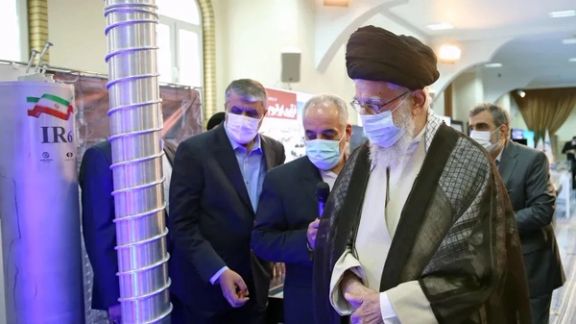
Iran says will never engage in talks aimed at dismantling its nuclear program
The Islamic Republic will never participate in talks intended to dismantle its nuclear program, Iran's mission to the United Nations said on Sunday, a day after Supreme Leader Ali Khamenei rejected nuclear talks with world powers.
"If the objective of negotiations is to address concerns vis-à-vis any potential militarization of Iran’s nuclear program, such discussions may be subject to consideration," Iran's UN mission said in a post on its official X account.
However, it added, "should the aim be the dismantlement of Iran’s peaceful nuclear program to claim that what Obama failed to achieve has now been accomplished, such negotiations will never take place."
A few hours later, Iran's foreign minister appeared to revise the statement by Tehran's UN mission.
"Iran's nuclear energy program has always been—and will always remain—entirely peaceful. There is fundamentally no such thing as its 'potential militarization'," Abbas Araghchi said.
"We will NOT negotiate under pressure and intimidation. We will NOT even consider it, no matter the subject," he added in a post on his X account.
On Saturday, Khamenei dismissed the prospect of talks with the United States in his first public speech after President Donald Trump said he sent a letter to him.
"The insistence of some bullying governments on negotiations is not aimed at resolving issues but rather at asserting dominance and imposing their demands," Khamenei said in a meeting with Iranian officials in Tehran.
"The Islamic Republic of Iran will certainly not accept their demands," he added.
The White House, responding to Khamenei's comments, reiterated Trump's assertion that Tehran can be dealt with either militarily or by making a deal.
"We hope the Iran regime puts its people and best interests ahead of terror," White House National Security Council spokesman Brian Hughes said in a statement.
A State Department spokesperson also told Iran International the Trump administration will maintain its maximum pressure campaign on Iran if Tehran refuses to reach an agreement.
Trump warned on Friday that the situation with Iran had reached a critical stage, adding that he preferred to reach a deal over Tehran's nuclear program than turn to military force.
Qatar's prime minister has warned that an attack on Iran's nuclear facilities would contaminate the waters of the Persian Gulf, threatening life in Qatar, the UAE and Kuwait.
Sheikh Mohammed bin Abdulrahman Al Thani said on Sunday that an attack on Iran's nuclear sites would leave the Persian Gulf with "no water, no fish, nothing ... no life".
He specifically mentioned his country, Kuwait and the UAE, and said some of Iran's nuclear sites were closer to Doha than they were to Tehran. Iran's only operating nuclear power plant is on the Persian Gulf coast at Bushehr.
Qatar, the UAE and Kuwait are three desert states, facing Iran on the opposite side of the Persian Gulf, with minimal natural water reserves and more than 18 million people whose only supply of potable water being desalinated water drawn from the Persian Gulf.
Israel has repeatedly threatened to bomb Iran’s nuclear sites but on Friday, US President Donald Trump said he had written to Iran warning it to open negotiations or face a military attack.
Iranian authorities have seized over 240,000 cryptocurrency mining devices in the past three years, the state electricity company Tavanir said on Sunday, as the country grapples with power shortages and network instability.
Mostafa Rajabi Mashhadi, Tavanir's CEO, told state media that the confiscated mining rigs consumed an estimated 800 megawatts of electricity.
He compared this to the 1,000-megawatt capacity of the Bushehr nuclear power plant, highlighting the significant strain the mining operations place on the national grid.
"Unfortunately, illegal use of the electricity network still occurs in the country," Mashhadi said, calling for increased cooperation with the Economic Security Police to identify and confiscate remaining illegal miners.
Under Iranian law, possession of unregistered cryptocurrency mining equipment can result in confiscation of the devices and fines of up to three times their value.
Tavanir's deputy for transmission and foreign trade estimated that approximately 700,000 illegal mining rigs are still operating in Iran, consuming around 2,000 megawatts of electricity.
The crackdown comes as Iran faces increasing pressure on its electricity grid, exacerbated by factors such as rising temperatures and increased industrial activity. It has led to mass closures of government offices, banks, and schools across most of Iran.
Earlier in the day, Iran's Power Plants Trade Association Chairman Ali Nikbakht predicted a 25,000-megawatt electricity deficit for next year, representing one-third of national consumption.
Iran's foreign minister says the country’s nuclear program cannot be destroyed by military means, citing the program's widespread dispersion and robust protection.
During an interview at the Iranian consulate in Jeddah, Saudi Arabia on Friday, Foreign Minister Abbas Araghchi told AFP, “Iran's nuclear program cannot be destroyed through military operations" because the technology is ingrained, facilities are dispersed and protected, and Iran would retaliate proportionally.
He made the remarks as Israel has repeatedly threatened to bomb Iran’s nuclear sites. Later on Friday, US President Donald Trump said he had written to Iran warning it to open negotiations or face a military attack.
Araghchi said that “if the Israelis or others were sure that they would achieve their goals through a military attack, they would have done so by now, but such a possibility is not feasible.”
Araghchi dismissed the threat of war against Iran as mere rhetoric, warning that any attempt to act on it would pose a grave danger and ignite a widespread conflict.
“The threat of war against Iran is a threat that is just talked about. Implementing this threat would be a very big danger and would turn into a widespread fire.”
Successive rounds of US sanctions on tankers and companies involved in Iran's oil trade are slowing shipments to China but trade with one of Iran's most important allies continues in 'dark mode' in spite of maximum pressure, according to Bloomberg.
Sanctions are having an impact on the trade link by increasing costs and logistical hurdles, Bloomberg reported, citing Chinese refinery executives and shipping analysts.
Private Chinese refineries, which are the primary buyers of Iranian crude, have faced supply disruptions in recent weeks due to seller defaults, Bloomberg reported, citing industry sources.
While no specific reason was given, refinery executives attributed the issues to rising expenses and logistical challenges caused by US sanctions.
Washington has blacklisted more than two-thirds of the 150 vessels that transported Iranian crude last year.
The sanctions announced on February 24 followed similar measures by the US Treasury in late 2024, targeting ultra-large crude carriers in Iran's shadow fleet.
More than half of the tankers sanctioned by the United States have ceased operations outside Chinese or Iranian terminals, an investigation by Iran International revealed last month.
The increased restrictions have led to record-high freight costs, with the chartering rate for a non-sanctioned supertanker moving Iranian oil from Malaysia to China reaching up to $6 million—an increase of 50% from last year, Bloomberg reported, citing traders.
Some Chinese port authorities are also taking precautions. Shandong Port Group, which operates in a key refining hub, recently advised against handling blacklisted tankers, Bloomberg's report said.
Despite these obstacles, flows surged to a four-month high last month, partly due to a backlog of delayed cargoes, Bloomberg said.
However, an increasing number of ship-to-ship oil transfers are being conducted in "dark" mode, where vessels switch off their transponders to avoid detection, Bloomberg reported, citing satellite images and analysts.
In the waters off Malaysia, a key hub for Iranian crude shipments, up to seven such transfers were observed in a single day last month. Analysts noted that most of these operations were entirely "dark," indicating that shippers are taking greater precautions as Washington signals increased enforcement efforts.
On Wednesday, Reuters reported that the Trump administration is considering a plan to inspect Iranian oil tankers under an international accord designed to curb the spread of weapons of mass destruction.
Anoop Singh, the global head of shipping research at Oil Brokerage Ltd, told Bloomberg that financial institutions working with private Chinese refiners importing Iranian oil may come under fresh scrutiny. He added that Washington could choose to pressure countries such as India and the United Arab Emirates, where key shipowners and dark fleet operators are based.
He said that so far, the US has focused its sanctions on ships and owners, but the market has managed to create workarounds. “However, there are more critical parts of the network to target, from banks to governments to flag states and insurers — and regulatory avenues to explore,” Singh told Bloomberg.
The US will maintain its maximum pressure campaign on Iran if Tehran refuses to reach an agreement, a State Department spokesperson told Iran International, after Iran's Supreme Leader Ali Khamenei ruled out the possibility of negotiations with Washington.
"If the Iranian regime does not want a deal, the President is clear, Iran will remain under the restored maximum pressure campaign," the spokesperson said.
"President Trump has been clear that the United States is committed to preventing Iran from acquiring a nuclear weapon and expressed his willingness to discuss a deal with Iran," the spokesperson added.
Khamenei dismissed the prospect of talks with the United States on Saturday in his first public speech after President Donald Trump said he sent a letter to him.
"The insistence of some bullying governments on negotiations is not aimed at resolving issues but rather at asserting dominance and imposing their demands," Khamenei said in a meeting with Iranian officials in Tehran.
"The Islamic Republic of Iran will certainly not accept their demands," he added.
His comments followed Trump’s revelation that he had sent Khamenei a letter offering negotiations on Iran's nuclear program while warning that military intervention was the alternative.
Iran's Foreign Minister Abbas Araghchi said on Saturday Tehran has not yet received Trump's letter to Khamenei.
Trump warned on Friday that the situation with Iran had reached a critical stage, adding that he preferred to reach a deal over Tehran's nuclear program than turn to military force.