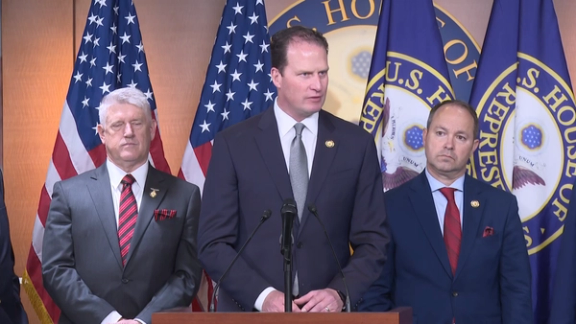
Republican Representative Zach Nunn of Iowa addresses reporters on April 1, 2025.
Republican lawmakers on Tuesday urged a tougher line on Washington's Mideast adversary Tehran and outlined plans for new legislation targeting the Islamic Republic as tensions have soared in recent days.
US President Donald Trump said on Sunday that Iran would face bombing if it did not agree to a new nuclear deal, prompting a senior advisor to Iran's Supreme Leader Ali Khamenei to moot the pursuit of a bomb in the event of an attack.
The Republican Study Committee (RSC) in a press conference advocated a series of new acts it said would increase pressure on Tehran in line with Trump's policy of stepping up sanctions in a bid to force the Islamic Republic to the negotiating table.
It named ten proposed pieces of legislation including the Free Iraq from Iran Act, Stop Corrupt Iranian Oligarchs and Entities Act and the No Sanctions Relief for Terrorists Act.
"This package is the strongest Iran sanctions and security package delivered to date. The Iranian people are not the target," Congressman August Pfluger of Texas told reporters.
"It's the leadership that wants to gain a nuclear weapon and wants to continue that pariah state of sowing chaos and terrorism throughout the world," he added. "If I were them, I would make the choice of announcing loud and clear that they will not attain a nuclear weapon."
The US director of national intelligence Tulsi Gabbard said last week that Washington assessed Iran is not building nuclear weapons but that a taboo in Iran on discussing nuclear weapons in public was eroding.
The RSC is a conservative caucus for house Republicans founded in 1973.
"Right now, Tehran has a very clear offering, and that's to enter into negotiations in good faith with President Trump, who has laid out not only a roadmap for the Persian Farsi people to be successful, but for Iran to have a future," Representative Zach Nunn of Iowa said.
"It simply means stop funding terrorism, stop avoiding the sanctions regime, come to the table, de-escalate and end a nuclear regime that only ends in death for potentially hundreds of thousands of people in the Middle East."
Trump told NBC News on Sunday that if a deal was not reached, "there will be bombing — and it will be bombing the likes of which they have never seen before." Khamenei vowed retaliation to any attack.
An attack, a veteran nuclear negotiator and advisor to the Supreme Leader said on Monday, would push Iran toward acquiring nuclear weapons to ensure its defense,
Tehran denies seeking nuclear weapons and Khamenei has issued a religious injunction against them, but the United Nations nuclear watchdog says Iran has enriched more uranium than any state lacking a bomb.
"Not only are they pursuing a nuclear weapon to vaporize Israel and ultimately the United States, they're developing ICBMs, which can only be for one purpose, and that is to deliver a nuclear attack against the American people," Representative Joe Wilson of South Carolina said.
"And there must be verification, not the charades we've had with the previous administrations."
Trump withdrew from a 2015 international nuclear agreement with Iran in his first term after bashing it as too lenient. Khamenei said talks were pointless if a new deal could easily be broken.
The US military has deployed long range bombers at a strategic Indian Ocean airbase, a spokesperson told Iran International last week, a move which presaged major bombing campaigns against Afghanistan in 2001 and Iraq in 2003.
Tehran and Washington have taken their exchange of threats to a new level, with the US president raising the prospect of bombing Iran and Tehran not only vowing to retaliate but also threatening to build nuclear weapons.
Iran’s threats have also included the far-fetched idea of targeting the US base at Diego Garcia in the Indian Ocean—a claim dismissed by military analysts, who argue that Iran lacks the capability to strike such distant targets. Still, Iran’s defense doctrine is rooted in asymmetrical warfare, and its commanders have often warned they could strike in unexpected ways.
Following Khamenei’s sharp response to Trump’s threat, Iran’s air force commander Amir Ali Hajizadeh noted that there are dozens of US targets within close range in the Persian Gulf region.
As tensions rose further, senior Khamenei adviser Ali Larijani suggested that Trump’s threats could push Iran toward building nuclear weapons. That message was quickly echoed by hardline MP Ahmad Naderi, a member of the parliament’s presidium, who argued that nuclear weapons have secured North Korea’s safety—and questioned why Iran should not follow the same path.
Larijani’s statement, however, carried a different weight. He has long been seen as a measured political figure—unlike the more impulsive military commanders or obscure ultraconservative lawmakers. As speaker of Iran’s parliament (Majles) for 12 years and one of the key architects of the 2015 nuclear deal with the West, Larijani played a central role in shaping Iran’s diplomacy. Hardliners still recall, often with resentment, how he pushed the JCPOA agreement through a predominantly hardline parliament in just 20 minutes.
At the same time, Larijani is a US-educated politician and a former IRGC officer, trusted by Khamenei both for his background and his lineage—he is the son of one of Iran’s highest-ranking clerics. He once oversaw Tehran’s nuclear file and only stepped down as Secretary of the Supreme National Security Council due to a personality clash with ultraconservative former President Mahmoud Ahmadinejad.
By allowing someone like Larijani to voice support for building nuclear weapons, Khamenei revealed one of the key complexities of Iranian politics. He is signaling to both Trump and the Iranian public that pressure to pursue the bomb is coming not just from hardline agitators in parliament, but also from figures seen as moderate and pragmatic. In doing so, he effectively sidelines his much-publicized fatwa banning nuclear weapons—though few ever believed it was an absolute or irreversible stance.
At the same time, Larijani’s statement—as a politician who often echoes Khamenei’s broader policy positions—renders previous threats about Iran leaving the Non-Proliferation Treaty (NPT) largely redundant. Once a country openly talks about building a nuclear bomb, it effectively signals its departure from the NPT, regardless of any formal announcement.
In a commentary on Larijani’s statement, Nour News—a media outlet affiliated with Iran’s Supreme National Security Council—wrote on Tuesday that Trump’s talk of bombing Iran has triggered serious concerns about national security. According to the commentary, this growing anxiety could shift public opinion in favor of changing Iran’s nuclear policy. It added that the United States should be held accountable for accelerating Iran’s potential turn toward developing nuclear weapons.
Nour News quoted Larijani as warning that any US or Israeli military strike aimed at ending Iran’s nuclear program could instead push Tehran toward the very path it has so far avoided.
The outlet also claimed that with the backing of Russia and China, Iran is no longer isolated on the international stage. Echoing Larijani’s remarks, it suggested that Yemen is now capable of responding to US aggression in ways that would prove costly for Washington and its allies.
According to Nour News, “The United States now faces two choices: either continue its hostile behavior and drag the region into an unprecedented security crisis, or change course to ease rising tensions.” The commentary added that Trump’s threats risk further complicating the situation, noting that “Iran has many options to defend its national security.” It concluded by stating that “Iran’s final decision will depend on future US actions.”
Meanwhile, Larijani’s brother-in-law, Ali Motahari, told the press that “there is nothing wrong with negotiating with the United States.” He went further, saying that “President Massoud Pezeshkian should have accepted Trump’s offer to negotiate”—though he did not mention that Pezeshkian lacked Khamenei’s approval to do so at the time.
Russia has warned against strikes on Iran's nuclear infrastructure as China called for diplomatic efforts after US President Donald Trump threatened to bomb the country if Tehran did not come to an agreement over its nuclear program.
"Threats are indeed being heard, ultimatums are also being heard," Russian Deputy Foreign Minister Sergei Ryabkov told the Russian journal International Affairs in an interview on Tuesday.
"We consider such methods inappropriate, we condemn them, we consider them a way for (the United States) to impose its own will on the Iranian side," he added.
Trump on Sunday warned that Iran could face bombing and secondary tariffs if a nuclear deal was not reached with Washington.
Ryabkov warned that a US strike on Iran, particularly targeting its nuclear infrastructure, could have catastrophic consequences for the entire region.
"There is still time, and the 'train has not left the station' yet. We must intensify efforts to reach a reasonable agreement," Ryabkov said. "Russia is ready to offer its services to Washington, Tehran and all parties interested in resolving this issue."
Kremlin spokesman Dmitry Peskov also said last month that Russian President Vladimir Putin had agreed to mediate nuclear talks between Washington and Tehran.
China also expressed concerns on Tuesday, with Ministry of Foreign Affairs spokesperson Guo Jiakun saying that the Iranian nuclear issue should be resolved through diplomatic means.
"China maintains that resolving the Iranian nuclear issue through political and diplomatic means is the only right option and that new consensus needs to be reached," Jiakun said in response to a reporter's question about Trump's threats against Iran during a press briefing.
"The US needs to show political sincerity and resume talks as soon as possible. Slapping sanctions, pressuring, and threatening with the use of force will lead nowhere,” he added.
Earlier in March, an Emirati official brought a letter from Trump proposing nuclear talks with Tehran, which the Islamic Republic's Supreme Leader Ali Khamenei rejected, saying such a proposal was deception from Washington amid crippling sanctions on Iran.
Iran officially responded to a letter last Wednesday seeking a nuclear deal. While Iran has rejected direct negotiations with the United States, Iran's President Masoud Pezeshkian said indirect talks can continue, adding that Ali Khamenei's response to Trump’s letter was delivered to the US contact in Oman.
A member of the Iranian parliament's presiding board has publicly advocated for Iran to develop and test an atomic bomb, arguing it would bring security to the nation similar to that of North Korea.
Ahmad Naderi, a representative for Tehran, made his comments in a post on X, echoing sentiments expressed by some Iranian hardliners after threats from US President Donald Trump that Iran would be bombed if it does not agree to a nuclear deal.
"Observing the behavior and words of Trump during his first presidential term with North Korea shows that having an atomic bomb has brought security for Korea," Naderi wrote.
During his 2017-2021 presidency, Donald Trump held three meetings with North Korean leader Kim Jong Un, in Singapore, Hanoi, and at the Korean border, the first time a sitting US president had set foot in the country.
Reuters reported in November that Trump's team was discussing pursuing direct talks with North Korean leader Kim Jong Un, hoping a fresh diplomatic push could lower the risks of armed conflict.
Naderi, who was sanctioned by the European Union in 2010 for designing a plan to respond to the European Union in case the Revolutionary Guards were included in the terrorism list, added, "For a long time now, many of the country's and the revolution's elite and concerned individuals have been requesting the testing and announcement of a [atomic] bomb."
In a direct response to Trump, he added, "If we were also armed with an atomic bomb, Trump would not dare to threaten bombing."
On Monday, Ali Larijani, a veteran nuclear negotiator and advisor to Supreme Leader Ali Khamenei, suggested that such threats from the US could push Iran towards acquiring nuclear weapons for self-defense, noting that public pressure for such a move would likely increase.
In October, a group of lawmakers called on Iran's Supreme National Security Council to review the country's defense doctrine and consider adopting nuclear weapons as the risk of escalation with Israel also continues to grow. Last year the two archenemies engaging in direct aerial attacks as the once long-time shadow war came to a head.
The MPs argue that Khamenei can reconsider his religious ban on nuclear weapons on the grounds that the circumstances have changed.
While Iran denies seeking nuclear weapons and Supreme Leader Khamenei has issued a religious decree against them, recent statements from political figures and lawmakers indicate a growing debate within Iran about its nuclear policy in the face of perceived external threats.
The UN's nuclear watchdog reports that Iran has enriched more uranium than any state without nuclear weapons.
In February, the Wall Street Journal reported that Iran has "sharply increased its stockpile of highly enriched uranium in recent weeks, according to a confidential United Nations report, as Tehran amasses a critical raw material for atomic weapons."
According to the report, it said that the increase in Iran’s holdings of uranium enriched to 60%, or nearly weapons grade, gives it enough to produce six nuclear weapons.
The White House said on Monday that a top Houthi missile expert was killed in US strikes, as President Donald Trump warned that that military action against the Iran-backed Houthi rebels in Yemen would continue until the group no longer threatens maritime security.
"The choice for the Houthis is clear: Stop shooting at US ships, and we will stop shooting at you. Otherwise, we have only just begun, and the real pain is yet to come, for both the Houthis and their sponsors in Iran," Trump said in a Truth Social post.
Following Trump’s remarks, the United States Central Command (CENTCOM) confirmed ongoing attacks on Houthi positions in Yemen on Tuesday, releasing video footage of the strikes.
The White House said that recent US strikes in Yemen have resulted in the death of a top Houthi missile expert. However, the US military has not confirmed the death, and the identity of the Houthi commander remains unclear.
National Security Advisor Mike Waltz, in comments to CBS News after the March 15 strikes, said that the first wave of attacks killed “their head missileer.”
Reuters reported that unnamed US officials said they were unaware of any independent confirmation from the US military regarding the death of the individual in question.
While on March 15, CENTOM said in a press release that its forces initiated an operation consisting of precision strikes against Iran-backed Houthi targets across Yemen, it did not provide further details on the targets.
Trump also referred to the death of Houthi leaders in his post on Truth Social, saying "The Iran-backed Houthi Terrorists have been decimated by the relentless strikes over the past two weeks. Many of their fighters and leaders are no longer with us."
US Air Force Lieutenant General Alexus Grynkewich did not mention a missileer in his comments about US strikes on Houthi positions on March 17 but confirmed that an aerial drone facility was targeted, along with several key leaders, the Reuters report added.
The strikes, the largest US military operation in the Middle East since Trump took office, aim to pressure the Iran-backed Houthis to end their attacks on shipping in the Red Sea, including US warships.
The group has carried out over 100 attacks on shipping since late 2023, citing solidarity with Palestinians in Gaza. What began as a campaign against Israeli-backed ships has led to a total blockade on global shipping with multiple international seamen killed in attacks.
Iran has formally lodged a complaint with the United Nations Security Council over US President Donald Trump's threat to bomb the country.
Iran's UN Ambassador Amir Saeid Iravani said in a letter that Tehran "strongly warns against any military adventurism and will respond swiftly and decisively to any act of aggression or attack by the United States or its proxy, the Israeli regime, against its sovereignty, territorial integrity, or national interests."
Trump on Sunday threatened to bomb Iran if the country did not come to an agreement with Washington over its nuclear program.
"If they don't make a deal, there will be bombing — and it will be bombing the likes of which they have never seen before," Trump was quoted as saying during a phone interview with NBC News' Kristen Welker.
Earlier on Monday, Iran's Supreme Leader Ali Khamenei vowed the United States would face retaliation if it follows through on Trump’s threat to bomb Iran.
While Iran denies seeking a nuclear weapon the UN's nuclear watchdog says Tehran has enriched more uranium than any state lacking a bomb.
Last month, Trump signed a directive restoring the so-called maximum pressure policy on Iran of his first term and warned of "catastrophic" consequences if Tehran does not make a deal on its nuclear program.