Iran says it pushed back on sanctions threat in Europe nuclear talks
Iran challenged European powers over their threat to renew UN sanctions during nuclear talks in Istanbul on Friday, Deputy Foreign Minister Kazem Gharibabadi said, in the first negotiations since Israeli and US attacks last month.
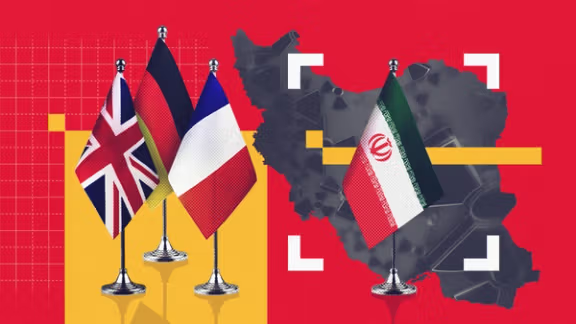
Gharibabadi said he and Deputy Foreign Minister Majid Takht Ravanchi led what he called “serious, frank, and detailed” discussions with Britain, France and Germany. The meeting focused on sanctions relief and the future of the 2015 nuclear deal, with both sides presenting specific proposals and agreeing to continue consultations.
“We explained our principled positions, including on the so-called snapback mechanism,” Gharibabadi wrote on X, adding that Tehran strongly criticized the E3’s stance on last month’s military strikes.
Iran’s Foreign Ministry spokesman Esmail Baghaei said earlier in the day that the talks were a “test of realism” for the E3 and warned against any effort to extend UN Security Council Resolution 2231, which expires in October.
Baghaei said the three powers had “no legal standing” to pursue such a move and accused them of aligning with the United States and Israel and Israel.
Iran did not reject a European offer to extend the UN resolution tied to the 2015 nuclear deal during talks in Istanbul on Friday, The Wall Street Journal’s Laurence Norman reported citing a European diplomat.
Norman said the meeting produced no breakthrough or breakdown and involved meaningful discussion as the E3 and EU offered a clear diplomatic proposal, with the European side prepared to pursue snapback sanctions but also expressed openness to an extension if Iran takes certain steps.
“There was a sense until recently that Iran seemed uninterested in any extension. Today that seems to have shifted,” Norman said on X, describing the talks as a potential turning point ahead of a decision expected by the end of August.
The Financial Times cited Western diplomats as saying that the E3 is considering offering Iran a delay in reimposing sanctions if Tehran resumes cooperation with the International Atomic Energy Agency and engages with Washington. Without progress, the snapback could be triggered by mid-September.
Gharibabadi said a technical IAEA team will travel to Tehran in the coming weeks, but inspections of nuclear facilities are not planned. Any future cooperation, he added, will depend on Iran’s Supreme National Security Council and laws passed in response to the June strikes.
The triggering of international sanctions on Iran threatened by Europe could unleash a cascade of new challenges on the country's energy sector, from shrinking oil exports, blocked payments, halted infrastructure upgrades and deeper isolation from global markets.
Originally designed as a safeguard within the 2015 Joint Comprehensive Plan of Action (JCPOA), so-called snapback allows any member of the United Nations Security Council to unilaterally reimpose sanctions if Iran is found to be in serious noncompliance.
The mechanism cannot be blocked by a Security Council veto.
What’s at risk?
If activated, snapback would reintroduce bans on Iran’s banking, insurance, shipping, and, most crucially, oil and gas sectors.
Iran’s already limited energy exports would be further squeezed, particularly as China—the country’s top customer—faces its own pressure from US secondary sanctions.
The blow wouldn’t stop at exports. Renewed sanctions would also block access to international banking systems, complicating payments and deterring investment.
With infrastructure already aging, efforts to modernize production facilities or increase capacity would stall. Crucial imports of equipment, spare parts, and technology would dry up, making basic maintenance difficult—let alone expansion.
Ripple effects
The reimposition of sanctions wouldn’t just hit Iran—it would ripple across global energy markets. A sharp decline in Iranian exports could tighten supply and drive up oil prices, especially in Asia and Europe.
Investors and insurers are already wary. A full snapback would only raise the stakes.
More concerning is Tehran’s potential response.
Iranian officials have warned that reactivating the snapback mechanism could trigger a shift in military posture, an exit from the Non-Proliferation Treaty (NPT), or an acceleration of its nuclear program.
The risk isn’t just economic—it’s strategic.
A more isolated Iran might double down on asymmetric tactics, expand regional proxy activities, or escalate maritime disruption in the Gulf.
The symbolic weight of snapback could also undercut any remaining diplomatic channels and push Tehran further from the negotiating table.
Iran’s energy goals on the brink
Despite sanctions, Iran has managed to modestly expand oil production—targeting an increase of 600,000 barrels per day by 2025—and made incremental gains in natural gas output, including at South Pars Phase 11.
But snapback could freeze or reverse this progress.
Refinery upgrades are already underway, but vulnerable to supply chain disruptions. Without access to critical technology or parts, domestic fuel production could falter, forcing greater reliance on crude exports just as export channels are closing.
Meanwhile, renewable energy remains marginal, and any growth in that sector would likely be stifled by sanctions-induced isolation.
Endurance and limits of pressure
Iran’s shadow export network has proven resilient.
Since 2022, an estimated 42 million barrels have moved via sanctioned tankers. Strategic ties with China have helped cushion the impact, and Tehran’s evasion playbook is growing more sophisticated.
Still, the economic toll is real.
Iran loses billions of dollars annually due to reduced crude sales. And snapback could widen that gap—though it may not deliver the decisive blow some expect.
Fragmented global enforcement, selective compliance by neighboring states, and geopolitical shifts toward multipolarity all chip away at the tool’s practical effect.
Reactivating the snapback mechanism would undoubtedly raise pressure on Iran’s economy, particularly its energy sector. But it may also entrench defiance, destabilize the Persian Gulf and weaken the very diplomatic leverage it’s meant to reinforce.
Whether it isolates Iran or backfires will depend not only on Tehran’s response, but on how fractured and fatigued the global sanctions consensus has become.
Iran has signaled readiness to resume technical-level discussions with the UN nuclear watchdog, though IAEA chief Rafael Grossi said Friday that any planned visit would not yet involve inspectors.
Speaking in Singapore, Grossi said the agency had proposed talks with Tehran on “the modalities as to how to restart or begin [inspections] again,” beginning with procedural issues and potentially moving to high-level consultations later.
Grossi emphasized the urgency of re-engagement, warning that the agency still lacks updated information on Iran’s stockpile of highly enriched uranium. “This is why it is so important that we engage as soon as possible and that we can start our inspection,” he said.
Iran suspended cooperation with the IAEA following last month’s Israeli and US airstrikes on its nuclear facilities, accusing agency chief Rafael Grossi of bias and failing to condemn the attacks.
Iran says IAEA visit will not include nuclear site inspections
On Friday, Iranian Foreign Ministry spokesperson Esmail Baghaei said a senior IAEA official is expected to visit Tehran in the coming weeks for talks on a new cooperation framework, but emphasized that there are no plans for the delegation to inspect nuclear facilities damaged in the strikes. He said the visit will focus on procedural coordination, and any further cooperation will depend on decisions by Iran’s Supreme National Security Council.
Deputy Foreign Minister Kazem Gharibabadi had earlier confirmed that a technical IAEA delegation would travel to Tehran, reiterating that site inspections were not on the agenda. He said Iran’s engagement with the agency is being guided by legislation passed after the June attacks.
Iran’s domestically made Nahid-2 telecommunications satellite was successfully launched into orbit on Friday aboard a Russian Soyuz rocket, Iranian media reported, in what marks Tehran’s second space-related operation this week.
The launch took place from Russia’s Vostochny Cosmodrome at 9:54 a.m. Tehran time, as part of a broader mission carrying two Russian Ionosfera-M satellites and 18 smaller payloads. Russian media did not publicly name Iran but said one of the CubeSats aboard was being launched “for the benefit of a foreign customer.” Iranian outlets later confirmed it was Nahid-2.
The mission comes just four days after the Islamic Revolutionary Guard Corps (IRGC) conducted a suborbital test of its Qased satellite carrier, part of what it described as an effort to enhance Iran’s space capabilities. Observers say the timing reflects Tehran’s intent to project technological resilience and strategic messaging following last month’s war with Israel.
Western officials have repeatedly voiced concern over Iran’s satellite launches due to their dual-use nature. “The same rocket that launches satellites can launch missiles; it’s the identical technology,” said Fatima Al-Asrar, a Yemeni-American policy analyst.
Tehran insists its space program is peaceful, but analysts say each launch potentially advances Iran’s ballistic missile know-how. “The timing shows Iran wants to project strength despite its recent setbacks,” said Middle East analyst Sina Azodi.
In January last year, the European Troika, Britain, France, and Germany, condemned Iran’s launch of the Soraya satellite aboard a Qaem 100 rocket, warning it "uses technology essential for the development of a long-range ballistic missile system."
Iran pushed back Friday on the prospect of extending a UN resolution tied to the 2015 nuclear deal, as it resumed direct talks with Britain, France and Germany for the first time since Israeli and US strikes on its territory.
Tehran rejects talk of extending UN resolution
Iran’s Foreign Ministry spokesman Esmail Baghaei described the meeting with Britain, France and Germany as a “test of realism” for the E3 powers, calling it a chance for them to correct past positions. He said Iran opposes any extension of UN Security Council Resolution 2231, which underpins the nuclear deal and expires in October, arguing that the E3 have “no legal standing” to pursue such a move.
Baghaei accused the three countries of siding with the US and Israel during last month's military strikes on Iranian soil and said they had “marginalized themselves” as negotiating partners.
E3 weighing sanctions delay
According to Western diplomats cited by the Financial Times, European powers are considering offering Iran a delay in reimposing UN sanctions, contingent upon Tehran resuming talks with Washington and restoring some cooperation with the International Atomic Energy Agency (IAEA). Without such a step, the so-called snapback mechanism could be triggered as early as mid-September.
IAEA to send team, but no access to nuclear sites
Baghaei said a senior IAEA official is expected to visit Tehran in the coming weeks for talks on a new cooperation framework, but emphasized there are no plans for the delegation to inspect nuclear facilities damaged in last month’s Israeli and US strikes. The focus of the visit, he said, will be procedural coordination, and any further cooperation will depend on decisions by Iran’s Supreme National Security Council.
Deputy Foreign Minister Kazem Gharibabadi had earlier confirmed that a technical IAEA team would travel to Tehran, reiterating that site inspections were not on the agenda. He said Iran’s engagement with the agency was being guided by parliamentary legislation passed in response to the June attacks.
Britain, France and Germany are prepared to delay a looming UN deadline to reimpose international sanctions on Iran if Tehran agrees to resume talks with Washington and cooperate with UN nuclear inspectors, Western diplomats told the Financial Times.
The proposal is expected to be presented during talks in Istanbul on Friday, the first direct meeting between European officials and Iranian negotiators since Israel’s 12-day war with Iran, which briefly involved the US, FT reported on Friday.
The offer would postpone the so-called snapback mechanism tied to the 2015 nuclear deal, which could automatically reinstate UN sanctions as early as mid-September unless Iran returns to negotiations. Any extension would likely require a UN Security Council resolution, diplomats told FT.
Iran says Europe lacks legal standing
Iran’s foreign ministry dismissed the European proposal as both illegitimate and irrelevant. “When the premise of restoring sanctions has no legal or logical basis, and the European parties themselves lack the authority to take such action, then talk of extending Resolution 2231 is doubly meaningless and groundless,” ministry spokesman Esmail Baghaei said Friday.
He added that the European trio had disqualified themselves by violating their own commitments under the 2015 deal and backing US and Israeli military action. “The Istanbul meeting is a chance for them to correct course, if they want to avoid further eroding their credibility.”
Iran insists enrichment will continue
Iran has suspended cooperation with the International Atomic Energy Agency since the June strikes on its nuclear facilities. However, Deputy Foreign Minister Kazem Gharibabadi said this week that a technical team from the agency would visit Tehran soon to discuss a “new modality” for cooperation, excluding access to nuclear sites.
Iranian Foreign Minister Abbas Araghchi told state television on Thursday that the upcoming talks did not signal any shift in Tehran’s position. “Uranium enrichment will continue and we will not compromise on the Iranian nation’s rights,” he said.
Iran insists its nuclear program is peaceful, while the US maintains that Tehran must abandon enrichment before talks resume. The IAEA has said Iran could restart uranium production “within months.”