Lebanon minister declines Iran visit as tensions fester over Hezbollah
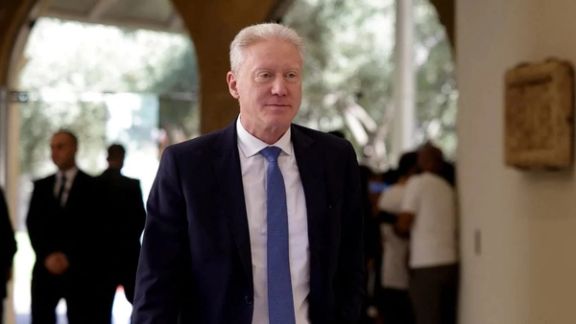
Lebanon’s Foreign Minister Youssef Raji said he had declined an invitation from Foreign Minister Abbas Araghchi to visit Tehran as Beirut continues to push for the disarmament of Iran-backed Hezbollah.
Israel mauled the group at the tail end of a year-long war which ended in November of last year, after which the Lebanese government tasked the army with confiscating Hezbollah's arsenal by 2026.
Iran has resisted the initiative to defang the group which it founded in 1982, saying continued Israeli attacks justify what it calls Hezbollah's resistance.
In a written reply published by Lebanon’s foreign ministry on X, Raji said not accepting the visit “does not mean rejecting discussion,” adding that “the favorable conditions are not available.”
He renewed an invitation to Araghchi to meet in “a neutral third country to be agreed upon.”
Raji said Lebanon was ready to establish “a new phase of constructive relations” with Iran, but only if ties were based “exclusively on mutual respect and absolute respect for the independence and sovereignty of each country and non-interference in internal affairs under any pretext.”
“Building any strong state cannot happen unless the state alone, through its national army, holds the exclusive right to carry arms and the sole authority over decisions of war and peace,” he added, saying Araghchi was welcome to visit Lebanon.
Iran invitation amid Hezbollah debate
Iran invited Raji to Tehran earlier this month to discuss bilateral ties, according to Iran’s foreign ministry, amid growing debate in Lebanon over the future of the Iran-aligned Hezbollah group and calls for state control over weapons.
The exchange followed criticism in Beirut of comments by Ali Akbar Velayati, a senior adviser to Iran’s Supreme Leader, who said Hezbollah’s existence was more important than “bread and water” for Lebanon.
Responding at the time, Raji wrote on X: “What is more important than bread and water for us is our sovereignty, freedom and independent decision-making,” rejecting what he described as outside interference.
Lebanon’s stance comes as Israel and Lebanon expand contacts through a committee monitoring their 2024 ceasefire, with Beirut saying the group could verify Israeli accusations that Hezbollah is re-arming.
Israel continues to occupy outposts on Lebanese territory and has launched a series of deadly attacks which it says targets Hezbollah militants despite the ceasefire.
Iranian authorities are stepping up the use of courts and security agencies to target members of the Baha’i community through prison sentences, arbitrary detention and property seizures, the Baha’i International Community and Human Rights Watch said.
“Iranian authorities are relentlessly persecuting Baha’is, depriving them of the most basic human rights in what amounts to ongoing crimes against humanity – solely because of their faith,” said Human Rights Watch Iran researcher Bahar Saba, quoted in the statement.
The groups said the crackdown intensified after the Israel-Iran war in June and involved arrests, interrogations, unfair trials and asset confiscation.
Between June and November, the Baha’i International Community recorded more than 750 cases of harassment across Iran, three times the number in the same period last year. The incidents included more than 200 raids on homes and businesses and the arrest of at least 110 Baha’is. Courts issued prison sentences of between two and ten years, including against mothers separated from young children.
“A justice system that should deliver fairness and neutrality instead serves as a weapon of persecution,” said Simin Fahandej, the Baha’i International Community’s representative to the UN in Geneva.
EU pressure builds over Iran record
The statements follow moves in Europe to raise pressure on Tehran. In April, the EU imposed sanctions on parts of Iran’s judiciary and several judges and prosecutors over human rights violations, including the persecution of Baha’is.
Last month, the European Parliament adopted a resolution urging EU governments to sanction Iranian officials involved in abuses against the Baha’i community and to press for the release of those jailed for their beliefs.
Iran does not recognize the Baha’i faith, the country’s largest non-Muslim religious minority, which rights groups say has faced sustained repression since the 1979 Islamic Revolution.
Mixmag, a leading electronic music magazine, has named Iranian DJ, producer and composer Nesa Azadikhah among its top DJs for 2025, noting her expanding role in electronic music and her support for Iranian artists.
The magazine said Azadikhah has become a standout figure through her work on IDM and breaks-focused Makhunik Records and Apranik Records, which she co-founded with artist AIDA. It said she has released music that supports Iranian musicians and raises money for causes including women prisoners whose freedom of speech is restricted.
Mixmag said Azadikhah organizes events in Tehran, curates artists through her platform Deep House Tehran and continues to release a steady flow of productions.
The magazine described her as one of the hardest working figures in Iran’s electronic music scene as she gains recognition abroad.
Crackdown widens on women artists in Iran
The attention for Azadikhah comes as Iranian authorities increase pressure on women in music and public performance.
Iran’s cyber police, known as FATA, blocked the Instagram accounts of two female singers in recent days as part of a wider effort to limit women’s public roles in music and online platforms.
Authorities shut down the Instagram page of singer Niousha Mofidi after she performed solo at a concert by Iranian pop singer Hamid Hami. Officials said the page was removed for producing criminal content. Her posts, including videos of her singing, were deleted.
The Instagram account of rapper Evi, which had nearly 26,000 followers, was also taken offline after security agencies told her to delete the page. She said publicly she would not do so.
Long-standing restrictions on women vocalists
Women in Iran have been barred from singing in front of men since the 1979 Islamic Revolution, based on state-backed religious interpretations. Artists and activists say restrictions have tightened in recent months, especially for women who oppose compulsory hijab rules.
In April, more than 160 artists, civil activists and organizations, including groups inside Iran, condemned what they described as a systematic effort to quiet female singers.
Iran is ready to expand cooperation with Belarus “without any restrictions,” First Vice President Mohammad Reza Aref said on Wednesday in Tehran, following the conclusion of the 18th Iran–Belarus Joint Economic Committee.
“Tehran and Minsk have complementary economies and can meet each other’s needs,” Aref said, stressing that political goodwill between the two nations provides “a strong basis for broadening ties in trade, industry, and technology.”
The two-day meeting, co-chaired by Iran’s Industry Minister Mohammad Atabak and Belarusian Industry Minister Andrei Kuznetsov, brought together senior officials, business representatives, and experts from both countries to outline a new phase of economic, scientific, and industrial cooperation.
Officials from Iran and Belarus meet in Tehran during the 18th session of their Joint Economic Committee to discuss expanding trade and industrial cooperation.
Atabak announced that Tehran and Minsk had agreed to establish joint industrial plants in Sistan-Baluchestan Province in southeastern Iran, focusing on the production of heavy machinery, agricultural equipment, and mining technology as part of efforts to expand bilateral industrial cooperation. He called the initiative “a turning point” in bilateral industrial relations and part of efforts to implement the Iran–Eurasian Economic Union (EAEU) free trade agreement.
Atabak added that the two governments aim to remove banking and customs obstacles, enhance trade facilitation, and allow Belarusian firms to use Iran’s southern ports as gateways to markets in India, Africa, and Southeast Asia.
Officials also discussed joint ventures in pharmaceuticals, medical technology, and higher education, including university partnerships and mutual recognition of degrees. Aref said these initiatives could “turn scientific and technological cooperation into one of the pillars” of Iran–Belarus relations.
In November alone Iran executed at least 260 people, the highest monthly total in more than two decades, while officially announcing only two, the United States Department of State said in a Persian-language post on X on Tuesday.
“This year, more than 1,500 people have been killed in Iran, many without fair trial or due process,” the post said. “The Islamic Republic uses the death penalty to instill fear and silence every dissenting voice.”
The same account earlier denounced what it called the suspicious death of Iranian human rights lawyer Khosrow Alikordi, saying his case highlights the severe risks faced by those defending basic freedoms in the Islamic theocracy.
Alikordi, a 46-year-old prominent lawyer for jailed protesters and a former political prisoner, was found dead under unclear circumstances on Friday night, prompting some attorneys and activists to suggest possible Islamic Republic involvement.
“The world cannot turn a blind eye,” the post said. “The United States stands with the people of Iran and will continue to condemn these horrific violations.”
Iranian authorities executed at least 24 people across the country on Saturday and Sunday, underscoring what monitors describe as a rapid escalation in the use of capital punishment, human rights groups reported.
The figures indicate an average of 12 executions per day — roughly one every two hours.
The executions took place in prisons in different cities across Iran, reports from the US-based Human Rights Activists News Agency (HRANA) and the Oslo-based Iran Human Rights (IHR) said. Iranian state media acknowledged only one case.
Authorities in Iran have blocked the Instagram pages of two female singers as part of an intensifying crackdown on women’s public performances and online presence.
Iran’s cyber police, known as FATA (Iran’s internet crime enforcement agency), blocked the account of Niousha Mofidi, a young woman who performed solo at a concert by Iranian pop singer Hamid Hami.
All posts on her Instagram account, which had nearly 12,000 followers, were deleted. Security officials said the page was closed for “producing criminal content.”
A video shared on social media showed Mofidi singing along from the audience while Hami told others, “Let her sing,” then remained silent so her voice could be heard alone. Mofidi had previously posted videos of her singing on Instagram.
Evi Instagram page
The Instagram account of Iranian rapper Evi, which had nearly 26,000 followers, was also taken offline on Monday. She had previously said security agencies contacted her, demanding she delete her page within 24 hours—a demand she refused.
“I will stand with my people for the rest of my life and will not accept anything that contradicts living freely, even if it is presented in the name of religious law,” she said in a post.
Niousha Mofidi blocked Instagram page
Since the 1979 Islamic Revolution, women in Iran have been banned from singing in the presence of men, based on religious interpretations. The policy ended the official careers of female singers active before the revolution and pushed their work to the margins.
More than 160 artists, civil activists, and organizations, including 19 based inside Iran in April condemned the government’s increasing crackdown on female singers, describing it as part of a systematic effort to suppress women and reinforce a gender-discriminatory system.