Biden under fire for US intel leak of Israel's Iran attack plans
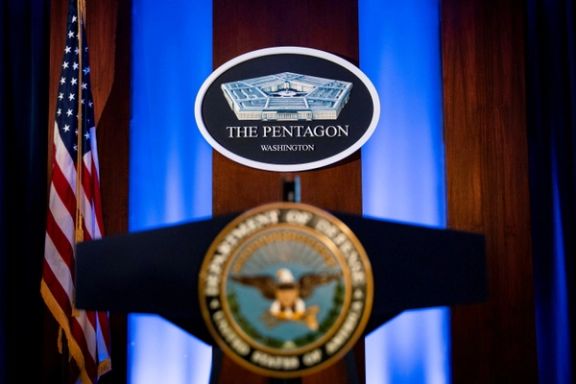
The Pentagon logo is seen behind the podium in the briefing room at the Pentagon in Arlington, Virginia, U.S., January 8, 2020.
The FBI launched an investigation into a leak of classified US assessments of Israel’s potential plans to attack Iran while Republican critics ripped the Biden administration for mishandling intelligence just two weeks before the Nov. 5 elections.
“The FBI is investigating the alleged leak of classified documents and working closely with our partners in the Department of Defense and Intelligence Community,” the agency said in a statement. “As this is an ongoing investigation, we have no further comment.”
The information relates to intelligence gleaned from US satellites on preparations for an Israeli air attack on Iran in retaliation for an Oct. 1 missile barrage on the Jewish state.
Republican Senator Tom Cotton wrote to Biden to request biweekly briefings on the status of its investigation into the leak.
"This leak is an outrageous betrayal of an ally and a breach of trust that will undermine our relationship with partners for years to come," Cotton, a senior member of the Senate Select Committee on Intelligence, wrote according to a copy of the letter published bytheWashington Free Beacon.
Donald Trump also capitalized on the opportunity to attack the Biden-Harris administration, just two weeks before his face-off with Vice President Kamala Harris.
"Israel has been seriously damaged and compromised ... MUST FIND THE LEAKER! Israel no longer wants to share documents with the US, and who can blame them!" the former President wrote on Truth Social.
Identity sought
Conflicting reports emerged on Tuesday over the progress of US investigators and the potential source of a leak.
Sky News Arabia reported on Tuesday citing a Pentagon official that a senior employee in US Defense Secretary Lloyd Austin’s office is suspected of leaking the assessments to Tehran.
The official, the report added, serves within the Office of the Assistant Secretary of Defense for Special Operations and holds a security clearance that provides access to highly sensitive information.
However, the Pentagon officially denied that Ariane Tabatabai, Chief of Staff of the Assistant Secretary of Defense for Special Operations, is a subject of interest in the investigation for the alleged leak of US documents on Israel's plan to attack Iran. "To my knowledge, the official that is being referenced is not a subject of interest," said Press Secretary Pat Ryder.
Also veteran Pentagon correspondent for Fox News Jennifer Griffin said on Tuesday that no suspects in any leak had been identified, calling the Sky News Arabia item "irresponsible reporting."
"This story is NOT TRUE," Griffin wrote on X. "I have spoken with the person the reporter alleges was behind the leak of Israeli preparations and she is at work at the Pentagon today, has her security clearance and has NOT been contacted by ... investigators".
The documents, marked as top secret, began circulating online on Friday after being posted on Telegram by an account called "Middle East Spectator." Dated October 15 and 16, the intelligence was intended for viewing only by the US and its "Five Eyes" allies, which include Australia, Canada, New Zealand, and the United Kingdom.
White House National Security Communications Adviser John Kirby said on Monday that it remains unclear whether the documents were released due to a leak or a cyber breach. He emphasized that the government does not anticipate any further unauthorized disclosure of classified material.
Senator Roger Wicker on Monday criticized the continued security clearance for Ariane Tabatabai, the chief of staff for the Assistant Secretary of Defense for Special Operations.
"The latest apparent leak to an Iranian Telegram channel reflects the Biden-Harris administration's tolerance of insider threats," Wicker wrote on X.
There was no evidence linking Tabatabai to any potential leak.
A September 2023 joint investigation by Semafor and Iran International named Tabatabai as a key figure in a network tasked by Iran's foreign ministry to echo Tehran’s strategic messaging.
Seven men from East Jerusalem were arrested for planning assassinations on behalf of Iran, according to Israeli officials. This marks the latest in a series of foiled operations amid escalating incidents within Israel.
It is the fifth assassination attempt foiled in last month, said Israel Police.
The group, from Beit Safafa, a village under Israeli control straddling East and West Jerusalem, had been recruited, like others revealed this year, through social networks.
Headed by a 23-year-old man who Times of Israel named as Rami Alian, they had been ordered to assassinate a nuclear scientist and a mayor from one of central Israel’s largest cities.
The Iranian handler had tasked him to recruit other members, who were all aged 19 to 23, without previous convictions.
Like other plots uncovered this month, the tasks had begun with minor operations such as painting graffiti against the government.
"The suspects carried out tasks of spraying graffiti in various places in Israel, setting fire to vehicles in the Ein Kerem area of Jerusalem and gathering intelligence," said Israel Police.
"The plot also included blowing up a police car and throwing a grenade at a house, all in exchange for $52,000," the statement by the police added.
The police explained that some of the suspects arrived near the residence of the senior scientist and, in exchange for $130, photographed the location with the intention to carry out the assassination.
"In the search conducted by the police in the suspects' houses, a sum of money of about $13,000, a fake police identification plate and a large number of credit cards were seized," Israel Police added.
Israel’s ex head of Interpol, Asher Ben Artzi, said the latest incident shows the depth of Iran’s operations to place cells across Israel. “Iranian intelligence knows how to work,” he told Iran International.
“What hurts me is they’re managing to infiltrate," he added, the extent of operations shocking even those who have been in the security apparatus for decades, such as Ben Artzi.
According to Channel 12, plans also included throwing a grenade at a soldier after Alian located a target who lived in Jerusalem, and received $4,000 to buy and throw the grenade. After that he was asked to photograph a scientific research institute, for which he received $1,300.
The source said the scientist was the final mission for the cell, with his name, place of work and other personal details having been laid out with preparations already made including attempts to purchase weapons.
According to Channel 12, the cell's motivations were nationalist, identifying as Palestinian and aware they were working directly with an Iranian agent. Beit Safafa has been under Israeli control since the 1967 war and is in proximity to volatile neighborhoods like Sheikh Jarrah, which have experienced recurring outbreaks of violence in recent years.
It is an area of Jerusalem which has also seen escalating Jewish settlement, heightening discord among the traditionally Arab Muslim population who are largely from middle and upper levels of Palestinian society, according to 2019 research by The Union of the Charitable Societies in cooperation with the Applied Research Institute.
The latest spy case comes just one day after a group of Azerbaijani-Israelis were arrested for having given intelligence to Iran which aided the ballistic attack earlier this month as well as a deadly Hezbollah attack on a military base near Haifa.
But it comes on the back of a series of cells being discovered in Israel, most shockingly, from Jewish backgrounds, all alongside the wars in Gaza and Lebanon as Israel takes on Iran's proxies on its borders.
This month has seen two separate cases of Russian-Israelis arrested accused of working for Iran but there have been cases of Jews from Jewish areas including Ashkelon and Beit Shemesh also arrested this year as cells become activated.
It remains unclear why Israeli authorities have been publicizing alleged Iranian infiltrations in recent weeks, particularly as tensions between the two sides have reached an all-time high.
Iranian President Masoud Pezeshkian presented his government’s first budget outline to parliament on Tuesday, signaling plans to tackle rising fuel subsidy costs ahead of the new fiscal year starting March 21.
Pezeshkian stated that the budget, developed over two months, focuses on boosting economic growth and reducing inequality. He emphasized that strengthening defense capabilities and controlling inflation are also key priorities in the proposal.
Addressing the lawmakers, he warned that the rising cost of subsidies for fuel, including gasoline, has become a critical issue, with current consumption levels 40% higher than in 2019.
He explained that the production cost of each liter of gasoline—excluding crude oil—stands at approximately 80,000 rials (about 13 US cents). Furthermore, imported gasoline costs between 300,000 and 400,000 rials per liter (50 to 65 US cents).
Iran's heavily subsidized gasoline costs just 2 cents per liter (or less than 10 cents per gallon), making it one of the cheapest in the world. However, this subsidy comes at a steep price for the government, which spends billions annually to sustain it. To manage consumption, Iran has implemented a rationing system: motorcycle owners are limited to 25 liters per month, while personal car drivers can access up to 60 liters. Any usage beyond these limits incurs a charge of 5 cents per liter. In comparison, average gasoline prices in the region hover around $1 per liter.
For most Iranians, who earn about $200 per month, a large increase could push an already struggling population to the brink. Violent protests shook Iran in November 2019, when the government suddenly tripled gasoline prices.
A scene of protests in 2019
Pezeshkian also stressed that reforms in the energy sector and fuel subsidies are essential to managing the nation’s growing economic imbalances.
He warned that if current consumption trends continue, Iran will need to import 130 trillion tomans (over $2 billion) worth of gasoline next year. This, he stressed, requires urgent reform to address these imbalances and ensure that energy subsidies benefit the most vulnerable.
While Iranian officials frequently assert that gasoline consumption is rising, reports from Iran International reveal that a significant portion of the daily gasoline sold is actually smuggled to neighboring countries due to the stark price disparity.
Pezeshkian pointed out that the budget calls for gradual economic reforms, including changes to the multi-tiered currency exchange system and fuel subsidies. He cited agreement among economists on the need to move towards a unified exchange rate. The Central Bank is already working on this policy, aiming to streamline currency exchange and reduce vulnerabilities to corruption within the economy, he added.
The president admitted that this budget, like many before it, faces challenges, particularly the country’s reliance on oil exports and deficits. Due to US sanctions, the Iranian government refrains from disclosing exact figures on its oil revenue. To circumvent sanctions, a significant portion of the country's exports is sold to smaller buyers, such as "teapot" refineries in China, through third parties. The government’s lack of transparency on this issue complicates the process of assessing the true state of the budget and revenue forecasts.
While the budget bill is a general draft and lacks detailed numbers on oil and fuel prices, Pezeshkian expressed confidence that it will eventually be approved by the Parliament. Historically, the Iranian Parliament has passed budget bills despite known deficits, which the government prefers to call "imbalances" or "discrepancies." Pezeshkian acknowledged that the country faces significant budget shortfall in several sectors.
For example, Pezeshkian noted that the government struggled with budget deficits in paying wheat farmers, a situation that was only resolved with the Supreme Leader’s approval to borrow from the National Development Fund.
The president also emphasized that next year’s budget draft includes increased support for low-income families, tax exemptions for wage earners, and expanded resources for healthcare, rail development, and housing for the underprivileged. However, tax revenues in the new budget are projected to reach a ceiling of 17,000 trillion rials (over $28 billion), marking a 39% increase year-on-year.
Immediately after delivering his speech to parliament, Pezeshkian visited the Hamas office in Tehran to offer condolences for the death of Yahya Sinwar, the leader of the group.
Israel’s killing of Hezbollah commanders, including Hassan Nasrallah, along with recent airstrikes on its infrastructure, has significantly disrupted the group’s funding from Iran, according to a senior Israeli intelligence official.
The Israeli military intensified its campaign against Hezbollah’s leadership with the July 30 assassination of Fuad Shukr, a key aide to Nasrallah, followed by multiple airstrikes over the next two months that culminated in the killing of the group’s leaderon September 27.
The airstrikes targeting the group’s leaders and infrastructure have created new challenges in Hezbollah's financial operations, which could have far-reaching consequences for its military capabilities, an Israeli intelligence official told reporters in a briefing on Sunday.
Iran provides most of Hezbollah’s training, weapons, and funding, sending the group hundreds of millions of dollars each year, according to the US State Department.
"Every month around $50 million comes from Iran to Syria and in Syria, they're transferred to Hezbollah. Some of the money is actually physical dollars, some of it is transferred to Syria through an oil agreement that Iran gives oil to Syria, which is then changed into money in Syria," the Israeli official explained.
The official said the money is also transferred by diplomatic figures coming from Iran to Lebanon through the Beirut International Airport, carrying suitcases of dollars to fund Hezbollah.
“Until about a month ago, Hezbollah's economic situation was pretty steady, because they received the funding from Iran on a very, very clear way every month. It came at the right time over the past few months. After that, a few things changed. They aren't able to receive funding as easily," the senior official said.
'Extreme rise in Hezbollah's expenses'
Disruption in money transfer is not the only financial problem Hezbollah is facing. Israel says the recent campaign against the Lebanese group has extremely increased their payments, as Hezbollah now faces additional financial burdens, including paying for more operatives, weapons, and the damages caused by the airstrikes, according to the Israeli official.
The official warned that Iran could easily resume funding after the war unless Israel systematically targets Hezbollah’s financial network.
The intelligence official made the remarks in a briefing that was held ahead of IDF airstrikes against multiple branches of Qard al-Hasan, a financial institution linked to Hezbollah in Beirut, southern Lebanon, and the Bekaa Valley.
Al-Qard al-Hasan is officially a non-profit charity institution operating outside the Lebanese financial system, and one of the tools by which Hezbollah entrenches its support among the country’s Shia population.
The branches hit by Israeli airstrikes had been evacuated weeks ago, according to pro-Hezbollah media. Therefore, their destruction is not expected to hugely impact Hezbollah’s financial capabilities. However, the target seems to be the Shia community’s trust in Hezbollah.
“The main objective is to is to affect the trust between Hezbollah and a lot of the Shia community that uses this association as a banking system, because economically speaking, a lot of it is based on the fact that there are people using it,” the Israeli official said Sunday.
As Israeli airstrikes continue to target Hezbollah's financial and operational infrastructure, the long-term effects on Hezbollah’s economic stability and military capabilities remain uncertain. However, Israeli officials stress the importance of maintaining pressure to disrupt the group's funding pipeline.
“They are under pressure at this point, but obviously it's something that unless we harm it on a systematic level, it's something that they could recuperate with pretty easily if Iran just gives the funding on the day after war. And that's why it's something that we really have target at this point on it,” the Israeli intelligence official said.
While Hezbollah has lost almost all its commanders and senior leaders in the Israeli airstrikes and targeted assassinations over the past three months, it does not seem to be losing momentum, continuing its daily rocket, missile, and drone attacks against Israel, going as far as hitting the residence of Prime Minister Netanyahu.
While in Kuwait as part of his Middle East tour, Iran’s Foreign Minister said that none of its neighboring Arab states would allow Israel to use their territory or airspace for any planned attack on Iran.
"All of our neighbors have assured us that they will not allow their territory or airspace to be used against the Islamic Republic of Iran," Abbas Araghchi stated in a press conference.
As part of his regional mission, Tehran's top diplomat has been intensifying efforts to rally support from Arab nations in response to the looming threat of an Israeli attack, visiting about a dozen states.
Iran’s diplomatic outreach to its neighbors has intensified following its own missile strike on Israel on October 1, during which over 180 missiles were launched. This marked the second missile strike initiated by Tehran against Israel this year. Israel has said it will retaliate against the missile barrage and is preparing its military for such an eventuality.
Iran's attack followed Israel’s assassinations of top leaders of militant groups backed by Iran, including those of Hezbollah and Hamas, and the Islamic Revolutionary Guards (IRGC).
As Tehran continues its efforts to engage with its neighbors, a report by the US-funded news outlet Alhurra this weekcited a senior Israeli source stating that Arab nations along the Persian Gulf have urged Israel to deliver a decisive blow to Iran.
The report further suggested that the Arab nations also view this moment as an opportunity to weaken Tehran through support of Israel’s military actions.
Arab nations are aware that Iran could retaliate against their oil facilities if they are seen as supporting attacks on its oil or nuclear sites by Washington or Tel Aviv – particularly, in light of the 2019 Saudi Aramco attacks, which inflicted significant damage on the kingdom's oil-dependent economy and were widely attributed to Iran. Their willingness to engage with Iran in recent weeks could be an attempt to lessen the likelihood of any Iranian hostile act during tit-for-tat attacks with Israel.
Iran's Foreign Minister, however, claimed there is a shared understanding to prevent tension and escalation.
"The Islamic Republic of Iran does not seek war in the region, although we are prepared for war. We have made every effort to reduce tensions, but we are both ready and capable of confronting any scenario,” Araghchi stated.
The foreign minister of the Islamic Republic, which has faced accusations of international crimes since coming to power in 1979, also expressed hope that international laws would prevent Israel from attacking its nuclear facilities.
He further claimed that "all the countries" in the region have informed Tehran of their opposition to any attack on Iran, particularly targeting its nuclear infrastructure.
"I emphasize again, however Israel attacks Iran, Iran will respond in kind," he said.
Recent statistics from Iran’s Central Bank indicate that the private sector has been largely eliminated from large-scale foreign trade and replaced with government entities, which are engaged in billions of dollars of imports.
The data shows that these entities were the primary recipients of foreign currencies from the Central Bank that is the repository of US dollars, euros and other stable currencies importers need to conduct business. As large-scale currency trading is controlled by the government, it has set up various rates. For essential imports it provides dollars at half the free market rate, subsidizing food and medicines.
Meanwhile, customs data reveals that the majority of the country's exports come from government-controlled petrochemical, steel, oil and gas products, indicating the gradual exclusion of the private sector from Iran's foreign trade.
The latest Central Bank statistics show that since the beginning of the current fiscal year (March 20), a total of $37.2 billion has been allocated for the import of goods.
On October 15, Mohammad Rezvani-Far, the head of Iran's Customs Administration, announced that during this period, non-oil exports reached $29.5 billion, while imports amounted to $37 billion.
The key point here is that the Central Bank recently reported that in the first half of the current fiscal year (March 20 to September 20), it allocated $32.4 billion to the ministries of Industry, Agriculture, and Health for imports. Customs data also shows that the total value of imports in the first six months of this fiscal year was $32.5 billion. In other words, the private sector has been effectively sidelined from the country’s import activities.
Foreign currency allocation by the Central Bank for imported goods
The Central Bank plans to allocate a total of $55 billion to the ministries of Industry, Agriculture, and Health for imports during this fiscal year. Last year, Iran imported $66.2 billion worth of goods, $1.9 billion of which was gold bullion. If Iran's imports remain at last year's level, 85% of the total imports will be handled by the three government ministries, leaving only 15% to be managed by other government and semi-governmental entities, including the Islamic Revolutionary Guard Corps (IRGC) and the real private sector.
Approximately, $8.13 billion of the foreign currency allocated by the Central Bank for the import of food and medicine was provided at the rate of 285,000 rials, or less than half of the free market rate. The rest was supplied at higher, but still preferential rates. The remaining imports were made at the free market exchange rate, which stood at around 600,000 rials per dollar.
Central Bank and customs data show that the real private sector lacks access to the government's subsidized currency at the rate of 285,000 rials and has very limited access to the higher preferential rate. As a result, the private sector must rely solely on the free market exchange rate to import goods, severely limiting its ability to compete.
$7 Billion Trade Deficit in the First Half of the Year
Iranian customs data indicates a $7 billion deficit in the country’s non-oil foreign trade during the first half of the current fiscal year.
Last fiscal year, Iran’s non-oil trade deficit also reached an unprecedented figure of $17 billion. Customs data shows that in the first half of the current year, non-oil exports amounted to $25.8 billion, while imports reached $32.5 billion.
Although Iran earns revenue from oil exports, capital flight from the country is also significant. Since 2018, coinciding with US sanctions, Iran's capital account has been negative.
For instance, last year, Iran exported $36 billion worth of oil and oil-related products, and the overall trade balance of the country was a positive $18 billion. However, the latest Central Bank report indicates that during the first nine months of last year, over $20 billion in capital fled the country.
Additionally, Central Bank data shows that Iran's service trade balance is consistently negative by around $7 to $8 billion each year.
It is unclear exactly what the state of Iran’s foreign currency reserves is, given the trade imbalance and widespread capital flight. However, in an effort to slow the decline of the rial, the Central Bank has been forced to inject large amounts of foreign currency into the market.