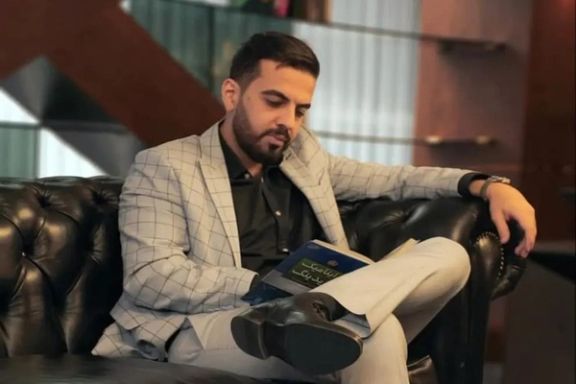
Two main IRGC agents, Mehdi Hajipour (right) and Mehdi Badi (left), who stole $21 million in cryptocurrency from Cryptoland. The image also features Supreme Leader Ali Khamenei and Mohammad Kazemi, the head of the IRGC Intelligence Organization.
Senior officers in Iran’s Revolutionary Guard's intelligence organization stole around $21 million in cryptocurrency while pretending to investigate a corruption case, Iran International has found.
The case centers on Cryptoland, a digital exchange shut down after the May 2021 arrest of its CEO, Sina Estavi.
At the time of his arrest, Estavi had no formal accusers, but once the news spread thousands of investors lodged complaints. Mizan news website, controlled by Iran's notorious Judiciary department, later reported over 51,000 plaintiffs.
The BRG token, which Estavi had developed, collapsed in value following his arrest. Blockchain records show that just a day after his detention, six billion BRG tokens were moved from his crypto wallet. This was before the general public was aware of a potential scandal.
These were then sold off by IRGC officers, generating tens of millions of dollars for the interrogators themselves.
A court-appointed expert identified two of the key figures: Mehdi Hajipour and Mehdi Badi, both senior interrogators in the IRGC’s economic branch. The expert’s report confirms that wallets controlled by Hajipour sold over $21 million in BRG tokens.
In March 2022, IRGC counterintelligence agents arrested Hajipour in a sting operation. He was caught accepting a $10,000 payment from Estavi, who had been led to believe he was buying back the stolen tokens from a third party — a fake identity Hajipour had created.
Cryptoland CEO Sina Estavi
Court documents show that before the token theft, Hajipour’s assets were worth about 10 billion rials ($40,000 at the time). Four months later, his fortune had surged to 600 billion rials — spent on real estate, gold, and luxury vehicles. He was later held in Ward 66, a prison used for detained IRGC personnel.
The court document also reveals that Hajipour had a network of senior interrogators from the IRGC Intelligence Organization working alongside him.
The second suspect in this case is Mehdi Badi, a senior interrogator who operated under the alias Dr. Ebadi, whose name has appeared in many major cases labeled as IRGC economic corruption investigations.
He is the nephew of Ali Akbar Hosseini Mehrab, the former Deputy for Economic Anti-Corruption Affairs at the IRGC intelligence organization, who also served for a time as the Director General of Intelligence in Khuzestan and was later appointed as the governor of Khuzestan under the President Ebrahim Raisi administration.
According to the court document, two other interrogators from the IRGC intelligence organization, Majid Jahan Parto and Majid Tabatabaei, are also members of the corruption network, along with four others who assisted the group by forging documents.
There is no available information about the fate of the defendants in this case or the sentences they received, except that Hajipour’s appeal was rejected in September 2022.
However, Sina Estavi was sentenced to 15 years in prison and ordered to return the embezzled funds. He fled the country under pressure from the senior interrogators—who had in fact stolen the victims' money themselves.
Three months after Hajipour’s arrest, Hossein Taeb was dismissed from his position as head of the IRGC intelligence organization and replaced by Mohammad Kazemi.
Half of the victims in this case—whose money amounted to $14 million—were repaid from Estavi’s account while he was in prison, but around 25,000 others are still owed money. They are creditors of funds that were obtained and never returned by Hajipour, Badi, and the other members of the network.
Calls are growing for the Iranian president to fulfill promises made during his campaign or step down, as the administration faces accusations of inaction amid mounting public dissatisfaction.
“If he promised to remove internet restrictions and says he can, then he should. If he can’t, he should walk away,” political analyst Abbas Abdi said in comments published by Khabar Online on Saturday.
“There was no need for more meetings. He could have issued the order in the summer and the platforms would have been unblocked immediately.”
The sharp remarks come amid waning confidence in the president, elected on a platform that included commitments to ease Islamic restrictions on society, give more freedom to the media, and restore access to global platforms like Telegram, Instagram, and YouTube.
Voters also hoped Pezeshkian would help achieve a diplomatic breakthrough with the United States and ease the burden of crippling US sanctions. However, foreign policy is under the firm control of Supreme Leader Ali Khamenei and it is clear he is not willing to make sufficient concessions.
Nearly eight months into his presidency, critics say none of these objectives have been meaningfully pursued—and the economic situation has deteriorated further, with the national currency plunging to an all-time low.
Abdi argued that Pezeshkian’s declining popularity reflected the administration’s inaction. “His approval should have gone up since taking office. Instead, it’s halved,” he said.
The critique reflects broader disillusionment among segments of the Iranian public. Protests over economic hardship and social constraints have surged in recent months, and Abdi warned that the next wave could be more expansive. “Right now, each sector has had its own protests. Economic protests have come from the lower classes, while cultural and social protests have been led by women... Now, they’ve all come together. In my opinion, the next wave of protests will be very widespread—unless the political system decides to address and resolve some of these issues.”
Although Pezeshkian promised reforms, he also said he had no plans of his own and would follow Khamenei's policies.
Esmail Gerami-Moghaddam, another political figure aligned with the Reformist camp, echoed similar frustrations, urging Pezeshkian to “stand firmly against hardliners” and fulfill the mandate given to him by voters. “The public voted not for the endurance of hardline power, but for its curtailment,” he said.
Gerami-Moghaddam criticized Pezeshkian’s decision to retain conservative ministers and warned that ongoing economic woes, compounded by sanctions, will persist unless there is a shift in foreign and domestic policy. “No one can stabilize the economy without addressing the sanctions,” he said.
Both figures cited structural dysfunction as a key impediment.
Pezeshkian appears to lack clear solutions on pressing issues. Addressing Iran’s soaring prices, he recently admitted, "I have no idea whom to blame for the uncontrolled rising prices." His remark drew sharp criticism on social media, where many reminded him that, as president, he is ultimately responsible for the government's handling of the crisis.
Iran's Foreign Ministry on Sunday emphasized the importance of maintaining the confidentiality of international negotiations and correspondence as it confirmed the exchange of messages with the United States.
The ministry said in a statement that keeping diplomatic processes private best serves national interests.
Also on Sunday, government spokeswoman Fatemeh Mohajerani reiterated that "Iran's response to the sent letter was prepared and delivered."
Writing on social media platform X, Mohajerani added, "In this regard, the path of indirect negotiations with the United States is on the agenda, and the diplomatic process continues."
The confirmation follows reports from Iranian officials detailing Tehran's response to a recent letter from US President Donald Trump, which, according to Iranian sources, reiterated long-standing positions, rejecting key US demands regarding its nuclear and missile programs, as well as its regional alliances.
While the specifics of the exchanged letters remain confidential, in line with the Foreign Ministry's statement, Iranian officials have offered insights into Tehran's stance.
Foreign Minister Abbas Araghchi confirmed earlier in the week that Iran's official response to Trump's letter had been conveyed appropriately via Oman, a traditional mediator between the two adversaries.
Araghchi reiterated Iran's unwillingness to engage in direct negotiations under what it describes as maximum pressure and military threats, though he noted that indirect talks could continue, as they had in the past.
Ahmad Bakhshayesh Ardestani, a member of the Iranian parliament's National Security and Foreign Policy Committee, also said that Iran had informed the US of its willingness to discuss the nuclear issue, but only through indirect channels and based on the framework of the 2015 nuclear deal, officially known as the Joint Comprehensive Plan of Action (JCPOA).
According to Ardestani, Iran's response rejected any discussion of its ballistic missile capabilities, which Tehran considers a matter of national defense and non-negotiable.
Similarly, Iran has pushed back against US efforts to curb its backing of regional groups, asserting that these relationships are based on bilateral agreements and that these allies are independent actors, he added.
"Given that Iran has no intention of acquiring an atomic bomb, as nuclear weapons have no place in our defense strategy, we are prepared to negotiate on this matter. However, discussions on other subjects are not on the table," he said.
On Saturday, the New Arab, citing anonymous Iranian sources, reported that Tehran's response mirrored the tone and structure of Trump's message, rejecting demands viewed as unreasonable.
The outlet said that Iran emphasized any nuclear talks must adhere to the original terms of the JCPOA and be based on mutual respect, resisting any attempts to broaden the scope of negotiations or impose new restrictions.
While Trump has said that a new agreement should guarantee that Tehran never acquires nuclear weapons, the JCPOA allowed limited uranium enrichment, which in the future can provide the technical means to obtain fissile material.
Regarding the mediators of the correspondence, Ardestani said that the US bypassed Oman, Switzerland, and Japan this time, possibly due to past unsuccessful attempts, and instead used the UAE, perhaps reflecting a more forceful tone. However, Iran delivered its reply via Oma, signaling its preference for a country it sees as more neutral.
Ardestani added that while the UAE received a copy, Oman is the messenger, likely due to Iran's higher level of trust.
The diplomatic overture unfolds against the backdrop of Trump's reimposition of a "maximum pressure" campaign in February, aiming to halt Iran's oil exports and force a broader deal encompassing its nuclear and missile programs, as well as its regional influence.
Trump has issued a two-month deadline for a new nuclear agreement, threatening military consequences if Tehran fails to comply. It remains unclear if Washington would accept indirect talks that from past experience could drag on for years.
Iran would strike a British-American naval base in the Indian Ocean if it is attacked by the US, The Telegraph reported citing an Iranian military official, after Washington deployed long-range bombers at the strategic airbase.
B-2 Spirit bombers have arrived at Naval Support Facility Diego Garcia in Chagos Islands, a US Strategic Command spokesperson confirmed to Iran International earlier this week as Washington ramps up rhetoric against Iran.
In an apparent response to the deployment, a senior Iranian military official told The Telegraph, "There will be no distinction in targeting British or American forces if Iran is attacked from any base in the region or within the range of Iranian missiles."
“When the time comes, it won’t matter whether you’re an American, British, or Turkish soldier – you will be targeted if your base is used by Americans," the senior official was quoted as saying.
However, the Indian Ocean base is 3,800 kilometers from the Iran and Iranian ballistic missiles have a maximum range of 2,000 kilometers.
A British government spokesman on Saturday condemned Iran's threats in the strongest terms.
"The UK Government continues to work with partners across the region to encourage de-escalation. The base on Diego Garcia is vital to UK and US security and plays a crucial role in maintaining regional and international security," The Telegraph reported citing the spokesman.
The US military has deployed the B-2 stealth bombers along with C-17 cargo planes and 10 aerial refueling tankers in the last few days, defense industry outlet The War Zone reported on Wednesday citing satellite imagery.
The joint UK-US military base at Diego Garcia has previously been used to launch US strikes on the Middle East including Iraq and Afghanistan, with the deployment suggesting the potential for large-scale air operations in the region.
US President Donald Trump has in a letter to Iran's Supreme Leader Ali Khamenei demanded Tehran come to a deal over its nuclear program or face a military intervention.
The Islamic Republic, in response, has rejected any negotiations on its ballistic missile program or regional allies, and any nuclear talks beyond the framework of the 2015 nuclear deal.
Meanwhile, the US military continues a bombing campaign on Tehran-aligned Houthi fighters in Yemen, warning that any attack by the Houthis would be treated as emanating from Iran.
An unprecedented police crackdown on pro-hijab protesters in Iran suggests a shift in priorities, signaling that defiance of higher authorities even by supporters will no longer be tolerated.
On Friday evening, hundreds of male and female police officers raided a makeshift vigilante camp outside the Iranian parliament, dispersing around two dozen protesters—mostly women—who had been stationed there for over 45 days. They were protesting the delay in enforcing a controversial hijab law.
While no arrests were reported, religious vigilante groups claim that police used excessive force. They called on their supporters to rally outside the parliament on Saturday afternoon. A spokesman, Hossein Allahkaram, announced later that the rally would be postponed until after the Nowruz holidays.
In the past, security forces have even protected radical supporters during high-profile actions, such as the storming of the British embassy in 2011 and the Saudi embassy in 2016—both of which triggered major diplomatic crises.
A defiance of the Supreme Leader and his policy shift?
In mid-September, Iran's Supreme National Security Council (SNSC) suspended the implementation of the hijab legislation, which imposes harsh penalties—including heavy fines and prison sentences—on women who violate strict dress codes and businesses that fail to enforce them. The decision was reportedly driven by concerns over public backlash and the risk of triggering anti-government protests.
Since the decision could not have been made without the approval of Supreme Leader Ali Khamenei, who has avoided discussing the issue in his speeches for months, criticism of the delay could be viewed as defiance of what appears to be a strategic shift in Khamenei’s approach.
Vigilantes continue to refer to Khamenei’s April 2023 speech, in which he took a firm stance. Khamenei declared in the speech that disregarding hijab was “religiously and politically haram (forbidden).” In the same speech, he accused foreign intelligence agencies of encouraging Iranian women to defy the mandatory hijab. However, he has conspicuously avoided addressing the hijab issue in recent months, including during his December 17 address to an all-female audience.
Rather than blaming Khamenei, vigilantes hold Mohammad-Bagher Ghalibaf responsible for the delay in enforcing the legislation and argue that he should be accountable for Friday’s crackdown. Hours before the crackdown, they chanted against Ghalibaf during his speech at Friday prayers in Tehran.
The Friday crackdown could also be seen as a warning to ultra-hardliners that opposition to Khamenei’s potential policy shifts— possibly including allowing engagement in direct talks with the Trump administration—will not be tolerated.
“Consider the recent actions against [pro-] hijab protesters as marking a shift in Iran’s political landscape,” a former aide to ex-President Mahmoud Ahmadinejad, Abdolreza Davari, posted on X, suggesting that authorities are now seeking to mend their relationship with the hugely disillusioned middle classes.
Debate over freedom of assembly
The police action has sparked debate over the right to assembly in Iran. Some opposition figures have criticized the crackdown.
Ali-Asghar Shafeian, chief editor of the reformist Ensaf News, argued in a tweet that the police response was unnecessary and contradicted President Masoud Pezeshkian’s stance on freedom of expression.
Others, including prominent Islamic law expert Mohsen Borhani, pointed out that the vigilantes—who had no permit for their sit-in—have consistently rejected the right of other political groups to protest, despite Article 27 of the Iranian Constitution protecting peaceful assembly.
Mahmoud Nabavian, a senior Paydari member who played a key role in drafting the hijab law, recently argued that the preservation of the Islamic Republic must take precedence over enforcing the law, given the multiple domestic and international crises that it is facing—implicitly acknowledging the risk of unrest.
Iran’s formal response to US President Donald Trump’s recent letter reaffirms longstanding positions: no negotiations on its ballistic missile program or regional allies, and no nuclear talks beyond the framework of the 2015 nuclear deal, The New Arab reported Saturday.
According to the Qatari outlet quoting anonymous sources in Iran, Tehran responded “line by line” to Trump’s message, mirroring its tone and structure. The reply rejected demands viewed as unreasonable and emphasized that any talks on the nuclear file must be based on the Joint Comprehensive Plan of Action (JCPOA) and mutual respect.
Issues addressed by Tehran
The Iranian reply addressed four main areas: the nuclear program, missile and defense capabilities, Iran's ties with regional militant groups, and US threats of more sanctions and military action.
On defense matters, the response rejected any discussion of Iran’s ballistic missile arsenal, which Tehran considers non-negotiable. It also reaffirmed that its military capabilities are essential to national defense and not subject to external bargaining.
In the nuclear section, Iranian officials reiterated that they are open to talks, but only within the original terms of the 2015 JCPOA. They rejected any attempt to expand the scope of negotiations or impose new restrictions on the program, which Iran continues to describe as peaceful.
The letter also addressed regional issues, pushing back on US efforts to curb Iran’s backing of militant groups. “These relationships are based on bilateral agreements,” the sources said. “The allies are independent and do not take orders from us. Any agreement reached with these parties would be welcomed by Iran.”
This position had already been outlined publicly by Iran’s ambassador to Iraq, Mohammad Kazem Al-Sadegh, who said Thursday that Tehran’s support for what it calls the “axis of resistance” in Lebanon, Iraq, and Yemen is non-negotiable. Iran has rejected US conditions seeking to limit its regional influence and missile program. “We only negotiate the nuclear file,” Al-Sadegh said, adding that such talks would only take place if Iran’s full rights were respected. “We do not negotiate our missiles. We do not negotiate our regional alliances.”
The final section of the reply responded to what Iranian officials described as threats included in Trump’s letter. In its reply, Tehran linked any future direct talks to a change in Washington’s tone. The letter said that dialogue would require “dealing with Tehran on the basis of respect, without threats or maximum pressure,” according to The New Arab.
Iran’s decision to send the reply through Oman, rather than the United Arab Emirates—which had delivered Trump’s original letter—was a deliberate one, The New Arab reported. Iranian sources said the move reflected Tehran’s trust in Oman’s longstanding role as a neutral mediator and a rejection of what it saw as an attempt to bypass established channels.
Iran reiterates policy positions in official comments
Iranian officials have since confirmed the delivery and broad content of the response. Foreign Minister Abbas Araghchi said Thursday that the reply had been conveyed “appropriately” through Muscat. He reiterated that Iran remains unwilling to engage in direct talks under what he described as maximum pressure and military threats. “Our policy remains not to negotiate directly with the United States under pressure,” Araghchi said on state television. “Indirect talks can continue, as they did in previous administrations.”
Senior Iranian figures also addressed the letter publicly during Friday’s Quds Day rallies. Parliament Speaker Mohammad Bagher Ghalibaf accused the United States of using nuclear diplomacy to push for Iran’s disarmament. “When the US says negotiation, it means disarmament,” he said. “No wise nation accepts talks under threat.”
Ali Shamkhani, former head of Iran’s Supreme National Security Council, described the response as “restrained” and confirmed it was prepared by multiple institutions. He said indirect negotiations remained possible, but only if conducted on equal terms. “If negotiations are based on parity, we are prepared to proceed,” he said.
Trump’s letter included a two-month deadline for reaching a new nuclear agreement, Axios reported.
The United States reimposed its maximum pressure campaign against Iran in February, seeking to reduce the country’s oil exports to zero and force a broader deal. Alongside calls for limits on Iran’s nuclear and missile programs, Washington has also demanded that Tehran scale back its support for armed groups in the region.
Speaking earlier this month, Trump said Iran would have to return to talks or face consequences. “They’re going to have to speak to us one way or another,” the US president told Fox Business. “We can’t let this happen.”