Iran summons Swiss envoy after Trump bombing threat
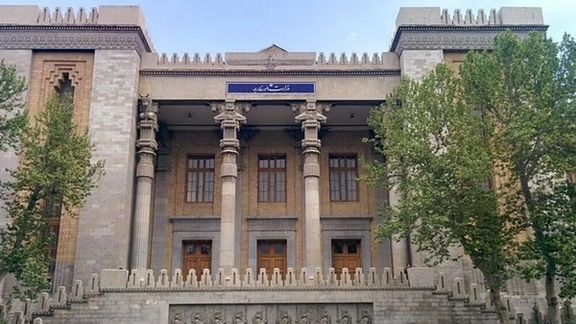
Iran’s Foreign Ministry building
Iran summoned the Swiss envoy in Tehran on Monday to deliver a formal warning following US President Donald Trump’s threat of bombing Iran if a nuclear deal is not reached, according to state media.
The Swiss diplomat was told that Iran would respond decisively to any such threats, according to IRGC-affiliated Tasnim News website.
The report referred to the envoy in Iran as the "caretaker of the embassy," implying the absence or unavailability of the Swiss ambassador.
Switzerland represents US interests in Iran since Washington and Tehran cut ties shortly after the 1979 Islamic Revolution. The Swiss embassy in Tehran has been consistently relaying diplomatic communications between the Islamic Republic and the United States.
Earlier in the day, Iran's foreign ministry spokesman condemned Trump's threat of bombing Iran if the country failed to reach a new nuclear deal with Washington, calling it a "shocking affront" to the core principles of international peace and security.
Iran's Supreme Leader Ali Khamenei also warned that the United States would face a strong blow if it follows through on Trump’s threat to bomb the country.
Khamenei's warning, delivered in a televised speech marking the end of Ramadan, came a day after Trump told NBC News that if a deal was not reached, "there will be bombing — and it will be bombing the likes of which they have never seen before."
Iran International has put a request for comment to the Swiss foreign ministry.
Supreme Leader Ali Khamenei on Monday vowed the United States would face retaliation if it follows through on President Donald Trump’s threat to bomb Iran.
Khamenei's warning, delivered in a televised speech marking the end of Ramadan, came a day after Trump told NBC News that if a deal was not reached, "there will be bombing — and it will be bombing the likes of which they have never seen before."
Khamenei said, "The enmity from the US and Israel has always been there. They threaten to attack us, which we don’t think is very probable, but if they commit any mischief, they will surely receive a strong reciprocal blow."
"If the enemies think they can instigate sedition within the country, the Iranian nation itself will respond to them," he added.
As Khamenei delivered these remarks, the crowd erupted into chants of "Death to America." He held an assault rifle in his hand—echoing a tradition from the 1980s, when clerics often appeared armed during sermons following the establishment of the Islamic Republic.
He did not specify what he meant by sedition. Iranian authorities often blame the West for protests, including those sparked by the death of Mahsa Amini in custody for alleged hijab violations in 2022, and the 2019 nationwide demonstrations over fuel price increases.
"The response by the Supreme Leader to Trump's letter was delivered to the US contact in Oman...In that response, direct negotiations have been rejected, but regarding indirect talks, Iran has always been involved in such talks, and the Supreme Leader has emphasized that indirect talks can still continue," Pezeshkian said.
Also on Sunday, government spokeswoman Fatemeh Mohajerani said that "Iran's response to the sent letter was prepared and delivered," as Iran's foreign ministry stressed the confidentiality of the exchanged letters.
Trump on Friday warned that “bad, bad things” would happen if Tehran did not agree to a nuclear deal.
While Iran denies seeking a nuclear weapon the UN's nuclear watchdog says it has enriched more uranium than any state lacking a bomb.
In February, Trump signed a directive restoring the so-called maximum pressure policy on Iran of his first term and warned of "catastrophic" consequences if Tehran does not make a deal on its nuclear program.
Trump's maximum pressure approach in his first term, which started in 2018, pummeled Iran's economy, causing a dramatic decline in oil exports and skyrocketing inflation.
Earlier this week, Khamenei's senior adviser Ali Larijani, as well as prominent economists in Tehran said that Iran needs to address its problems with the United States urgently in a bid to lift or reduce US sanctions and give the ailing economy a chance to grow after many years of crises and stagnation.
Iran has warned enemies against any potential attack on its territory, saying it is prepared to use its underground missile cities to impose a heavy cost on the US after Donald Trump ramped up his rhetoric against Tehran.
"Iran has achieved a level of active deterrence in which any violation of its sovereignty will be met with a severe response," the General Staff of Iran's Armed Forces said in a statement on Sunday marking the anniversary of the Islamic Republic's foundation.
The state-run English newspaper Tehran Times also reported that "Iranian missiles are loaded onto launchers in all underground missile cities and are ready for launch."
"Opening the Pandora's box will come at a heavy cost for the US government and its allies," the report added, citing information it had obtained.
Tehran Times is owned by Islamic Propagation Organization whose director is appointed by Iran's Supreme Leader Ali Khamenei.
Trump on Sunday warned of bombing Iran if Tehran fails to reach a deal over its nuclear program.
"If they don't make a deal, there will be bombing — and it will be bombing the likes of which they have never seen before," Trump was quoted as saying during a phone interview with NBC News' Kristen Welker.
Hours later, Trump told reporters he "would prefer a deal to the other alternative which I think everybody on this plane knows what that is. That's not going to be pretty."
The report, which cited a senior Iranian military official, came after Washington deployed long-range bombers at the strategic airbase.
B-2 Spirit bombers have arrived at Naval Support Facility Diego Garcia in Chagos Islands, a US Strategic Command spokesperson confirmed to Iran International earlier this week as Washington ramps up rhetoric against Iran.
In an apparent response to the deployment, the Iranian official told The Telegraph, "There will be no distinction in targeting British or American forces if Iran is attacked from any base in the region or within the range of Iranian missiles."
However, the Indian Ocean base is 3,800 kilometers from the Iran and Iranian ballistic missiles have a maximum range of 2,000 kilometers.
Protests over water shortages in central Iran escalated over the weekend after demonstrators set fire to a key water transfer station in Isfahan province, disrupting the supply line that channels water to hundreds of thousands of Iranians in the province of Yazd.
Footage received by Iran International shows smoke rising from the pumping station early Saturday, following a rally by farmers demanding access to Zayandeh Rud water — a long-promised resource they say has been diverted elsewhere.
“There’s been no release of water into the river despite repeated promises,” said one farmer at the protest, adding that local agriculture has been devastated by years of inaction.
Farmers in Isfahan have repeatedly accused the government of diverting their water to other provinces, particularly Yazd, while their own access to Zayandeh Rud — once the lifeblood of regional farming — remains restricted. The issue has sparked protests for years, often met with a heavy security response.
The disruption has triggered a major water emergency in Yazd, which is now facing what officials describe as red-level shortages for the population of well over half a million.
Mohammad-Javad Mahjoubi, head of Yazd’s regional water authority, said the pipeline was completely shut off after the attack and warned there was no estimate for when it might resume.
Jalal Alamdari, the managing director of Yazd’s water utility, described the situation as critical and confirmed that 13 mobile tankers had been deployed across the province.
Isfahan is considered one of the most critically affected provinces in Iran in terms of water scarcity, and the people of this region have repeatedly gathered and protested against the inefficient management of the Islamic Republic in addressing the issue.
In some cases, the protests have been met with repression by Iran's security forces. The first major act of sabotage on the pipeline occurred in 2012, tensions only intensifying since.
Interior Minister Eskandar Momeni acknowledged the broader crisis last week, calling water scarcity a “serious national issue” and urging citizens to cut back on usage.
US President Donald Trump on Sunday warned of bombing Iran if Tehran fails to reach a deal over its nuclear program.
"If they don't make a deal, there will be bombing — and it will be bombing the likes of which they have never seen before," Trump was quoted as saying during a phone interview with NBC News' Kristen Welker.
"The response by the Supreme Leader to Trump's letter was delivered to the US contact in Oman...In that response, direct negotiations have been rejected, but regarding indirect talks, Iran has always been involved in such talks, and the Supreme Leader has emphasized that indirect talks can still continue," Pezeshkian said.
Also on Sunday, government spokeswoman Fatemeh Mohajerani said that "Iran's response to the sent letter was prepared and delivered," as Iran's foreign ministry stressed the confidentiality of the exchanged letters.
Trump on Friday also warned that “bad, bad things” would happen if Tehran did not agree to a nuclear deal.
While Iran denies seeking a nuclear weapon the UN's nuclear watchdog says it has enriched more uranium than any state lacking a bomb.
Last month, Trump signed a directive restoring the so-called maximum pressure policy on Iran of his first term and warned of "catastrophic" consequences if Tehran does not make a deal on its nuclear program.
Trump's maximum pressure approach in his first term beginning in 2018 pummeled Iran's economy, causing a dramatic decline in oil exports and skyrocketing inflation.
Earlier this week, Khamenei's senior adviser Ali Larijani, as well as prominent economists in Tehran said that Iran needs to address its problems with the United States urgently in a bid to lift or reduce US sanctions and give the ailing economy a chance to grow after many years of crises and stagnation.
The future of indirect negotiations between Iran and the US hinges on Washington's behavior, the Iranian president said on Sunday following Tehran's response to a letter from President Donald Trump.
Masoud Pezeshkian told his cabinet, "In this response, although the issue of direct negotiation between the two sides has been rejected, it has been stated that the path of indirect negotiation is open."
He emphasized that Iran has never avoided negotiations, and that past issues arose from breaches of promises by the US that need to be rectified to rebuild trust.
"[In the response] it has been emphasized that Iran has never avoided negotiation, and it was only bad faith that caused problems in this path, which must be compensated and trust rebuilt; it is the behavior of the Americans that determines the continuation of the negotiation path," Pezeshkian said.
Earlier reports indicated that Trump's letter proposed discussions on Iran's nuclear program, while Iranian sources said their response reiterated long-standing positions, including a refusal to negotiate on its missile program or regional alliances.
Foreign Minister Abbas Araghchi also said on Thursday that Iran's response was conveyed through Oman, and that while direct talks were off the table under Trump’s so-called maximum pressure and military threats, indirect negotiations could continue.
Earlier on Sunday, Iran's Foreign Ministry emphasized the importance of maintaining the confidentiality of international negotiations and correspondence as it confirmed the exchange of messages with the United States.