Iran has no secret nuclear site, atomic agency chief says
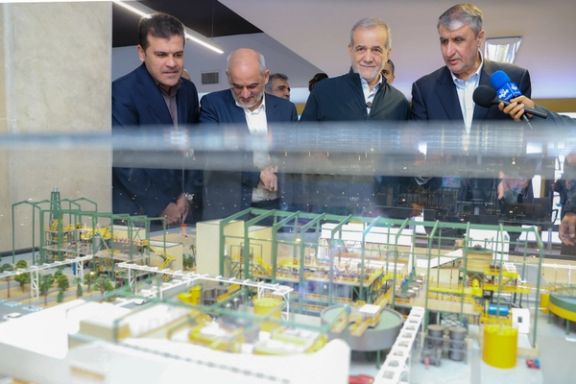
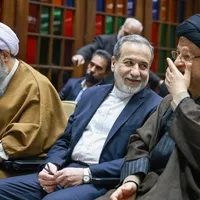
Iran’s nuclear chief Mohammad Eslami (right) and President Masoud Pezeshkian visiting a nuclear expo in Tehran (April 2025)
Iran's nuclear chief on Thursday rejected allegations of secret weapons activity, saying the country has never operated an undeclared nuclear site and that all its activities remain under the oversight of the UN nuclear watchdog.
Mohammad Eslami, head of Iran’s Atomic Energy Organization, told the closing session of the 31st National Nuclear Conference in Mashhad that “Iran has never had any undeclared or covert nuclear activity,” and that all operations are conducted “within the framework of cooperation with the International Atomic Energy Agency (IAEA).”
Eslami said IAEA inspectors continue to conduct both announced and unannounced visits to Iranian nuclear facilities and noted that more than 25% of all global International Atomic Energy Agency (IAEA) inspections in 2024 took place in Iran, despite Iran holding a small share of the world’s nuclear infrastructure.
His comments follow a Fox News report citing satellite imagery and information from the opposition group National Council of Resistance of Iran (NCRI), which claimed a previously undisclosed facility—dubbed the “Rainbow Site”—in Semnan province has been operating for over a decade to extract tritium, a material used in advanced nuclear weapons. The NCRI alleged the site operates under the guise of a chemical firm, Diba Energy Siba.
Iranian officials have dismissed the report as politically motivated. Foreign Minister Abbas Araghchi said on Friday the claims were part of a smear campaign amid indirect nuclear talks with the United States.
“More Very Scary Satellite Images are being circulated,” he wrote on X, accusing Israel of fueling disinformation via proxy groups.
Eslami accused Western powers of trying to destroy Iran’s technological achievements “through either hard or soft power,” and reiterated that Iran’s nuclear goals remain “entirely peaceful and transparent.”
Iran maintains its nuclear program is for peaceful purposes. The IAEA has not publicly confirmed the existence of the so-called Rainbow Site, but its Director General Rafael Grossi recently warned that Tehran now possesses enough enriched uranium to produce “a few warheads” and could do so within months.
Speaking at the Council on Foreign Relations in New York in April, Grossi said that while Iran has not yet built a nuclear weapon, “the material for it … is already there.”
Grossi also said that past research and testing related to nuclear weaponization by Iran remain a source of concern, with the agency lacking “full confidence that they have disappeared completely.”
Grossi described the current state of IAEA monitoring in Iran as “insufficient,” citing a significant shortfall in the agency’s visibility into the full scope of Iran’s nuclear activities.
During his recent visit to Tehran, Grossi met with senior Iranian officials to urge greater transparency, while also noting a strong international consensus—shared by Beijing—against the emergence of a nuclear-armed Iran.
The IAEA remains the sole authority capable of verifying Iran’s compliance with nuclear commitments, and Grossi says any breakthrough in negotiations will hinge on technical clarity and inspection access.
US President Donald Trump said on Thursday that Iran had “sort of agreed” to American terms in ongoing nuclear negotiations, suggesting a breakthrough in the long-running standoff may be imminent.
“We’re getting very close to a deal,” Trump told reporters. “You probably read today the story about Iran has sort of agreed to the terms. We're not going to be making any nuclear dust in Iran.”
Trump emphasized that his administration’s core demand remains unchanged: “They can’t have a nuclear weapon. That’s the only thing. It’s very simple.”
Iran has enough enriched uranium to produce several nuclear warheads and could do so within months, International Atomic Energy Agency Director General Rafael Grossi said last month.
Trump said Tehran now has two options moving forward, either diplomatic or military.
“There’s a very, very nice step. And there’s a violent step, the violence like people haven’t seen before,” Trump warned. “I don’t want to do the second step. Some people do. Many people do. I don’t want to do that.”
Trump’s remarks came while Iranian officials signaled readiness to accept significant constraints on the country's nuclear activities.
In an interview with NBC News published Wednesday, Ali Shamkhani, a senior adviser to Supreme Leader Ali Khamenei, said Tehran was prepared to stop enriching uranium to weapons-grade levels, reduce its stockpile, and allow international inspections — if the United States lifts economic sanctions.
Asked whether Iran would sign such a deal immediately, Shamkhani responded: “Yes.”
“It’s still possible,” he said. “If the Americans act as they say, for sure we can have better relations,” after decades of animosity, the two having broken diplomatic ties in 1979 after the Islamic Revolution.
Trump, speaking at a state dinner in Doha alongside Qatar’s Emir Sheikh Tamim bin Hamad AlThani, said he hoped the situation would be resolved peacefully. “We want to see Iran do well and thrive and be successful,” he said. “We want to have this end peacefully, not horribly.”
He added that his administration was “in very serious negotiations with Iran for long-term peace” and suggested that he views himself as a moderate voice. “In a certain sense, I guess I’m a good friend [to Iran], because a lot of people would rather have me take a much more harsh road,” he added.
Iranian President Masoud Pezeshkian and senior officials issued a sharp rebuke to Trump on Wednesday, following a blistering speech in Riyadh in which Trump accused Tehran of destabilizing the Middle East and mismanaging its economy.
Pezeshkian, speaking in Kermanshah on Thursday, condemned US policies as the true source of regional bloodshed, citing civilian deaths in Gaza as the US supports its ally Israel against Iran-backed militant group Hamas, and US arms sales to Persian Gulf states. "Is it us who are the threat, or those who flood this region with bombs?" he said.
Iran’s foreign ministry accused Trump of attempting to sow division between Iran and its neighbors, with spokesman Esmail Baghaei calling the Riyadh speech a “deliberate move” against regional unity.
Tehran maintains it is not seeking nuclear weapons but vowed to continue uranium enrichment.
Iranian lawmakers said on Wednesday that Iran can enrich up to 93% if deemed necessary, while Foreign Minister Abbas Araghchi proposed a regional enrichment consortium with Arab and US participation, in talks mediated by Oman.
The fourth round of indirect talks between the US and Iran in Muscat ended with Iranian officials warning that continued US pressure could derail progress.
Araghchi also criticized Trump’s earlier remarks in Riyadh, calling them “delusional” and blaming US policy for the country’s economic problems.
Still, Trump, traveling through the Persian Gulf region, projected optimism. “We’re going to try and get it done. They have to move quickly,” he said.
While refraining from directly threatening military action, Trump said that the US would take “all action required” to prevent Iran from obtaining a nuclear weapon.
Trump began his Middle East tour in Saudi Arabia on Tuesday, where he stressed economic ties and regional alliances over military confrontation.
At the GCC summit in Riyadh, he urged Iran to end its support of military proxies in the region, accusing the Biden administration of empowering Tehran and abandoning traditional US allies.
Iranian President Masoud Pezeshkian delivered a fiery response on Wednesday to his American counterpart’s speech in Riyadh the previous day in which Donald Trump accused Iran’s leaders of mismanagement and destabilizing the Middle East.
Pezeshkian rejected the allegations in sweeping terms, turning the blame on Washington and its allies.
“Did we kill sixty thousand women and children in Gaza within a year, under bombs and missiles? Did we cut off water, bread, and medicine from those poor people? Are we the threat?” he asked in a speech in Kermanshah in western Iran.
Referring to US arms sales to Iran's Arab neighbors, Pezeshkian said, “When they boast of having missiles and bombs beyond imagination, is it us who are causing war and bloodshed—or is it them, who flood this region with weapons and ammunition?”
“You want the countries of this region to turn on each other by handing out bombs and missiles, and then you say you are peace-seekers?” he added.
Soleimani killing
Pezeshkian also reminded Trump that he was the one who ordered the killing of Iran's top military commander Qassem Soleimani in 2020, saying, "Soleimani was the man who stood against ISIS—the same ISIS you trained, supported, and nurtured. And now you claim you defeated them?”
Iranian officialdom had seethed at Trump for years after Soleimani's assassination, and the US Justice Department in November unsealed murder-for-hire charges against an Afghan national it said was tasked by Iran’s Islamic Revolutionary Guard Corps with killing Trump.
However, the issue of avenging Soleimani's killing had been somewhat dulled down in recent months amid Trump's renewed campaign of 'maximum pressure' and calls to make a fresh nuclear deal.
“If they martyr our great figures, hundreds more will rise from this land to build this nation," Pezeshkian said.
Responding directly to Trump’s comments about Iran’s internal struggles, Pezeshkian said, “Trump is doing everything he can to sow seeds of division, despair and conflict among the Iranian people. He can only dream of that. All Iranians will stand up for their country with all their might.”
On Iran’s domestic resilience, the president said the Islamic Republic had withstood more than four decades of pressure. “For 47 years, they’ve used all their power to try to bring this system and this people to their knees—and they couldn’t. And they won’t be able to.”
"The kind of pressure they’ve put on Iran—if it had been put on any other country, it wouldn’t have lasted 24 hours.”
His comments came one day after Trump's sharp criticism of Iran's leadership in a lengthy speech in Saudi Arabia.
"Iran's decades of neglect and mismanagement have left the country plagued by rolling blackouts lasting for hours a day ... While your skill has turned dry deserts into fertile farmland, Iran's leaders have managed to turn green farmland into dry deserts as their corrupt water mafia ... causes droughts and empty river beds. They get rich," the US president said.
A large bloc of Congressional Republicans is urging US President Donald Trump to maintain a hardline stance on Iran, calling in an open letter signed by more than 200 lawmakers for the complete dismantling of Iran's uranium enrichment technology.
All Republican senators except one, along with 177 GOP representatives, signed the letter warning against any agreement resembling the 2015 nuclear deal brokered under former President Barack Obama.
That accord, they argued, merely delayed Iran’s nuclear ambitions while allowing it to continue enrichment activities under international oversight.
“The United States cannot afford another deal that gives Iran room to maneuver,” the lawmakers wrote. “The regime must be stripped of all enrichment capacity — even for peaceful energy purposes.”
Rand Paul of Kentucky was the only Republican who did not endorse the letter led by Senator Pete Ricketts of Nebraska and Representative August Pfluger of Texas.
Citing what they described as Iran’s expanding nuclear program, the Republicans expressed skepticism over the possibility of verifying any future agreement that permits enrichment.
“The scale of Iran’s nuclear activity today makes verification of any such deal impossible,” the letter said.
The message comes as the fourth round of US-Iran talks concluded without a breakthrough, and Trump is on a diplomatic tour of Iran's Arab neighbors.
The signatories praised Trump’s earlier decision to withdraw from the Joint Comprehensive Plan of Action (JCPOA) and his administration’s “maximum pressure” policy, which reimposed sweeping sanctions on Tehran.
“You have rightly drawn a red line against any deal that permits uranium enrichment,” they wrote. “We stand ready to support your administration with whatever tools are necessary to protect American national security.”
Trump has said that the goal of the negotiations is to achieve "full dismantlement" of Tehran's nuclear program. However, Tehran insists that its enrichment program is not open to negotiation, but it is ready to cap the level of enrichment.
President Donald Trump’s high-profile trip to Saudi Arabia has drawn renewed attention to the often fraught relationship between the Middle East’s main heavyweights: Sunni Saudi Arabia and its Shi'ite rival Iran.
While Trump’s trip may not have fundamentally shifted the course of Iran-Saudi relations, it underlines how central their evolving dynamic remains to the region’s future especially as nuclear negotiations between Tehran and Washington continue to unfold.
On Wednesday, Saudi Foreign Minister Faisal bin Farhan underscored the importance of the US-Iran nuclear talks, saying the kingdom fully supports them and hopes for a positive outcome.
Iran's Foreign Minister Abbas Araghchi, in turn, visited Saudi Arabia on Saturday before the fourth round of talks with the US to brief them on the latest developments. He had said last Wednesday that Tehran seeks regional consensus on the talks and any potential deal.
Rivalry and diplomatic tension
The two regional powerhouses have long been vying for influence across the Middle East. Their rivalry has played out in a series of proxy conflicts over the past two decades — from Iraq and Bahrain to Syria and Yemen — where the two sides supported opposing factions.
One of the most acute flashpoints came in 2015, when Riyadh launched a military campaign in Yemen against the Iran-backed Houthi rebels. Although Tehran has always denied direct military involvement, it has been widely accused of supplying weapons and political support.
Relations deteriorated further in 2016 after Saudi Arabia executed prominent Shia cleric Sheikh Nimr al-Nimr. The move sparked violent protests and attacks on Saudi diplomatic missions in Tehran and Mashhad, prompting Riyadh to sever diplomatic ties. This marked one of the lowest points in bilateral relations in decades.
Aramco attack
A September 2019 drone and missile attack on the state-owned Saudi Aramco oil hub that disrupted about five percent of global oil supply marked one of the most significant escalations in the Tehran-Riyadh relations in recent years.
Although the Houthis claimed responsibility and Iran denied any involvement, the sophistication of the weaponry used in the attacks led not only Riyadh and Washington but also European powers to directly blame Iran.
Riyadh appeared to change tack away from years of direct and indirect confrontation with Tehran gradually after the assault on its economic lifeline, paving the way for detente.
Signs of a diplomatic thaw
The recent years have seen a cautious thaw in relations. After the initiation of direct talks in April 2021, a breakthrough came in 2023 with Chinese-brokered talks that led to the restoration of diplomatic relations. Since then, both sides have tentatively explored cooperation and re-engagement, even as deep-seated mistrust remains.
From early 2025 to now, Iranian and Saudi officials have held multiple high-level meetings.
Diplomatic momentum picked up pace in October 2024, when the newly appointed Araghchi visited Riyadh and met with Crown Prince Mohammed bin Salman and foreign minister amid growing the growing Gaza conflict.
The timing — just days before another round of Tehran-Washington nuclear talks — underscored Saudi Arabia’s possible diplomatic involvement.
Araghchi returned to Riyadh on May 10, ahead of the fourth and most recent round of nuclear talks in Doha. Iranian media reported that he delivered a response to the Saudi king’s letter, continuing what appeared to be an unprecedented backchannel of direct communication.
Toward a regional nuclear consortium?
During Trump’s meetings in Riyadh, the possibility of a civil nuclear agreement between the US and Saudi Arabia was reportedly discussed.
The initiative, not officially confirmed by either Tehran or Riyadh so far, may have been pitched as a confidence-building measure designed to reassure the West about Iran’s nuclear intentions while embedding regional powers and the United States in a shared framework.
Saudi Arabia, long intent on developing its own civilian nuclear capabilities, may view such a proposal as an opportunity to gain influence over regional nuclear policy while maintaining checks on Iran’s activities. However, significant technical and political obstacles would need to be overcome.
Iran’s parliament warned on Wednesday that any perceived infringement by the UN's nuclear watchdog on its nuclear rights, including the right to enrich uranium up to 93%, would be met with backlash.
In a statement by lawmakers addressed to the International Atomic Energy Agency (IAEA), the group said that Iran's rights under the Nuclear Non-Proliferation Treaty (NPT) — including nuclear research, development, and peaceful use — are non-negotiable and fully verifiable under the IAEA safeguards.
Read by presidium member Ahmad Naderi during a public session, the statement said, "According to Article 4 of the Treaty on the NPT, the great nation of Iran is entitled to three inalienable rights: first, the right to research and development; second, the right to produce; and third, the right to utilize nuclear energy."
The lawmakers argued that in accordance with this article of the NPT, "the Islamic Republic faces no limitations in nuclear research and development and can proceed with enrichment up to 93% based on its scientific, medical, and industrial needs."
The lawmakers also criticized the IAEA for what they called four decades of obstructing Iran’s peaceful nuclear development, and for relying on what they called politically motivated intelligence, particularly from Iran's archenemy, Israel.
Last month, IAEA chief Rafael Grossi said in an interview with Le Monde that Iran was “not far” from being able to produce an atomic bomb, describing the country’s progress as “pieces of a puzzle” that could potentially come together.
Iran maintains that its nuclear program is for peaceful purposes and remains under IAEA monitoring.
Also on Wednesday, Iran’s Parliament Speaker Mohammad Bagher Ghalibaf condemned US President Donald Trump’s recent remarks in Riyadh in which he referenced Iran's alleged nuclear weapons program and Tehran's support for military proxies, calling them “delusional” and blaming US policies for instability in West Asia.
Speaking at the Parliamentary Union of the OIC Member States in Jakarta, Indonesia, Ghalibaf said, “The root of chaos in the West Asia region lies in the US regime’s support for the Zionist mafia.”
Responding to Trump’s allegations, also in Riyadh, that Iran is the region’s main source of instability, while offering a conditional nuclear deal, Ghalibaf said, “His remarks show he lives in illusion.”
“We advise him to open his eyes to the reality that resistance holds a deep place in the hearts of the people,” Ghalibaf said in reference to Tehran-backed regional armed groups.
“Instead of worrying about Iran’s internal affairs, he should be concerned about his own popularity, which has plummeted to historic lows for an American president,” Ghalibaf added.
The speaker also criticized the US for decades of hostile actions against Iran, including the 1953 coup, support for Saddam Hussein during the Iran-Iraq war, the downing of an Iranian passenger plane in 1988, and the assassination of Revolutionary Guard commander General Qassem Soleimani.
“The Islamic Republic has withstood maximum pressure and continues to challenge the global hegemonic system. Even US universities are feeling the impact of this resistance message,” he said, alluding to recent campus protests over the war in Gaza across the US.
Ghalibaf maintained that Iran does not seek nuclear weapons and called for regional security through cooperation among neighbors, “free from the interference of non-regional powers.”
“Iran is not a warmonger, but we will never surrender. We are brothers with our neighbors and reject US efforts to stir division to boost its arms sales,” he said.