Exiled prince says 50,000 insiders back Iran regime change - Politico
Iranian exiled prince Reza Pahlavi
Reza Pahlavi, the exiled son of Iran’s last shah, told Politico that at least 50,000 government and military insiders have registered with his defection platform to help topple the Islamic Republic.
“There’s tens of thousands — the last estimate is over 50,000 at least, maybe more,” Politico quoted Pahlavi as saying in an interview published on Saturday, adding that his office is giving priority to those within key state institutions.
He said his team is working to verify identities and assess the credibility of registrants. A second site for civilian supporters is expected to go live in the coming weeks.
Pahlavi to convene opposition conference in Munich
The Convention of National Cooperation, scheduled for Saturday in Munich, is expected to bring together around 500 regime opponents from inside and outside the country. Pahlavi said it will be “perhaps the largest gathering ever” of anti-regime voices since the 1979 revolution, aiming to project unity among opposition groups and reach audiences inside Iran via smuggled internet services, such as Starlink.
He said all participants back three core principles: preserving Iran’s territorial integrity, defending individual freedoms and equality, and separating religion from the state.
Nine people, including three assailants, were killed and 20 others wounded in an armed attack on a courthouse in the southeastern Iranian city of Zahedan on Saturday, Iranian state media reported.
Fars News Agency, affiliated with the Islamic Revolutionary Guard Corps, said gunmen stormed the judiciary building in the restive Sistan and Baluchestan province and opened fire, first targeting court offices and then shooting at civilians outside.
Security personnel helped court staff and visitors leave the area as gunfire and an explosion were heard from inside the building, Fars said. The cause of the explosion has not been announced. Local speculation pointed to a possible suicide bomber, though this remains unverified.
According to the rights group Haalvsh, the attackers entered through Azadi Street and directly targeted the judges’ offices. Eyewitnesses said several judiciary employees and security forces were hit. The area remains under tight lockdown.
Jaish al-Adl, a Sunni armed group rooted in Iran’s Baluch minority, claimed responsibility for the attack. The group had recently threatened retaliation over the execution of Baluch prisoners in Iran.
The province has seen a sharp rise in executions this year. Iran Human Rights (IHR) NGO recorded at least 343 executions in the first four months of 2025, a 75-percent increase compared to the same period last year.
Baluch prisoners accounted for nearly one-third of all executions in April, including four men hanged on April 30. Rights groups have warned of the possible execution of 85 Baluch inmates in Zahedan Central Prison.
Jaish al-Adl, which has claimed a series of past attacks on military positions including those of the IRGC, is designated as a terrorist organization by both the Islamic Republic and the United States.
Sistan and Baluchestan has long been a center of unrest, frequently targeted by armed factions like Jaish al-Adl, known for ambushes, bombings, and raids that have killed both civilians and security personnel.
The defense and foreign ministers of Australia and Britain hit out on Friday at what they called Iran's rising use of the death penalty and ongoing repression of women, girls and human rights defenders.
“Ministers condemned Iran’s unjust detention of foreign nationals and raised ongoing concerns over the human rights situation in Iran,” said the joint statement by the four ministers, who met for consultations in Sydney on Friday.
It cited “the escalation of the use of the death penalty as a political tool during the 12-day conflict, and the ongoing repression of women, girls, and human rights defenders.”
Their broad remarks also covered shared policy toward many other countries.
Iran’s judiciary chief announced on Wednesday that around 2,000 people were arrested during and after the 12-day war with Israel. Some detainees, accused of collaborating with Israel, could face the death penalty.
“Some of these individuals face severe punishments, including the death penalty, while others may receive lighter sentences,” Judiciary Chief Gholamhossein Mohseni Ejei said in an interview with state TV.
The UN Special Rapporteur on human rights in Iran Mai Sato urged Tehran last month to end what they described as a “post-ceasefire crackdown.”
Australia and the UK also called on Iran to fully cooperate with the International Atomic Energy Agency (IAEA) and “refrain from actions that would compromise efforts to address the security situation in the Middle East.”
Iranian Foreign Ministry spokesperson Esmail Baqaei said a senior IAEA official is expected to visit Tehran in the coming weeks to discuss a new cooperation framework.
“Ministers stated their determination that Iran must never develop a nuclear weapon,” the UK-Australia joint statement added.
A 25-year-old transgender woman, Sogand Pakdel, was shot in the head by her own uncle in an alleged honor killing at a family wedding near Shiraz in southern Iran last month.
Her death was the latest in a series of murders of queer Iranians by their own relatives, according to human rights groups, and testament to the grim practice's persistence in the Islamic theocracy.
Pakdel, a well-known trans activist in Iran, attended her cousin’s wedding despite threats from her family.
Upon arrival, her uncle allegedly fired a warning shot into the air before killing her, according to the Human Rights Activists News Agency (HRANA). The murder took place just days before the start of the 12-day war between Israel and Iran last month.
Pakdel had faced years of abuse, including beatings, abduction and death threats from family members.
The Norway-based Hengaw Organization for Human Rights cited a source saying she had been living in a Shiraz guesthouse after being ostracized yet remained active in Iran’s trans community.
“She never stayed silent,” the source told Hengaw, noting that Pakdel frequently used social media to advocate for trans rights and speak out against discrimination.
"As a transgender woman with lived experience in Iran, hearing this news is not only deeply distressing for me, but also traumatizing," said Shaya Goldoust, an Iranian trans activist now living in Vancouver, told Iran International. "It brings back the pain and fear I endured throughout three decades of life in that country."
Goldoust, who had gender affirmation surgery in 2012, said she feared for her life in Iran. She fled to Turkey in 2016, where she also faced discrimination, before eventually seeking refuge in Vancouver in 2020.
"Iran is a country where being different can cost you your life, and where even death is met with celebration by some," Goldoust added. "The reactions on social media, where many users justified or even welcomed her death simply because of her identity, are a chilling reminder of that truth."
Pakdel was a member of the Qashqai tribe known as “Galleh Zan.” Her killing was reportedly aimed to restore so-called family honor, a term used to justify such murders where they occur in traditional, socially conservative communities.
HRANA reported that her funeral was held in near-secrecy under family pressure, with only a small number in attendance. Her uncle later confessed and turned himself in.
No protection under the law
Shadi Amin, director of the Iranian LGBTQ+ rights group 6Rang, said Pakdel’s killing highlights how vulnerable trans people remain under Iran’s legal system.
Her murder occurred in a legal vacuum in which queer Iranians lack any formal protections and remain vulnerable to systemic abuse and lethal violence.
"As a trans person, Sogand should have been protected by the law—but they weren’t. Their murder by their uncle exemplifies the deadly intersection of patriarchy, heteronormativity, and systemic violence against the LGBT+ community," she told Iran International.
"To prevent such tragedies, we need profound political, cultural, and legal transformation."
Arsham Parsi, a queer Iranian-Canadian activist, was resigned.
“This is yet another heartbreaking and tragic incident from Iran. Sadly, it is not the first time a member of the LGBTQ+ community has been killed by their own family simply for being different — and tragically, it may not be the last,” he told Iran International.
Parsi, who founded Iran’s first underground LGBTQ+ support group in 2001, now lives in Toronto, where he leads the International Railroad for Queer Refugees (IRQR) and the Marjan Foundation, both of which support LGBTQ+ communities across the Middle East.
While being transgender is not criminalized under Iranian law, trans and queer Iranians face widespread violence, exclusion, and discrimination. Homosexuality, by contrast, is punishable by death under the Islamic Republic’s penal code.
In September 2022, two women — Zahra Sedighi-Hamadani and Elham Choubdar — were sentenced to death by the Islamic Revolution Court of Urumieh for defending LGBTQ+ rights online.
Amnesty International said the verdicts were based on their “perceived sexual orientation and gender identity.” Despite international outcry, Iranian authorities stood by the sentences.
Such honor-based killings continue to surface. In February 2024, a man in Tabriz murdered his 17-year-old queer child, Parsa, and was released after serving only six months. In May 2021, Alireza Fazeli Monfared, 20, was killed by male relatives in Ahvaz for being gay—one of the few publicly acknowledged cases.
These murders typically go unpunished and underreported, ignored by the judiciary and state-run media. Activists warn that only international pressure and public scrutiny can disrupt the cycle.
“We know the Iranian regime consistently fails to take meaningful action to prevent such violence or protect LGBTQ+ individuals," Parsi told Iran International.
That’s why the responsibility falls on us — activists, human rights defenders, and allies — to raise awareness, challenge harmful norms, and advocate for change."
But with threats continuing to grow at home, many queer Iranians seek to flee the country in search of safety abroad.
Israel’s attack on Damascus may unintentionally clear a path for its arch-foe Iran to regain influence in war-torn Syria, warns Thomas Juneau, a professor at the University of Ottawa's Graduate School of Public and International Relations.
“The best way to prevent Iran from rebuilding its influence in the new Syria is to have a strong Syria... weakening the new Syria goes exactly against that,” Juneau told Eye for Iran. “That’s why I struggle to see how Israel, in the longer term, is acting in favor of its own interests.”
Israel launched airstrikes on Syria's defense ministry and an area adjoining the presidential palace on July 16 following days of sectarian killings between Bedouin tribes and members of the Druze minority in southern Syria.
Israel cited a need to protect the Druze, an ethnoreligious community which also lives in Israel and the Israeli-occupied Golan Heights.
The UK-based Syrian Observatory for Human Rights reported on Sunday that the past week’s violence killed 1,120 people, including 427 Druze fighters, 298 Druze civilians, 354 government security forces and 21 Sunni Bedouin.
But the Israeli strikes may risk destabilizing the already fragile central government of former jihadist-turned-president Ahmed al-Sharaa, Juneau said.
“To actively work against the creation of a new Syria, where there is a once-in-a-lifetime opportunity now... this could easily fall back against Israel itself,” said Juneau, an associate fellow with the Chatham House's Middle East and North Africa Program.
“The more unstable the new Syria is, the more it creates openings for Iran to rebuild its influence.”
Israel appears to be adamantly opposed to the new rulers of Damascus.
Diaspora Affairs Minister Amichai Chikli called for Syrian President Ahmed al-Sharaa to be assassinated in a statement posted in both English and Hebrew on his X account on July 15.
“Anyone who thinks Ahmad al-Sharaa is a legitimate leader is gravely mistaken — he is a terrorist, a barbaric murderer who should be eliminated without delay,” Chikli wrote.
The next day, Israeli jets pounded heart of Damascus, in an attack that was caught live on a news broadcast as the anchor ducked for cover.
A large flag flying outside the stricken defense ministry which replaced that of the ousted Assad dynasty dictatorship was left shredded.
US Special Envoy to Syria Tom Barrack has taken aim at Israel’s intervention, describing the strikes to the Associated Press as “poorly timed” and a setback to ongoing efforts to stabilize the region.
Tehran eyes comeback amid Syrian chaos
Iran is likely exploiting Syria’s current instability to reactivate dormant networks tied to the former Assad regime, said Juneau, who previously served as the Canadian Department of National Defense's strategic policy analyst focused on the Middle East.
“There is no doubt in my mind that the Islamic Republic will try—probably already is trying—to rebuild its influence networks in Syria, especially with dissatisfied elements and former regime elements,” he told Eye for Iran.
Under Bashar al-Assad, Syria had become Iran’s closest state ally, acting as a conduit for arms to Hezbollah, a strategic launchpad for attacks against Israel, and a hub for Islamic Revolutionary Guard Corps (IRGC) commanders and loyalist militias.
Al-Sharaa, Syria's de facto president, has taken steps to block Iranian re-entry into Syria, including cutting arms transfer routes to Hezbollah that would be used against Israel and working to prevent the return of Iranian influence.
Iran has long justified its refusal to negotiate or normalize ties with Israel on ideological and strategic grounds. But Juneau warned that Israel’s current actions could validate Tehran’s narrative that diplomacy is futile.
“What message does it send when Israel not only hits Iranian and former Iranian assets in Syria, but actively hits the new Syrian government?” he asked. “I think it sends a very negative message... to the Sharaa administration itself, which has clearly said it has no hostile intentions towards its neighbors, including Israel.”
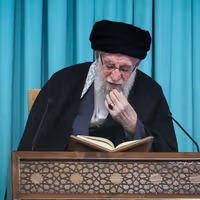
Iran’s Supreme Leader on Friday described Israel's killing of top military commanders and scientists in a war last month as a heavy blow but insisted Tehran's arch-enemy failed in its goal to weaken Tehran.
"The blow was delivered by the wicked and criminal Zionist ruling group, which is the vile and hostile enemy of the Iranian nation," Khamenei said in a message commemorating the 40th day after the killing of the senior military commanders and scientists.
"Without a doubt, the loss of commanders such as the martyrs Baqeri, Salami, Rashid, Hajizadeh, Shadmani and other military personnel, as well as scientists like the martyrs Tehranchi, Abbasi and other scholars, is heavy for any nation, but the foolish and shortsighted enemy did not achieve its goal," he added.
Khamenei said the Islamic Revolution's military and scientific progress would soon "press forward faster than before toward lofty horizons."
The defiant remarks by Iran's 86-year-old veteran theocrat signal no retreat from decades of official hostility to Israel and the United States despite the recent military setback and mounting economic problems.
Israel launched a surprise military campaign on Iran on June 13 that hit military, nuclear, and civilian sites nationwide, kiling hundreds of senior Iranian military commanders, nuclear scientists and civilians.
Iran retaliated with ballistic missile and drone attacks on Israel, killing 27 civilians. Iran says 1,062 people were killed during the 12-day conflict with Israel, including 786 military personnel and 276 civilians.
During the June conflict, Israel's air force took control of Iranian airspace, delivering a significant blow to the country's air defenses, while Iran's armed forces responded with successive waves of missile and drone attacks on Israeli territory.
In his message on Friday, Khamenei urged Iran's military commanders to "increasingly equip the country with tools for safeguarding security and national independence."
He also called for the acceleration of the country's "scientific and technological advancement in all sectors."
Israeli military officials say that 120 air defense systems were destroyed or disabled since the first wave of attacks—around a third of Iran’s pre-war total.
Long-range systems, including Russian-supplied S-300s and Iran’s Bavar-373 batteries, were among those targeted.