France threatens renewed sanctions if Iran talks fail
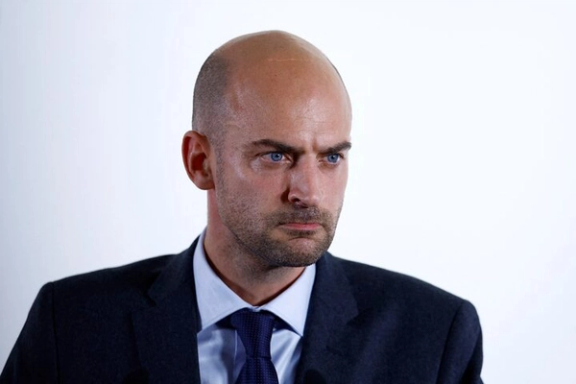
French Minister for Europe and Foreign Affairs Jean-Noel Barrot attends a press conference during an international aid conference in support of Lebanon in Paris, France, October 24, 2024.
France said on Sunday it will push for sweeping global embargoes on Iran unless a broader deal is reached by the end of August covering not just Tehran’s nuclear program but its missile and regional activities.
“We now want a more comprehensive agreement that would encompass both the nuclear dimension of Iranian destabilization activities, but also it's the ballistic component, as well as the regional destabilization activities,” French Foreign Minister Jean-Noël Barrot said on CBS News’ Face the Nation.
Barrot warned that Iran’s repeated violations of the 2015 nuclear accord had rendered the previous terms obsolete.
“Unless a new and robust and durable and verifiable agreement is reached by the end of the summer, France, Germany and the UK will have no other choice but to reapply the global embargoes that were lifted 10 years ago,” he said. These include bans on arms, nuclear equipment and banking.
Barrot said Paris has been in weekly contact with US officials, including Secretary of State Marco Rubio and Special Envoy Steve Witkoff, and has supported efforts to reengage Iran diplomatically since the ceasefire following last month’s war with Israel.
“We have pressed Iran, after the 12-day war, to go back to a discussion with the US,” Barrot said. “If there is no solid agreement that can be found by the end of August, we will have no other option but to snap back.”
Once activated, the mechanism would restore all UN sanctions on Iran without the possibility of veto from Russia or China.
In Tehran, senior official Mohammad Bagher Zolghadr dismissed the threat. “Even if the snapback mechanism is activated, it has no effect and we should not be concerned about it,” he said. “The new negotiation should be about why America betrayed the talks.”
Zolghadr said that renewed sanctions would be ineffective. “Given the current state of the country, new sanctions cannot create restrictions,” he said, adding that Iran had “discovered methods rendering sanctions obsolete.”
US President Donald Trump on Sunday expressed surprise at Tehran’s continued insistence on uranium enrichment despite last month’s American airstrikes on its nuclear facilities, vowing to block any attempt by Iran to maintain the program.
"Iran has been very nasty with their words, with their mouth. They got the hell knocked out of them, and they, I don't think they know it. I actually don't think they know," Trump told reporters on the sidelines of his meeting with the president of the European Commission.
"The whole thing's a con job. We have a lot of con jobs going on. But Iran was beaten up very badly, for good reason. We cannot have them have a nuclear weapon," he added.
On June 22, Trump ordered airstrikes against Iran's nuclear sites in Fordow, Esfahan and Natanz, capping off a surprise military campaign by Israel which killed hundreds of people, including military personnel, nuclear scientists, and civilians.
The 12-day Israeli war on Iran was launched following the 60-day deadline set by Trump for Iran to reach a deal with the West over its disputed nuclear program.
Uranium enrichment was one of the US conditions for the possible deal, but Iran has long been insisting on maintaining its enrichment program, even in the aftermath of last month’s conflict.
Iranian Foreign Minister Abbas Araghchi told Fox News earlier this week that the country will not abandon its uranium enrichment program, calling it both a scientific achievement and a matter of national pride.
“Our enrichment is so dear to us,” he said. “Obviously we cannot give up our enrichment, because it is an achievement of our own scientists and now more than that, it is a question of national pride.”
Trump on Sunday expressed surprise at Iran's insistence on enrichment after what Araghchi called "serious and severe" damage to its nuclear infrastructure.
"They still talk about enrichment. I mean, who would do that? You just come out of something that's so bad, and they talk about, we want to continue enrichment. Who would say that? How stupid can you be to say that?"
Trump vowed that his administration is "not going to allow that to happen."
Iran’s uranium enrichment program has long been a source of international tension. While Tehran maintains that the program is for peaceful purposes, the UN nuclear watchdog argues that enriching uranium to high levels of purity lacks any civilian justification.
Last month's US air strikes targeting Iran's nuclear infrastructure dampened foreign support for Tehran, US Secretary of State Marco Rubio said Saturday in an interview with Fox News.
"I think everyone, China, Russia, others, even North Korea, have become a little bit more cautious about supporting Iran, especially after our B-2s flew halfway around the world and conducted an operation and left before anyone found out about it," he said.
The strikes—dubbed Operation Midnight Hammer—saw B-2 stealth bombers target three key Iranian nuclear sites using 30,000-pound “bunker buster” munitions.
The June 22 attacks followed an Israeli missile barrage that had triggered a 12-day war with Iran. A ceasefire was reached on June 24.
Speaking with Lara Trump on Fox News’My View, Rubio said the operation had a deterrent effect, especially during the height of the fighting. “They all kind of took a pass and said, we don't want to get involved in this thing,” he said of Iran’s traditional allies.
“President Trump reminded them” that the United States has “the most extraordinary military capabilities in the world.”
The June attack came after five inconclusive rounds of nuclear negotiations between Washington and Tehran.
Iran will face the return of UN sanctions unless it resumes cooperation with nuclear inspectors and returns to talks, the leaders of Britain, France and Germany agreed on Saturday during a phone conversation.
UK Prime Minister Keir Starmer, French President Emmanuel Macron and German Chancellor Friedrich Merz "agreed that unless Iran co-operated with the IAEA and returned to diplomacy, sanctions would be reinstated at the end of August," according to the British government's readout of the joint call.
The three European powers have until October to trigger the so-called snapback mechanism under UN Security Council Resolution 2231, which would restore all international sanctions on Iran lifted by the 2015 nuclear deal.
Once invoked, if the UN Security Council fails to unanimously agree within 30 days to continue waiving the sanctions, the previous UN measures will automatically be reinstated.
Negotiators from Iran and the three European powers held a fresh round of nuclear talks in Istanbul on Friday. In the meeting, Iran pushed back on an alleged proposal by Europe to extend the deadline for triggering the snapback mechanism.
Friday's talks marked the first round of nuclear negotiations following the US-Israeli airstrikes on Iran. Washington was not part of the talks, as Tehran has said it is not currently willing to engage in further talks with the Trump administration.
'No talks with US without guarantees'
Iran’s Deputy Foreign Minister Majid Takht Ravanchi said on Saturday Tehran had conveyed messages to the US via intermediaries and would not re-enter talks without firm guarantees against further attacks.
“Before a new round of talks, we must receive guarantees that we will not face similar attacks again,” Turkish outlet Haberturk quoted him as saying.
Citing Israeli and US strikes, he said more than a thousand people had been killed. “These acts must be condemned,” he said.
He confirmed discussions with the E3 are ongoing and centered on uranium enrichment and sanctions relief. “In any agreement, enrichment must be preserved. That is a key element of our position,” he said. “Sanctions must be lifted fully. This is an essential requirement.”
Takht Ravanchi rejected Western demands to limit enrichment, calling them incompatible with Iran’s rights under the Non-Proliferation Treaty.
“Zero enrichment is not acceptable. Our nuclear program is peaceful, conducted on our soil, and in line with the NPT,” he said.
No date has been set for the next E3 round, though Takht Ravanchi said Turkey remains Iran’s preferred venue.
Israel was preparing a final wave of attacks aimed at toppling Iran’s ruling system when US President Donald Trump announced a ceasefire, The Washington Post reported, citing Israeli and American officials involved in the operation.
“When Trump declared a ceasefire, Israel was moving into a final phase of attacks intended to topple the regime,” said David Ignatius in an opinion piece published by The Washington Post on Friday evening.
The final phase, which Israeli planners believed could bring down the Islamic Republic, was halted when Trump intervened.
The ceasefire announced by Trump on June 23 ended a 12-day conflict between Israel and Iran that was capped off by US strikes on Iranian nuclear sites.
The United States had signaled it would join only if the campaign was going well, officials were quoted by the Post as saying.
At the height of the conflict, both Israeli Prime Minister Benjamin Netanyahu and Trump hinted at favoring Iranian regime change.
"It’s not politically correct to use the term, 'Regime Change,' but if the current Iranian Regime is unable to MAKE IRAN GREAT AGAIN, why wouldn’t there be a Regime change??? MIGA!!!" Trump said in a post on Truth Social in late June.
According to the Washington Post, Israel’s 12-day assault dealt such severe damage to Iran’s nuclear and military infrastructure that it set Tehran’s weapons program back by at least one to two years.
“Iran is no longer a threshold nuclear state,” one Israeli source told the paper. The official said the campaign eliminated nearly all of Iran’s first- and second-tier nuclear scientists and crippled both enrichment and weaponization capabilities.
Strikes on facilities at Natanz, Fordow, Isfahan and hidden uranium caches were paired with targeting of electromagnetic pulse and nuclear fusion research. The Israeli source said the intent was to dismantle not only Iran’s hardware but also the human and logistical backbone of its nuclear efforts.
The Post described the operation as combining aerial bombing, intelligence penetration and algorithm war.
After the first two days, Israel achieved total air superiority and destroyed around half of Iran’s ballistic missiles and 80 percent of its launchers, according to the report.
Israel's surprise campaign of airstrikes and drone attacks killed hundreds of Iranians including civilians, military personnel and nuclear scientists. Iran's retaliatory missile strikes killed 27 Israeli civilians.
Iranian President Masoud Pezeshkian on Saturday called for the return of Iranians living abroad and urged coordination between the judiciary and intelligence services to ease concerns, despite past detentions of returnees.
“We must create a framework for Iranians abroad to return comfortably and without fear, and this requires coordination with the judiciary and the Ministry of Intelligence,” Pezeshkian said during a meeting at the foreign ministry.
“These individuals are also assets of this land,” he added, appealing for their reintegration. His remarks followed a state media interview one day earlier in which Cultural Heritage, Tourism and Handicrafts Minister Reza Salehi Amiri said, “This land belongs to you, and we are rolling out the red carpet.”
Yet the government’s invitation comes against a record that has left many expatriates wary. In recent years, dual and foreign-based nationals returning to Iran have faced arrests, lengthy interrogations, and prison sentences often without formal charges being made public.
Nasrin Roshan, an Iranian-British dual citizen, was detained at Tehran’s Khomeini airport in November 2023 while trying to leave the country. She was held for 550 days before being freed in May, after repeated inquiries by rights groups and British officials.
In another case, Iranian-American journalist Reza Valizadeh returned to Iran in early 2024 after a 14-year absence. Within days, he was taken to Evin Prison’s Ward 209 and sentenced in December to 10 years by the Revolutionary Court. His family said he had returned only for a family visit.
The Iranian parliament last week passed the general outline of a bill titled “Support for Iranians Abroad,” backed by 209 lawmakers. The draft law includes measures such as easing entry and exit, offering consular support, reviewing dual citizenship policies, and facilitating academic and investment opportunities.
But critics in parliament questioned its likely impact.
“Until domestic issues such as administrative corruption, a weak banking system, and lack of meritocracy are resolved, this bill will not encourage Iranians to return,” MP Ahmad Fatemi of Babol said earlier this month.
Despite the doubts, Pezeshkian has consistently urged diaspora engagement. In a July 14 message, he told expatriates, “We must join hands and strive for the dignity of our country.”
A nationwide survey in December 2024 titled “Migration of Iranians: Causes and Motives” found that while 19 percent of 12,000 respondents lived abroad, only a fifth of them expressed any interest in returning.
Only 16 percent of Iranians are not considering emigration, according to this study.