Iran accuses Israel of violating Hamas truce after deadly Gaza strike
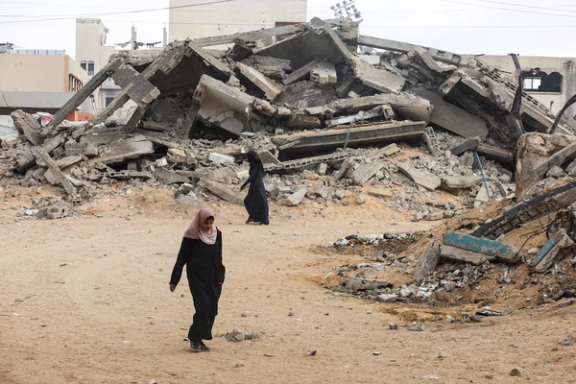
Palestinian women walk near rubble after a ceasefire, in Khan Younis in the southern Gaza Strip, October 9.
Iran’s foreign ministry on Saturday condemned what it called Israel’s violation of the Gaza ceasefire, after the Israeli military said it struck a car in the enclave that had entered a restricted area, killing 11 members of a Palestinian family.
The Israel Defense Forces (IDF) said troops fired warning shots before hitting the vehicle when it continued to approach “in a threatening manner.”
Foreign Ministry spokesman Esmail Baqaei called the incident a violation of the ceasefire with Hamas and urged governments that brokered the truce to ensure its enforcement.
Israel’s actions, including the continued closure of the Rafah crossing, he said, "represented serious breaches of international obligations."
Gaza officials said the victims, including seven children and three women, were members of the Abu Shaban family, who were returning to their home in Gaza City’s Zeitoun neighborhood on Friday when their vehicle was struck.
Hamas described the attack as a “deliberate crime against civilians." The Gaza Civil Defense agency said the bodies were later recovered with the UN's help.
The IDF said the car had crossed into the so-called Yellow Line — a buffer zone separating Israeli-held areas from the rest of Gaza — and refused to stop after warning shots.
Israeli Defense Minister Israel Katz said his country's military would install clearer physical markers along the boundary to prevent future incidents, warning that “any violation of the line will be met with fire.”
Baqaei urged the international community to act to stop what he called further civilian deaths and to secure access to food and humanitarian aid for Gaza’s population.
The ceasefire mediated in early October by the United States, Egypt, Turkey and Qatar put an end to over two years of Israeli attacks on Gaza, which started in response to Hamas's October 7 attack.
Gaza’s media office says Israel has breached the ceasefire with Hamas 47 times since it took effect, leaving 38 Palestinians dead and 143 others injured.
An international human rights conference opened Saturday in Oslo, bringing together Iranian and non-Iranian activists, legal scholars, and political figures to debate the shape of a rights-based future for Iran after the Islamic Republic.
The event titled"Human Rights in Iran After the Islamic Republic" was hosted by the Oslo-based Iran Human Rights Organization, which said its goal was to foster a “respectful and neutral space” for discussion among diverse opposition voices.
Nobel Peace Prize laureate Shirin Ebadi told the gathering that building an effective coalition for change in Iran required agreement on concrete principles rather than abstract ideals.
“Using broad terms like democracy and freedom as a basis for unity has not worked,” she said. “We must ask what kind of democracy we want, define what we mean by freedom of expression, and see where we truly agree.”
Shirin Ebadi (right) and Abdullah Mohtadi take part in the Oslo human rights conference
Iranians should not fear transition, Ebadi added, rejecting comparisons between a post–Islamic Republic future and the turmoil that followed the 1979 revolution.
“People should not be afraid of change.”
Respectful dialogue among opposition groups
Mahmood Amiry-Moghaddam, director of Iran Human Rights, told Iran International that the Oslo meeting for the first time invited representatives from a range of political parties and civic movements opposed to the Islamic Republic.
“The aim is not to form a new alliance or enforce political uniformity, but to enable respectful dialogue among all groups on the foundations of human rights,” he said. “Whatever form the next political system takes, all Iranians must enjoy equal rights.”
Recognizing diversity was essential to preventing the return of authoritarianism, Asso Hassanzadeh of the Democratic Party of Iranian Kurdistan said. “The key to avoiding future tyranny is political justice and acceptance of plurality.”
Abdullah Mohtadi of the Komala Party of Iranian Kurdistan told the conference that any transition must follow today’s international standards.
“It should not turn into bloodshed or political revenge,” he said. “Transitional justice must be based on global norms.”
Fouad Pashaie, secretary-general of the Constitutionalist Party of Iran, said democracy starts today, warning that decades had already been lost.
“Every political group that cares about a united Iran must now cooperate, despite differences,” he said, stressing that opposition efforts should focus on how to end the Islamic Republic without allowing it to rebrand itself under a new guise.
The conference continues Sunday behind closed doors with addresses by party representatives and policy experts.
Iranian opposition figures have stepped up calls to rally against Tehran following a punishing 12-day war with Israel in June, but there have been no significant protests.
Iranian exiled prince Reza Pahlavi urged unity among Iran's opposition during a pro-monarchy conference in Munich in July, saying the Islamic Republic's downfall would lead to sustainable peace and prosperity in the Middle East.
Later that month, Maryam Rajavi, the leader of exiled opposition group the National Council of Resistance of Iran, vowed the armed ouster of its decades-old nemesis the Islamic Republic and the founding of a democratic, non-nuclear state in its place.
Iran will be held responsible for the actions of armed groups it supports, including Hamas, and should be kept out of ceasefire negotiations between Israel and Hamas, a senior US senator told Iran International on Friday.
“The Islamic Republic will be held accountable for its proxy activity,” Senator Joni Ernst (R-Iowa) said. “Iran must stay away from Israel and stop sending money to Hamas.”
She said the ceasefire is vital for Israel’s stability and long-term security, but can only succeed if all hostages, living or dead, are returned and those responsible are brought to justice. “The hostages must come home without exception,” she said.
Her comments came as the first phase of a US-brokered ceasefire took effect under President Donald Trump’s plan to end the two-year war in Gaza. The deal, signed by the leaders of Egypt, Turkey and Qatar alongside Trump, began on October 10 and has so far led to the release of 20 living hostages by Hamas in exchange for nearly 2,000 Palestinian prisoners. Hamas also handed over the bodies of 10 hostages, while Israel says the remains of 18 others are still in Gaza and must be returned without delay.
Analysts say Iran’s next steps could shape future talks
Analysts say the Gaza ceasefire could also have wider implications for Iran. A recent commentary from the Stimson Center said the truce may give Tehran another chance to re-engage in diplomacy with Washington if it chooses pragmatism over confrontation. It said that if the agreement endures, Iranian hard-liners could face pressure to support the peace deal or risk further isolation in the region.
A report from Chatham House said that while Trump’s success in securing the ceasefire was significant, the United States needs a clearer Iran strategy to make the peace sustainable. It said that without renewed diplomatic outreach, a cornered and economically strained Iran could act as a spoiler and undermine regional stability.
Two Iranian lawmakers — one sitting and one former — have been handed suspended jail sentences and bans on media activity over separate cases involving public remarks deemed damaging to national security and public order, the judiciary’s official news outlet reported on Saturday.
The former lawmaker, Mostafa Kavakebian, was convicted after repeating allegations in two televised interviews accusing a French-born journalist of having intimate relations with senior Iranian officials.
“Following the remarks, the former member of parliament was summoned by the judiciary to present evidence and documentation, but after failing to provide any credible proof to support his statements, an indictment was issued by the prosecutor’s office and the case was referred to court for trial,” wrote Mizan News Agency.
The court sentenced him to 14 months in prison, suspended for four years, and imposed a two-year ban on all media activity, including interviews and publication of commentary across outlets or online platforms.
The editor-in-chief of the outlet that broadcast his comments was also fined under the court’s ruling, Mizan News Agency added. The verdicts are subject to appeal.
Kavakebian’s remarks concerned Catherine Perez-Shakdam, a French journalist of Jewish background who had previously visited Iran and written favorably about its leadership. In a July state TV interview, he said that she was an Israeli spy who had slept with 120 senior officials. Speaking to Iran International, Shakdam dismissed the charge as “not true, not possible, and completely absurd.”
Shakdam now works as a political analyst and spokesperson for an Israeli advocacy group We Believe In Israel.
Separate sentence for Tehran MP
In a separate ruling, a current member of parliament representing Tehran was convicted of “disturbing public opinion” after describing the government of President Masoud Pezeshkian as plotting to “end the Islamic Revolution” and “terminate Khamenei’s rule” during an online interview in June.
Abolfazl Zohrevand, who formerly served as Iran’s ambassador to Afghanistan, received a sentence of three months and one day in prison, suspended for three years, along with a two-year prohibition on media engagement. The editor responsible for publishing his comments was likewise ordered to pay a fine.
The court said it had first consulted the parliament’s oversight board, which confirmed the remarks fell outside Zohrevand’s duties as a lawmaker.
Each of the lawmakers remains free but under suspended sentences that would take effect if similar offenses are repeated within the designated period.
Iran parliament speaker Mohammad Bagher Ghalibaf has sent to President Masoud Pezeshkian the law approving the country’s accession to the UN anti-terror finance convention, with conditions that limit implementation to Iran’s constitution and domestic laws.
Ghalibaf issued the notification under Article 123 of the constitution, which requires the speaker to forward approved legislation to the president for enforcement.
The law is part of Iran’s effort to meet Financial Action Task Force (FATF) standards requiring countries to monitor and report financial transactions to curb money laundering and terror funding.
Mohsen Dehnavi, spokesman for the Expediency Council, said Iran’s accession was approved with two safeguards. Parliament attached a clause requiring the government to act within the framework of the constitution, and the council added that the Islamic Republic would implement the treaty only insofar as it aligns with domestic laws.
“If any part of the convention conflicts with Iran’s internal legislation, national laws will take precedence,” Dehnavi said. “The Expediency Council approved joining the convention based on these two conditions.”
The move came days after lawmakers voted down a bid to block the government from joining the United Nations convention against terror financing. Lawmakers rejected the motion with 150 votes in favor, 73 against and nine abstentions out of 238 members present. The proposal, introduced by conservative lawmakers, sought to halt Iran’s conditional approval to join the convention.
Earlier this month, the Expediency Council, which resolves disputes between parliament and the Guardian Council under Supreme Leader Ali Khamenei, gave conditional approval for joining the treaty after years of delay, saying implementation would depend on guarantees that Iran’s economic and security interests are protected.
Backers see relief, opponents fear exposure of financial networks
Hardline lawmakers say joining the UN anti-terror finance convention could expose Iran’s financial networks used to bypass US sanctions and support regional allies. Supporters argue that compliance could reconnect the country’s banks to global systems and attract investment amid a deep economic crisis.
Mohammad-Mehdi Shahriari, a member of parliament’s national security committee, said on Saturday that reopening debate on the Countering Financing of Terrorism bill was illegal and would deepen Iran’s isolation, ILNA reported.
He said President Masoud Pezeshkian’s government had obtained the Supreme Leader’s consent to review the measure after expert study. “The CFT was approved with conditions and safeguards after a long process involving parliament, the Guardian Council, and the Expediency Council,” he said.
Shahriari criticized ultraconservative lawmakers for trying to block progress. “Our revolutionary brothers said it was not the right time to discuss this,” he said. “But with so many barriers in trade and banking, the Palermo and CFT bills can ease the burden created after years of sanctions.”
Revisiting the bill in parliament was illegal because the Supreme Leader had already authorized its review, he said.
Regional ties and economic impact
Failure to adopt global financial rules has worsened Iran’s economic problems and strained ties even with friendly states, Shahriari said. “Russia and China have both said that our refusal to join FATF conventions complicates trade with them,” he said. “When most countries have joined and only Iran and North Korea stand apart, what purpose does it serve except more isolation?”
The United States has for decades accused Tehran of using its regional allies to fund and organize attacks, labeling Iran the world’s leading state sponsor of terrorism for 39 consecutive years.
Iran will no longer implement any of its commitments under the 2015 nuclear deal, which expired on Saturday, the country’s foreign minister told the United Nations, once again refusing to acknowledge the reimposition of UN sanctions triggered by European powers last month.
Foreign Minister Abbas Araghchi said in a letter to the UN secretary-general and the president of the Security Council that the resolution’s termination on October 18 was “in full accordance with its explicit provisions.”
He added that all related restrictions on Iran’s nuclear program had now lapsed and that the Council’s involvement in Tehran’s peaceful nuclear activities had formally ended.
Araghchi said Iran had “implemented the JCPOA in good faith and with full precision” while the United States “grossly violated international law” by withdrawing in 2018 and reimposing unilateral sanctions.
The three European signatories, he wrote, “failed to meet their obligations and instead imposed additional unlawful measures.”
Referring to the European decision in August to trigger the deal’s snapback mechanism—which reimposed UN sanctions on Iran without the possibility of a veto—Araghchi called the move “unilateral and arbitrary” and said it had “no legal, procedural, or political basis.”
He warned that any claim to reinstate expired resolutions was “null and void.”
The same position was echoed on Saturday by Foreign Ministry spokesperson Esmail Baghaei, who said Iran believes “no decision has been taken in the Security Council to bring back the lifted resolutions,” citing opposition from Russia, China, and several other Council members.
Moscow’s foreign ministry said Western efforts to restore UN sanctions were “legally null and void,” adding that after the expiration of Resolution 2231, Iran’s nuclear program should be treated like that of any other non-nuclear-weapon state under the Non-Proliferation Treaty.
Russian Foreign Minister Sergei Lavrov earlier described Iran’s acceptance of the snapback clause in 2015 as “a legal trap,” but said Moscow remained firmly committed to a political and diplomatic settlement of the dispute.