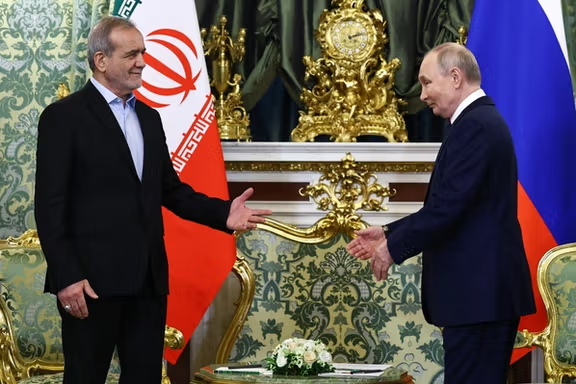
Iran's president Masoud Pezeshian meets Russian counterpart Vladimir Putin in Moscow, January 2025
A fresh debate has erupted in Tehran over Russia’s role in Iran’s foreign policy amid diplomatic moves that may suggest an intermediary role for President Vladimir Putin between the Islamic Republic and its arch-foes Israel and the United States.
Russia said on Friday it was ready to help resolve the impasse over Iran’s nuclear program—a day after former foreign minister Mohammad Javad Zarif accused Moscow of standing in the way of Tehran’s potential path to normalcy with the West.
Zarif reignited long-running suspicions about Moscow’s intentions as Iran’s security chief Ali Larijani visited the Russian capital to deliver a message from Supreme Leader Ali Khamenei.
The former head of parliament’s National Security Committee Heshmatollah Falahatpisheh echoed the charge on Friday, asserting that Russia had previously obstructed a potential agreement with the United States in 2021.
“Over-reliance on the Kremlin puts Iran on a dangerous path,” he warned in the economic daily Donya-ye Eghtesad. “Russia is not a trustworthy partner around the world, and ignoring this could be costly.”
Another moderate outlet, Rouydad24, argued in a Friday editorial that “historical experience shows Moscow’s interests do not always align with Tehran’s.”
Lifeline or liability?
Iran’s dependence on Russia—even amid Putin’s hints at goodwill mediation—has long been questioned by moderates who favor a tilt toward the West.
Those calls have intensified since the June war with Israel, when Moscow offered little help—either unwilling, as some in Tehran suggested, or unable due to its own entanglement in Ukraine.
Hardliners, and most crucially the Supreme Leader, appear to think otherwise.
Ali Khamenei has rarely been seen since Israel demonstrated its ability to strike top commanders in June, but the message from those considered closest to him remains unmistakably combative.
Khamenei’s top foreign-policy adviser Kamal Kharrazi said in an interview with the leader’s website that Iran’s missile program and support for armed allies in the region remain non-negotiable.
While emphasizing Iran’s openness to diplomacy, Kharrazi also laid bare Tehran’s limited room for compromise with Washington.
Anti-West line rules
That same day, cleric Alireza Panahian, close to Khamenei’s office, promoted a state-sponsored book advocating Israel’s annihilation—underscoring how deeply confrontation remains embedded in the system’s worldview.
Covering Larijani’s trip to Moscow, hardline outlets invariably hailed him as a “trusted figure,” implying that others, including President Masoud Pezeshkian, were not considered reliable enough to represent Khamenei.
It didn’t help the relatively moderate president that he was filmed cycling through Isfahan as part of a campaign promoting healthy living just as the veteran conservative Larijani delivered Khamenei’s message to Putin.
The image was mocked by social media users who saw it emblematic of a fragmented government in which real authority rests beyond the president's station.
While relations between Moscow and Tehran have generally been good, ties between former Iranian Foreign Minister Mohammad Javad Zarif and the seemingly perpetual Russian Foreign Minister Sergei Lavrov are decidedly not.
Lavrov has often claimed that Russia “always supported” and helped bring about the 2015 Iranian nuclear accord formally known as the Joint Comprehensive Plan of Action, or JCPOA. Zarif, however, has argued that Moscow actually tried to prevent it from being finalized.
Back in 2015, I also believed that Moscow was trying to derail the JCPOA.
Zarif recently told a conference in Tehran that Russia did not want Iran to have normal relations with the rest of the world, yet did not wish for Iran to enter direct confrontation with other states either.
In my view, Zarif’s accusation rings true.
Russia's way
Before Putin’s 2022 invasion of Ukraine froze my ability to meet Russian colleagues, I regularly spoke with Russian scholars who were candid about their view of the Iranian-American relationship.
Several indicated that, from their perspective, the worst-case scenario for Russia was not an Iranian nuclear weapon, but an Iranian-American rapprochement. They feared that if such a rapprochement occurred, Tehran would have far less need for Moscow and might even work with Washington against Russian interests.
From their point of view, it was clearly in Russia’s interests for Iranian-American relations to remain hostile.
As for Zarif’s charge that Moscow prefers Iran not to have normal relations but also avoids direct confrontations: this reflects Russia’s standard diplomatic approach. Moscow benefits when countries are at odds, since it can then provide security assistance to one side—or even both.
When adversaries make peace, they tend to focus on economic development and cooperation with the US, Europe or China—but rarely with Russia.
While Moscow profits from tension, it usually does not want outright conflict, as that can expose its unwillingness or inability to support its “allies”—as seen during the recent 12-day war between Israel and Iran.
Despite Iran having sold armed drones and reportedly even ballistic missiles to Russia for use in Ukraine, Moscow did virtually nothing to help Tehran during that conflict.
This could have led to a rupture in relations, but ongoing hostility between Iran and the US has kept Tehran tied to its one-sided cooperation with Moscow.
Tehran’s choice
Still, Russia cannot be blamed entirely.
One striking feature of today’s “multipolar” order is how many states in the “Global South” manage to cooperate simultaneously with both the West and with Russia and China. In the Middle East, countries like Turkey, Saudi Arabia, the United Arab Emirates, Qatar and even Israel maintain such balanced relations.
Washington may be uneasy with this but has largely had to accept it. Moscow, for its part, takes satisfaction in America’s discomfort, though it harbors no illusion that these states would abandon the West in favor of Russia or China. They benefit from good relations with all major powers.
Not so Iran.
Continued hostility with the US prevents Tehran from reaping the benefits of cooperation with Washington, while ensuring that Russia can exploit the relationship without fear of losing Iran to the West.
And this, as Zarif observed, is precisely where Moscow wants Tehran to remain.
Doomed—or not?
It need not be this way.
Syria’s new, formerly jihadist leader Ahmed al-Sharaa has shown that it is possible to build productive ties with America, Europe, Turkey Arab states—and even with Russia, whose forces bombed his rebel movement just last year.
Instead of dwelling on justified grievances against Moscow, Sharaa has focused on how Syria can benefit from engagement with all sides.
It is highly doubtful that Iran’s aging Supreme Leader Ali Khamenei would ever countenance rapprochement with the United States. His worldview is too deeply rooted in the revolutionary notion of America as a permanent enemy.
But 86-year-old Khamenei cannot last indefinitely, and leadership change is coming.
However unlikely it seems now, his successor may yet recognize the advantages of setting aside old grievances to improve ties with Washington—and, in turn, to gain leverage over a Russia now wary of losing Iran to Western influence.
Whether the US would reciprocate is another matter. Donald Trump’s willingness—even eagerness—to make deals with long-time adversaries such as Russia and North Korea suggests he might be open to one with Iran as well.
There is, of course, no guarantee this will happen.
It is more likely that Khamenei’s successor will resemble him—someone who refuses “on principle” to allow rapprochement with the US, Europe, or Iran’s Arab neighbors, regardless of the economic benefits such a shift might bring to Iranians.
Meanwhile, Moscow will continue to profit from Iran’s isolation.
A new and far deadlier conflict between Israel and Iran looms, former Israeli intelligence official Danny Citrinowicz told Eye for Iran, warning that Tehran has learned from past clashes and is rapidly improving its missile capabilities.
Citrinowicz, a former head of the Iran branch within Israel's military intelligence, said the United States still seeks a negotiated deal with Tehran while Israel remains focused on weakening or toppling the Islamic Republic — a fundamental imbalance he warned makes escalation “almost inevitable.”
“The starting point of the next war will be the ending point of the previous one,” he said.
Now a nonresident fellow with the Atlantic Council’s Middle East program, Citrinowicz also serves as a research fellow at the Institute for National Security Studies (INSS) in Tel Aviv.
“It will be very violent from the get-go. And I really think that there won’t be a mechanism that will allow us to close it, because unlike previously when the US forced the sides to close it, now the Iranians will not be willing to close it until they feel they have balanced the equation of deterrence with Israel."
"That is why I think the next will be much more violent and longer,” he added. "It will lead to more civilian casualties."
Citrinowicz’s warning comes as President Donald Trump continues to frame the 12-day Iran–Israel war as a decisive victory. Trump has repeatedly maintained US B-2 bomber strikes "obliterated" Iran’s key nuclear sites, forcing Tehran to accept a ceasefire and halting its nuclear ambitions.
Critics, however, say the claim is largely rhetorical and that the strikes likely delayed, not ended, Iran’s nuclear advancements, leaving the conflict’s root cause unresolved.
Satellite imagery taken in recent months shows that Iran is continuing construction at the Natanz “Pickaxe” mountain or Mount Kolang Gaz-La, consistent with activity seen before the June war.
The mountain complex south of Natanz includes another older tunnel network associated with Iran’s main enrichment site, which also shows signs of ongoing work, particularly reinforcement of tunnel entrances.
'Israel didn't win anything'
After the 12-day war between Israel and Iran, many in Israel came away with the impression that Israel had won the war. Iran was hit hard, and Israeli operations left Tehran no longer viewed as a threshold nuclear state, as US and Israeli officials say. But Citrinowicz argues that this is a dangerous misconception.
“In Israel we have the wrong perception. We are saying we won — we didn’t win anything,” he said. “We had major achievements, but from the Iranian standpoint, they really believe they had major achievements too. Both sides think they won, and that’s what makes another clash inevitable.”
Citrinowicz says Israel must not underestimate Iran’s capacity to recover. He noted that Tehran has rapidly replaced assassinated commanders, resumed missile testing “almost daily,” and is seeking Russian and Chinese air defense systems to harden its skies.
“If there’s one lesson from recent history,” he said, “it’s that the regime is stronger than many believed.”
Another confrontation, he said, is likely within weeks or months as Washington’s demands — on uranium enrichment, missile limits and even some talk of joining normalization deals with Israel — meet flat Iranian refusals.
He argued that US advisers continue to misread Iran’s ideology and decision-making, while Tehran is rapidly rebuilding and testing capabilities at Natanz and Fordow, and acting bolder at sea — all of which may prod Israel into striking again.
Israel, he added, is unlikely to enjoy the same US military umbrella it had during the last war, when Washington deployed advanced interceptors and coordinated air operations. With Trump now juggling multiple crises, Citrinowicz said, “Israel could face a far tougher fight — and far less help.”
Just over a year ago, Iran launched Operation True Promise II against Israel — part of a steady escalation in which each confrontation has become more intense.
'Growing gap' between US and Israel on Iran
In his October 13 address to the Knesset, Trump declared that Iran had been “two months away” from a bomb before the US strikes in June and that he “terminated” its nuclear program afterward. “They’re not starting anything,” he said. “They just want to survive.”
Those lines, Citrinowicz cautioned, project misplaced confidence.
“Despite the fact that both sides basically want to reach an agreement, their present stances are not allowing one to be reached,” he said.
“What President Trump said in Israel actually highlights that misunderstanding — about Iran’s behavior and ideology — that will probably lead to another confrontation. Definitely, we are reaching another round of escalation.”
Russia said on Friday it was ready to help resolve the impasse over Iran’s nuclear program after Russian President Vladimir Putin said this month he was receiving messages from both Israel and Iran.
“Moscow remains firmly committed to a political and diplomatic settlement around the Iranian nuclear program and calls on all parties involved to focus their efforts on finding the necessary solutions to avoid a new uncontrolled escalation of tensions,” the Russian foreign ministry said in a statement.
“We are ready to assist in this endeavor in any way possible," it added.
Iranian security chief Ali Larijani met Putin on Thursday and announced later he had delivered a message from Supreme Leader Ali Khamenei. Its contents were not disclosed.
Putin said earlier this month that Israel had reached out to enlist Moscow's aid in transmitting to Tehran its desire to avoid further clashes.
“We continue our trusted contacts with Israel and are receiving signals from the Israeli leadership asking us to convey to our Iranian friends that Israel is focused on further settlement and is not interested in any form of confrontation,” Putin said, according to Russian state news agency TASS.
US President Donald Trump announced on Thursday that he would soon meet Putin in the Hungarian capital to discuss ending the war in Ukraine, though a date has yet to be set. It was unclear if Iran would be a topic of discussion.
'Brute force'
The Russian foreign ministry statement was released on the eve of the expiration of UN Security Council Resolution 2231, which endorsed a 2015 nuclear deal, officially known as the JCPOA.
Last month, UN sanctions were reimposed on Iran after France, Germany and the United Kingdom triggered the so-called snapback mechanism under the resolution, after they accused Tehran of spurning diplomacy and nuclear inspections.
Tehran rejects the powers' standing to invoke the sanctions and denies seeking any nuclear arms.
Russia said earlier this month the restoration of UN sanctions on Iran was "legally null and void and cannot impose any legal obligations on other states."
Moscow added on Friday that following the resolution’s expiry, Iran’s nuclear program should now be treated like that of any other non-nuclear weapon state under the Treaty on the Non-Proliferation of Nuclear Weapons (NPT).
The ministry said Western states had rejected a joint Russian-Chinese proposal to extend the technical aspects of the deal by six months, showing what it called “an inability to negotiate and a reliance on illegal methods and brute force.”
Earlier this week, Russian Foreign Minister Sergei Lavrov said Moscow was surprised by Iran's agreement to the so-called UN snapback sanctions mechanism of the JCPOA, describing it as a legal trap for Tehran.
“To be honest, we were surprised. But if our Iranian partners accepted this formulation - which, frankly, was a legal trap - we had no grounds to object,” Lavrov told reporters in Moscow on Monday.
The snapback provision allowed any JCPOA signatory, including the five permanent members of the UN Security Council plus Germany, to reimpose UN sanctions on Iran in the event of alleged violations without the possibility of a veto.
As the world races to meet the UN’s 2030 Sustainable Development Goals, Iran faces a bleak environmental outlook given the scale of its problems and authorities' record of short-term policymaking.
From vanishing water reserves and dried wetlands to fragile cities, failing infrastructure and a fossil-fuel-dependent economy, decades of reactive decisions have set the country on an unmistakably unsustainable path.
Iran now stands on the brink of “water bankruptcy,” a term describing when consumption far exceeds natural replenishment.
Over-extraction from aquifers, unchecked dam-building, inter-basin transfers, and ill-planned agricultural projects have left more than 500 plains suffering groundwater collapse and land subsidence—what experts call a “silent earthquake.” In some areas, land sinks by more than 20 centimeters a year.
Hundreds of villages across central and eastern Iran now lack safe drinking water, triggering waves of climate-driven migration.
The crisis no longer threatens only agriculture and food security but the country’s social stability and national security.
No climate plan
Iran is among the world’s most climate-vulnerable nations.
Rising temperatures, shrinking snowfall, extended droughts and intensifying dust storms reveal the scale of change, yet the country still lacks a national adaptation plan.
Limited engagement with international scientific bodies, poor climate data and a reactive policy mindset have weakened its ability to respond.
While many countries invest in innovations like smart farming and early-warning systems for floods and droughts, Tehran’s measures remain short-term and unsustainable.
Cities Strained
In five decades, Iran has urbanized at one of the fastest rates globally—without the infrastructure or governance to match.
Tehran, Mashhad, Isfahan and Ahvaz now face toxic air, crumbling public services, decaying neighborhoods, and growing informal settlements.
Municipal priorities lean toward costly showcase projects instead of building resilient, livable cities.
As a result, Iran’s urban quality-of-life indicators remain far below global averages, and its cities are increasingly vulnerable to earthquakes and floods.
Self destruction
Iran’s economy remains tethered to the overuse of natural resources and fossil fuels, eroding efficiency and environmental security.
Agriculture, despite contributing little to GDP, consumes more than 90% of the nation’s water—often to grow water-intensive crops like rice and pistachios in arid zones.
Inefficient subsidies for energy and water encourage overconsumption, soil degradation and aquifer depletion. Heavy reliance on oil and gas fuels pollution and delays a shift toward a green economy.
Unlike many of its neighbors, Iran still lacks a binding strategy for renewable energy—a gap that risks locking the country into technological stagnation and environmental decline.
Governance at the core
At its core, Iran’s crisis stems less from a lack of natural resources than from weak governance and fragmented decision-making.
Years of unscientific, short-term policymaking and exclusion of civil and expert institutions from decision processes have eroded the capacity for sustainable development.
Centralized, project-based management continues to dominate where transparency, public participation and local knowledge could drive meaningful solutions.
Sustainable development is no longer optional. It is vital to Iran’s survival.
Continuing the current course—from vanishing wetlands and land subsidence to air pollution and climate migration—will erode the country’s ecological and human foundations.
Reversing course will demand a new development model—one built on sustainable water management, restored aquifers, reformed crop patterns, national climate adaptation, urban renewal and investment in clean energy.
Yet these are tall orders—and they appear far down the list of priorities for rulers consumed by political rather than ecological survival.
Iran plans to activate about 80,000 trained volunteers in Tehran province to support social and religious outreach programs, including new coordination on hijab and public behavior, a senior official said on Thursday.
“The country’s greatest asset is its faithful and revolutionary people,” Rouhollah Momen-Nasab, head of Tehran’s headquarters for the Promotion of Virtue and Prevention of Vice, told reporters. “By activating 80,000 trained personnel, we can bring about major transformation in the province even before relying on large state budgets,” he said.
He announced the formation of a “chastity and hijab situation room” involving cultural and executive bodies, inviting citizens to join a network of local observers to help promote what he described as social discipline and religious values.
Momen-Nasab described the group’s response to what he called a “cognitive and cultural war” as data-driven and multi-layered, with monitoring and policy recommendations sent to relevant authorities. The organization, he said, will also push institutions through legal and audit channels to fulfill their “statutory duties.”
Momen-Nasab said the headquarters was coordinating with the prosecutor’s office and cyber police to monitor online and streaming platforms, warning that “virtual spaces and VODs must not be safe havens for lawbreakers.”
The renewed push comes as most Iranians continue to oppose mandatory hijab rules. A 2022 survey by Netherlands-based GAMAAN found more than 70 percent of Iranian men and women opposed compulsory veiling.
For Iran’s leadership, however, enforcement of hijab laws remains a pillar of political legitimacy. Since Mahsa Amini’s death in 2022, women appearing unveiled in public have turned defiance into a sustained act of civil protest.
In recent weeks, authorities have sealed cafés and restaurants across cities for noncompliance after outcry by hardliners. Police warned that all businesses “must observe current laws.”