Iran says Grossi’s remarks paved way for US-Israeli attack
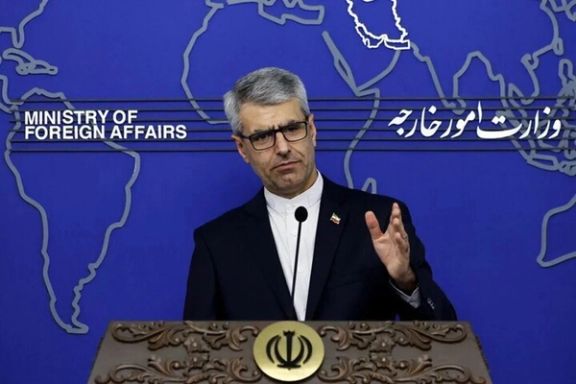
Iran’s foreign ministry spokesman Esmail Baghaei
The fallout from International Atomic Energy Agency Director General Rafael Grossi’s statements paved the way for an American-Israeli attack on the country, Iran’s foreign ministry spokesman said on Thursday.
“Grossi knows very well that Iran’s nuclear program is peaceful,” Esmail Baghaei told Al-Jazeera.
“The consequences of Grossi’s catastrophic statements paved the way for American and Israeli aggression against Iran.”
Grossi’s comments in New York
Inspectors had not observed any suspicious activity at Iranian nuclear sites struck by the United States in June, Grossi said on Wednesday in New York, adding that monitoring had resumed in part.
“We do not see anything that would give rise to hypotheses of any substantive work going on there,” Grossi added.
"We are trying to build it back, and we are inspecting in Iran," he said, "not at every site where we should be doing it - but we are gradually coming back."
Conditional cooperation
Iran limited cooperation with the IAEA following the 12-day war in June, under legislation giving the Supreme National Security Council authority over inspection access.
Iran continues to meet its safeguards commitments under the Nuclear Non-Proliferation Treaty while adhering to the parliamentary law, Baghaei said on Tuesday.
“In fulfilling these safeguards obligations, we are maintaining interactions with the IAEA while taking into account parliament’s law, which designates the Supreme National Security Council as the authority responsible for decisions on cooperation with the agency,” Baghaei said.
Although Iran and the IAEA agreed in Cairo last month to resume inspections, doubts persist after Germany, France, and the United Kingdom triggered procedures to restore UN sanctions.
A report by the Center for Strategic and International Studies said satellite imagery shows continued construction at a major underground nuclear facility near Natanz.
Iran says Grossi’s remarks paved way for US-Israeli attack | Iran International
Iran’s Supreme National Security Council Secretary was challenged over his interpretation of a study by the Jewish Institute for National Security of America on the June 2025 Israel-Iran conflict, after he cited the report in remarks posted on X last week.
The Iranian security chief Ali Larijani “cites my 12-Day War report but skips the part where Iran lost: Iran’s missile and drone attacks were overwhelmingly defeated by US and Israeli defenses and Israel’s crushing strikes against Iran,” Ari Cicurel, Associate Director of Foreign Policy at JINSA and author of the report “Shielded by Fire,” wrote on X.
The Iranian official had written that “Iran's armed forces demonstrated power in the war against the Zionists,” invoking the JINSA study to back his argument. But the report, released in August 2025, found that Iran’s missile and drone attacks were mostly neutralized through integrated US-Israel air and missile defenses.
US defenses decisive
The 29-page study said Iran launched 574 ballistic missiles and more than 1,000 drones between June 13 and 24, yet only 49 missiles impacted populated areas or infrastructure. It attributed Israel’s limited damage to the combined interception network, which it said achieved an 85 percent success rate.
“The vast majority of the over 500 ballistic missiles fired by Iran did no damage to Israel, that success due in large part to ad hoc US-led air defense cooperation,” the report said.
The analysis credited Washington’s role as decisive, noting that the United States deployed two THAAD missile defense batteries and several Aegis-equipped destroyers to support Israel and provided over 230 interceptors -- around a quarter of its total stockpile.
Contrasting narratives
Israel’s counterstrikes destroyed hundreds of Iranian launchers and reduced its missile stockpile from 2,500 to roughly 1,000 - 1,500, forcing Tehran to scale back its offensives, according to the report.
The report concluded that Israel and the United States must expand interceptor production and formalize their missile defense coordination to prevent Iran from regaining its offensive capacity.
Indian police have arrested a 59-year-old man accused of running an espionage and fake passport racket and maintaining contact with nuclear scientists overseas, including in Iran and Russia, Indian media reported on Wednesday.
The suspect, identified as Mohammad Adil Hussaini, had travelled to several countries, including Pakistan, and was allegedly involved in sharing sensitive material abroad, India Today reported, citing police sources.
During questioning, Hussaini allegedly said he obtained nuclear-related designs from a Russian scientist and passed them to a contact in Iran, the report said.
Police said Hussaini earned large sums from the exchange, investing part of the money in property in Dubai. Officials are investigating whether any classified information was shared, saying the matter involves foreign contacts and remains under inquiry.
Delhi Police said Hussaini, also known by several aliases, was found with one original and two forged Indian passports. He is suspected of using fake documents to obtain multiple identity cards linked to sensitive installations.
Additional Commissioner of Police (Special Cell) Pramod Singh Kushwah said the racket had been operating for years and was run from the eastern city of Jamshedpur, where forged passports were produced. “Several others are under the scanner,” Kushwah said on Tuesday.
Police said Hussaini’s brother, Akhtar Hussaini, had been arrested in Mumbai for helping secure fake IDs and travelling to Persian Gulf countries to expand the network. A cafe owner linked to the operation has also been detained.
Hussaini has been remanded in seven days of police custody for questioning, Delhi Police said.
International Atomic Energy Agency (IAEA) chief Rafael Grossi said on Wednesday there were no signs of suspicious activity at Iranian nuclear sites bombed by the United States in June, adding that inspectors had gradually resumed some work in Iran.
"We do not see anything that would give rise to hypotheses of any substantive work going on there," IAEA Director General Rafael Grossi said in New York.
"These are big industrial sites where there is movement, there is activity going on and we are very quick to indicate that this does not imply that there is activity on enrichment," he added.
Iran suspended cooperation with IAEA inspectors after a 12-day war in June against Israel and the United States, codified via a new law passed by parliament.
Grossi told reporters that inspectors had no access to the to sites stricken in June, but confirmed that some inspection was under way.
"We are trying to build it back, and we are inspecting in Iran," he said, "not at every site where we should be doing it - but we are gradually coming back."
Respecting NPT
In September, Iran and the agency agreed in Cairo to restart inspections. However, after Germany, France and the United Kingdom triggered the reimposition of UN sanctions, it remained unclear whether Iran would comply.
Foreign Ministry spokesman Esmaeil Baghaei said on Tuesday that Iran's commitments under the Non-Proliferation Treaty (NPT) safeguards agreement with the agency remain in place.
"In fulfilling these safeguards obligations, we are maintaining interactions with the IAEA while taking into account parliament's law, which designates the Supreme National Security Council (SNSC) as the authority responsible for decisions on cooperation with the agency," official media cited Baghaei as saying.
Under the new law, inspections proceed via SNSC approval for limited IAEA access at non-stricken sites, maintaining safeguards obligations under conditional cooperation while excluding full reporting and NPT oversight.
The Center for Strategic and International Studies (CSIS) reported on Tuesday citing satellite imagery that Iran has continued construction at a major underground nuclear site near Natanz.
US forces destroyed Iran’s nuclear capability and prevented it from acquiring a nuclear weapon, President Donald Trump said on Tuesday while addressing US troops aboard an aircraft carrier in Japan.
“They took out that nuclear capability. Iran would have had a nuclear weapon within two months. Not anymore,” Trump told cheering troops on the USS George Washington, which is stationed in Japan. “If we’re in a war, we’re going to win the war,” he said.
Trump described the strikes as part of a broader effort to “end wars all over this planet.” “I ended eight wars in eight months, the most of any president in history,” he said, listing “Kosovo and Serbia, the Congo and Rwanda, Pakistan and India, Israel and Iran” among the conflicts.
Trump made the remarks during a stop in Japan, the second leg of his three-country tour of Asia. Earlier in Tokyo, he met newly elected Prime Minister Sanae Takaichi and signed a rare earths deal, calling the partnership a “golden age” in US-Japan relations.
Iran says US threat ‘has always existed’
Hours before Trump’s speech, Iran’s Foreign Ministry spokesman Esmaeil Baghaei said the possibility of US military action “has always existed.”
“The United States has always said that all options are on the table,” Baghaei said. He added that Tehran “did not expect such a threat during previous negotiations” but must remain alert and “take past experiences into account” in any future talks.
Baghaei also said that remarks by Deputy Foreign Minister Majid Takht-Ravanchi about a letter from Trump to Supreme Leader Ali Khamenei were “reflected incorrectly.”
State media had earlier quoted Takht-Ravanchi as saying the March letter warned that if talks failed “there will be war.” Baghaei said that interpretation was inaccurate.
The message was sent three months before the 12-day war in June, when Israel launched coordinated strikes on Iran’s nuclear facilities. The United States joined the campaign, striking Iranian military and nuclear sites in support of Israel. The fighting caused heavy damage to nuclear sites and killed several senior Iranian commanders.
Iran has continued construction at a major underground nuclear site near Natanz months after US and Israeli strikes damaged key facilities, new satellite images show, according to a report by the Center for Strategic and International Studies (CSIS).
The Center for Strategic and International Studies (CSIS) said in a report published Monday that Iran “has stepped up construction” at the so-called Pickaxe Mountain site, about one mile south of Natanz.
CSIS said satellite images taken between late June and late September showed Iran building a security wall around the facility, expanding tunnels, and covering several entrances with gravel and sand. “The increased activity points to the renewed need for greater transparency into Iran’s nuclear activities and ambitions,” CSIS analysts Joseph Rodgers and Joseph S. Bermudez Jr. wrote.
The researchers said it was unclear whether Iran was completing a planned centrifuge-assembly hall or repurposing the site to move other sensitive nuclear work underground. They said Iran could also be preparing a clandestine enrichment facility using its remaining stockpile of 400 kilograms of uranium enriched to 60 percent.
The report also said imagery of Iran’s other main nuclear sites -- Fordow, Natanz, and Isfahan -- showed “virtually zero activity or attempts to rehabilitate” damaged facilities.
A separate report published earlier this month by the Institute for Science and International Security (ISIS) said satellite images from September showed progress on the security perimeter and finishing work on tunnel entrances at the same site. The report said the site was not yet operational and that activity was focused on construction and reinforcement.
The area, known as Pickaxe Mountain or Mount Kolang Gaz-La, has been under development since 2020, when Iran announced plans to build a new centrifuge facility there after a fire at the Natanz enrichment plant.
Iran restricts IAEA access
Iranian Foreign Minister Abbas Araghchi told parliament on Monday that International Atomic Energy Agency (IAEA) inspectors had not been granted access to any sites damaged during the June conflict.
“In recent inspections, the IAEA was not granted access to the sites targeted during June’s war; only two inspections — of the Bushehr power plant and the Tehran research reactor — were carried out with authorization from Iran’s Supreme National Security Council,” he said, according to state media.
He said requests for further access “must be referred to the Supreme National Security Council,” which has delegated the matter to the national nuclear committee.
Iran ends JCPOA limits but remains in NPT
The CSIS report followed Tehran’s October 18 announcement that its commitments under the 2015 nuclear deal had expired. Foreign Minister Araghchi told the United Nations that the move was “in full accordance with Resolution 2231,” which ended on that date, and said Iran was no longer bound by the deal’s restrictions.
Iran, however, remains a party to the Nuclear Non-Proliferation Treaty (NPT) and continues limited cooperation with the IAEA under its safeguards agreement.
IAEA Director General Rafael Grossi said earlier this month that diplomacy “must prevail” to prevent renewed confrontation and that Iran’s “technical know-how has not vanished” despite the June strikes. He said Tehran was allowing limited inspections “in dribs and drabs” and that talks were continuing to restore routine monitoring.