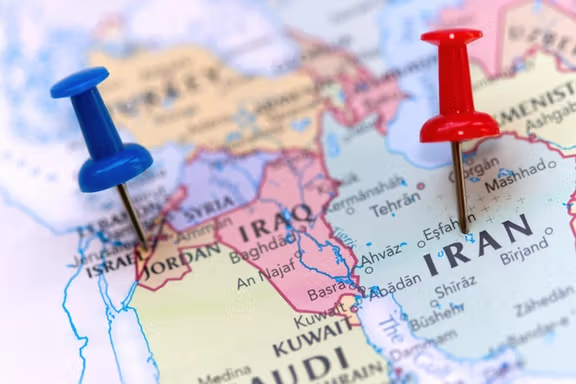
A new and far deadlier conflict between Israel and Iran looms, former Israeli intelligence official Danny Citrinowicz told Eye for Iran, warning that Tehran has learned from past clashes and is rapidly improving its missile capabilities.
Citrinowicz, a former head of the Iran branch within Israel's military intelligence, said the United States still seeks a negotiated deal with Tehran while Israel remains focused on weakening or toppling the Islamic Republic — a fundamental imbalance he warned makes escalation “almost inevitable.”
“The starting point of the next war will be the ending point of the previous one,” he said.
Now a nonresident fellow with the Atlantic Council’s Middle East program, Citrinowicz also serves as a research fellow at the Institute for National Security Studies (INSS) in Tel Aviv.
“It will be very violent from the get-go. And I really think that there won’t be a mechanism that will allow us to close it, because unlike previously when the US forced the sides to close it, now the Iranians will not be willing to close it until they feel they have balanced the equation of deterrence with Israel."
"That is why I think the next will be much more violent and longer,” he added. "It will lead to more civilian casualties."
Citrinowicz’s warning comes as President Donald Trump continues to frame the 12-day Iran–Israel war as a decisive victory. Trump has repeatedly maintained US B-2 bomber strikes "obliterated" Iran’s key nuclear sites, forcing Tehran to accept a ceasefire and halting its nuclear ambitions.
Critics, however, say the claim is largely rhetorical and that the strikes likely delayed, not ended, Iran’s nuclear advancements, leaving the conflict’s root cause unresolved.
Satellite imagery taken in recent months shows that Iran is continuing construction at the Natanz “Pickaxe” mountain or Mount Kolang Gaz-La, consistent with activity seen before the June war.
The mountain complex south of Natanz includes another older tunnel network associated with Iran’s main enrichment site, which also shows signs of ongoing work, particularly reinforcement of tunnel entrances.
'Israel didn't win anything'
After the 12-day war between Israel and Iran, many in Israel came away with the impression that Israel had won the war. Iran was hit hard, and Israeli operations left Tehran no longer viewed as a threshold nuclear state, as US and Israeli officials say. But Citrinowicz argues that this is a dangerous misconception.
“In Israel we have the wrong perception. We are saying we won — we didn’t win anything,” he said. “We had major achievements, but from the Iranian standpoint, they really believe they had major achievements too. Both sides think they won, and that’s what makes another clash inevitable.”
Citrinowicz says Israel must not underestimate Iran’s capacity to recover. He noted that Tehran has rapidly replaced assassinated commanders, resumed missile testing “almost daily,” and is seeking Russian and Chinese air defense systems to harden its skies.
“If there’s one lesson from recent history,” he said, “it’s that the regime is stronger than many believed.”
Another confrontation, he said, is likely within weeks or months as Washington’s demands — on uranium enrichment, missile limits and even some talk of joining normalization deals with Israel — meet flat Iranian refusals.
He argued that US advisers continue to misread Iran’s ideology and decision-making, while Tehran is rapidly rebuilding and testing capabilities at Natanz and Fordow, and acting bolder at sea — all of which may prod Israel into striking again.
Israel, he added, is unlikely to enjoy the same US military umbrella it had during the last war, when Washington deployed advanced interceptors and coordinated air operations. With Trump now juggling multiple crises, Citrinowicz said, “Israel could face a far tougher fight — and far less help.”
Just over a year ago, Iran launched Operation True Promise II against Israel — part of a steady escalation in which each confrontation has become more intense.
'Growing gap' between US and Israel on Iran
In his October 13 address to the Knesset, Trump declared that Iran had been “two months away” from a bomb before the US strikes in June and that he “terminated” its nuclear program afterward. “They’re not starting anything,” he said. “They just want to survive.”
Those lines, Citrinowicz cautioned, project misplaced confidence.
“Despite the fact that both sides basically want to reach an agreement, their present stances are not allowing one to be reached,” he said.
“What President Trump said in Israel actually highlights that misunderstanding — about Iran’s behavior and ideology — that will probably lead to another confrontation. Definitely, we are reaching another round of escalation.”
Tens of thousands of supporters of the Iran-backed armed Houthi movement converged in the Yemeni capital Sanaa on Friday to mourn the group's military chief of staff assassinated by Israel, which accused him of close ties to Iran.
The Israeli military first said it had killed Major General Mohammed al-Ghamari in an attack in August which killed the Prime Minister appointed by the Shi'ite group.
The Houthis did confirm his death until Thursday, and the date or details of his assassination were not immediately released.
"Appointed in 2016, al-Ghamari played a central role in building Houthi missile systems and weapons-production infrastructure, trained by Hezbollah and IRGC," the Israeli military said in a statement, referring to Iran's Revolutionary Guards.
"His elimination delivers a severe blow to the Houthi command structure, responsible for hundreds of attacks against Israel during the war."
At the mass funeral, Houthi politburo member Daifallah al-Shami praised the slain leader's role in confronting its enemies.
"Al-Ghamari and his comrades in the various formations of our armed forces played a great role in inflicting a humiliating defeat on America at sea, along with Britain, as well as on the criminal Zionist entity enemy over the course of two years," he said.
UK forces played a supporting role in a US military campaign against the Houthis earlier this year which appeared to make little headway in dislodging it from power.
"They proved to the whole world that God’s promise of victory to his believing servants is true and honest, even if it was in the face of the most modern arsenals of the world: aircraft carriers and strategic American bombers," al-Shami added.
Leadership central
Al-Ghamari, according to Yemen analyst Mohammed al-Basha, "was one of the most senior and influential figures within the group’s leadership."
"As the top military commander, he directed operations that targeted both civilian and military infrastructure across Yemen and neighboring countries. His leadership was central to shaping the Houthis’ strategy."
His assassination marks one of the biggest blows to the hardened fighters since Hussein Badreddin al-Houthi, their founder and brother of the current Houthi leader, was killed by Yemeni government forces in 2004.
The Houthis launched attacks on waterways straddling the war-torn Arabian Peninsula republic beginning in November 2023, in what it called a blockade of Israel in solidarity with Palestine as war raged in Gaza.
Attacks killed eight international mariners and targeted dozens of vessels with no apparent connection to Israel or Western foes.
The group has fired scores of missiles and drones to Israel since the outbreak of the Gaza war, with most intercepted by air defense systems, though there have been some lapses.
One man was killed in a drone attack on Tel Aviv which hit a residential building last year and a missile attack narrowly missed Israel's busiest airport in May.
Israel responded with multiple airstrikes in Yemen, where the Houthis control large amounts of the territory after a civil war erupted in 2014. Local health authorities say the attacks have killed scores of civilians.
Russia said on Friday it was ready to help resolve the impasse over Iran’s nuclear program after Russian President Vladimir Putin said this month he was receiving messages from both Israel and Iran.
“Moscow remains firmly committed to a political and diplomatic settlement around the Iranian nuclear program and calls on all parties involved to focus their efforts on finding the necessary solutions to avoid a new uncontrolled escalation of tensions,” the Russian foreign ministry said in a statement.
“We are ready to assist in this endeavor in any way possible," it added.
Iranian security chief Ali Larijani met Putin on Thursday and announced later he had delivered a message from Supreme Leader Ali Khamenei. Its contents were not disclosed.
Putin said earlier this month that Israel had reached out to enlist Moscow's aid in transmitting to Tehran its desire to avoid further clashes.
“We continue our trusted contacts with Israel and are receiving signals from the Israeli leadership asking us to convey to our Iranian friends that Israel is focused on further settlement and is not interested in any form of confrontation,” Putin said, according to Russian state news agency TASS.
US President Donald Trump announced on Thursday that he would soon meet Putin in the Hungarian capital to discuss ending the war in Ukraine, though a date has yet to be set. It was unclear if Iran would be a topic of discussion.
'Brute force'
The Russian foreign ministry statement was released on the eve of the expiration of UN Security Council Resolution 2231, which endorsed a 2015 nuclear deal, officially known as the JCPOA.
Last month, UN sanctions were reimposed on Iran after France, Germany and the United Kingdom triggered the so-called snapback mechanism under the resolution, after they accused Tehran of spurning diplomacy and nuclear inspections.
Tehran rejects the powers' standing to invoke the sanctions and denies seeking any nuclear arms.
Russia said earlier this month the restoration of UN sanctions on Iran was "legally null and void and cannot impose any legal obligations on other states."
Moscow added on Friday that following the resolution’s expiry, Iran’s nuclear program should now be treated like that of any other non-nuclear weapon state under the Treaty on the Non-Proliferation of Nuclear Weapons (NPT).
The ministry said Western states had rejected a joint Russian-Chinese proposal to extend the technical aspects of the deal by six months, showing what it called “an inability to negotiate and a reliance on illegal methods and brute force.”
Earlier this week, Russian Foreign Minister Sergei Lavrov said Moscow was surprised by Iran's agreement to the so-called UN snapback sanctions mechanism of the JCPOA, describing it as a legal trap for Tehran.
“To be honest, we were surprised. But if our Iranian partners accepted this formulation - which, frankly, was a legal trap - we had no grounds to object,” Lavrov told reporters in Moscow on Monday.
The snapback provision allowed any JCPOA signatory, including the five permanent members of the UN Security Council plus Germany, to reimpose UN sanctions on Iran in the event of alleged violations without the possibility of a veto.
Iran's foreign ministry on Friday condemned Israeli air strikes on south Lebanon, calling it a violation of a ceasefire with the weakened Hezbollah group it backs and holding the truce's guarantors the United States and France responsible.
Israeli air attacks targeted the village of Mazraat Sinay on Thursday, killing one person and wounding seven others according to local health authorities.
Videos shared on social media depicted a large orange blast and mushroom cloud rising in the night sky. The Israeli military said it aimed at "terrorist" targets.
Iranian Foreign Ministry spokesman Esmail Baqaei called the attacks "a blatant violation of Lebanon’s territorial integrity and national sovereignty."
"This situation stems from the persistent inaction and appeasement of the ceasefire guarantors, France and the United States," he added.
A shaky truce has held since a November truce ended over a year of cross-border combat between old foes Hezbollah and Israel, in which over 4,000 Lebanese people were killed according to medics.
The punishing war culminated in attacks on Hezbollah leaders' communication devices, maiming hundreds. Massive air strikes killed the group's veteran leader Hassan Nasrallah, a canny commander and the most charismatic advocate of the so-called Resistance Axis of armed groups Tehran led in the Arab world.
A chastened Hezbollah, once seen as a key deterrent for its Iranian patrons against Israeli attack, totally sat out the 12-day Iran-Israel war in which Tehran was badly bruised.
Iran's regional influence has been sapped by the nearly two years of regional conflict sparked by the attacks its Palestinian ally Hamas launched on Israel on Oct. 7, 2023.
Its continued sway hangs in the balance as a truce brokered by US President Donald Trump took hold in Gaza over the weekend.
Lebanese President Joseph Aoun accused Israel of violating the ceasefire with Hezbollah.
“The repeated Israeli aggression is part of a systematic policy aimed at destroying productive infrastructure, hindering economic recovery, and undermining national stability under false security pretexts,” he said in a statement.
Israel has demanded Hamas and Hezbollah disarm, and the Lebanese government has called for the group to give up its arsenal by the end of the year.
However, President Aoun seeks to limit Hezbollah’s weapons rather than fully disarm the group, sources close to Aoun told Iran International.
The aim is to gradually wear down and neutralize Hezbollah’s arms without the need for forced disarmament, the sources said.
Iran plans to activate about 80,000 trained volunteers in Tehran province to support social and religious outreach programs, including new coordination on hijab and public behavior, a senior official said on Thursday.
“The country’s greatest asset is its faithful and revolutionary people,” Rouhollah Momen-Nasab, head of Tehran’s headquarters for the Promotion of Virtue and Prevention of Vice, told reporters. “By activating 80,000 trained personnel, we can bring about major transformation in the province even before relying on large state budgets,” he said.
He announced the formation of a “chastity and hijab situation room” involving cultural and executive bodies, inviting citizens to join a network of local observers to help promote what he described as social discipline and religious values.
Momen-Nasab described the group’s response to what he called a “cognitive and cultural war” as data-driven and multi-layered, with monitoring and policy recommendations sent to relevant authorities. The organization, he said, will also push institutions through legal and audit channels to fulfill their “statutory duties.”
Momen-Nasab said the headquarters was coordinating with the prosecutor’s office and cyber police to monitor online and streaming platforms, warning that “virtual spaces and VODs must not be safe havens for lawbreakers.”
The renewed push comes as most Iranians continue to oppose mandatory hijab rules. A 2022 survey by Netherlands-based GAMAAN found more than 70 percent of Iranian men and women opposed compulsory veiling.
For Iran’s leadership, however, enforcement of hijab laws remains a pillar of political legitimacy. Since Mahsa Amini’s death in 2022, women appearing unveiled in public have turned defiance into a sustained act of civil protest.
In recent weeks, authorities have sealed cafés and restaurants across cities for noncompliance after outcry by hardliners. Police warned that all businesses “must observe current laws.”
Russia has long sought to prevent Iran from having normal relations with the world, former foreign minister Mohammad Javad Zarif said, days after the Russian foreign minister faulted him for accepting a sanctions clause in a 2015 nuclear deal.
Speaking at a conference in Tehran, Zarif said Russia has two “red lines” in its policy toward Iran — that the country should never enjoy normal relations with the world and should also not enter direct confrontation. “That is why Russia supported the Geneva interim agreement. It kept the wound open but prevented conflict,” he said, according to the official IRNA news agency.
Lavrov said earlier this week that the snapback provision — which allows the rapid return of UN sanctions if Iran breaches the agreement — was “largely Zarif’s creation” and a “legal trap” for Tehran.
Zarif said the snapback clause was added during the final stage of nuclear talks as a substitute for a far worse proposal from Russia and France. “Mr Lavrov and the French had suggested a very bad plan on the status of previous UN Security Council resolutions, and we worked hard to replace it,” he said, according to the official IRNA news agency.
He said the final mechanism, later included in the 2015 nuclear deal and endorsed by UN Security Council Resolution 2231, was designed to prevent any single country from using its veto to block or extend sanctions.
Hardliners in Iran have long criticized Zarif for accepting the JCPOA’s snapback mechanism, viewing it as a concession that enabled the reimposition of UN sanctions.
Last month, France, Germany and the United Kingdom triggered the snapback mechanism, restoring UN sanctions on Iran over its nuclear activities after they accused Tehran of blocking inspections and rejecting diplomacy. The move came despite opposition from Russia and China.
Long mistrust
In a leaked 2022 interview, Zarif said Russia had tried to prevent the 2015 deal from being finalized, adding that “Russia made every possible effort in the final week to stop the agreement from being concluded.”
Zarif also accused Moscow this week of disclosing sensitive information about Iran’s military and diplomatic activities, including General Qassem Soleimani’s visit to Moscow and details of Iranian drone supplies to Russia for the war in Ukraine. “They were the ones who made those public,” he said.
Lavrov has said Russia has always supported the nuclear deal and the UN Security Council resolution that endorsed it. He said the final decision on the JCPOA “was made directly by Zarif and Kerry” and that other participants, including Russia, were observers.
The United States withdrew from the deal in 2018 during first President Donald Trump’s administration. In response, Iran gradually reduced its compliance and in 2019 began enriching uranium at higher levels.